
How to specify a custom spring: 10 key parameters explained for engineers and buyers. Learn about wire diameter, coil count, spring rate, material, and end configurations for compression, extension, and torsion springs.
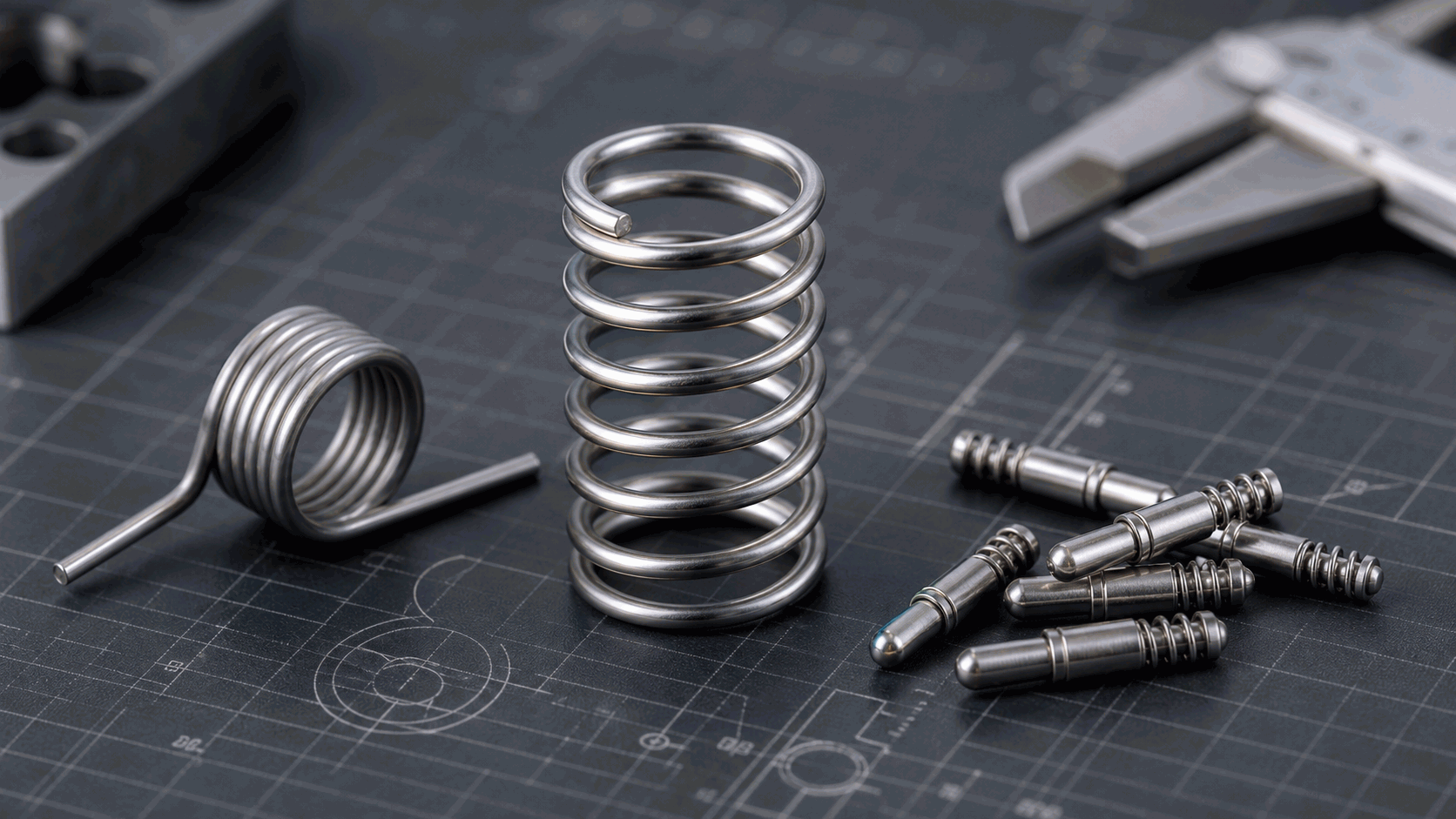
Whether you’re sourcing compression springs for a battery contact, torsion springs for a connector latch, or extension springs for a mechanical assembly, here are the 10 parameters you need to specify—and why each one matters.
1. Spring Type
First, define what kind of spring you need. The three main types are:
- Compression springs — Open-coil helical springs designed to resist axial compression. The most common type for connectors, battery contacts, and mechanical assemblies.
- Extension springs — Close-coil springs with hooks or loops at each end, designed to resist axial tension. Used in latches, counterbalances, and return mechanisms.
- Torsion springs — Helical springs that resist rotational (torque) force. Used in hinge mechanisms, door returns, and connector latches.
Each type has its own set of critical parameters. Compression springs are the most straightforward; torsion springs require the most dimensional detail.
2. Wire Diameter (d)
Wire diameter is the single most influential parameter in spring design. A 0.05 mm change in wire diameter can alter the spring rate by 20–30%. Always specify:
- Nominal diameter — In mm or inch, with tolerance. Standard tolerances are ±0.02 mm; precision tolerance is ±0.01 mm.
- Material condition — Wire should be specified by standard (ASTM A228 for music wire, ASTM A313 for stainless, etc.) with the required temper or hardness.
3. Coil Diameter (OD / ID)
The outer diameter (OD) or inner diameter (ID) determines how the spring fits in your assembly. If the spring goes inside a bore, specify OD; if it fits over a shaft or pin, specify ID.
Critical considerations:
- A spring under compression expands in OD—design for clearance
- Ratio of spring index (D/d) should ideally be between 4 and 12 for manufacturability
- Index below 4 causes excessive tool wear; above 12 causes coil instability (buckling)
4. Free Length (L₀)
Free length is the unloaded length of the spring, measured with no external force applied. For compression springs, this determines how much travel you have. For extension springs, it’s the body length before the hooks.
Specify free length with upper and lower tolerance. Typical tolerance is ±1.0 mm for standard springs, and ±0.2 mm for precision springs. The tighter the tolerance, the more expensive the tooling and inspection.
5. Working Lengths and Loads
This is the most important functional parameter. Instead of just specifying a spring rate, provide actual working conditions:
- Load at installed height (P₁) — Force when the spring is at its installed/assembled position
- Load at working height (P₂) — Force at the maximum working deflection during operation
- Spring rate (k) — Force per unit deflection, usually in N/mm or gf/mm
For pogo pin springs and contact springs, the load tolerance is typically ±10%. For critical applications, ±5% is achievable with tighter process control and 100% load testing.
6. End Configuration
End configuration affects how the spring seats in the assembly and how force transfers through it.
| Type | Best For | Notes |
|---|---|---|
| Closed and ground | Precision compression springs, vertical seating | Flatter ends, better load transfer, higher cost |
| Closed not ground | General compression springs | Good enough for most applications |
| Open ends (not closed) | Low-cost, non-critical applications | Spring may tilt under load |
| Hooked / Looped ends | Extension springs | Hook orientation and position must be specified |
| Straight offset / Custom bends | Torsion springs, wire forms | Leg angle tolerance is critical |
7. Material
Material defines the spring’s performance envelope. The most important properties to consider:
- Tensile strength — Higher tensile = higher force capacity, but lower ductility
- Fatigue life — Measured in cycles to failure. Beryllium copper and spring steel offer the best fatigue life.
- Operating temperature — Standard spring steels lose force above 120°C; Inconel holds to 400°C+
- Corrosion resistance — Stainless steel or plated springs for outdoor/marine/medical environments
- Electrical conductivity — Beryllium copper and phosphor bronze for current-carrying springs
If you’re unsure, start with stainless steel 301 (ASTM A313) — it offers the best balance of cost, strength, and corrosion resistance for most connector and electronic applications.
8. Surface Finish & Plating
The surface finish affects friction, corrosion resistance, and fatigue life.
- As-coiled (no finish) — Lowest cost, for non-critical applications
- Oil-tempered — Standard for music wire, provides light rust protection
- Passivation — For stainless steel, removes surface contamination
- Zinc / Nickel plating — General corrosion protection
- Silver plating — For high-current electrical springs (EV contacts, power connectors)
- Gold plating — For signal contacts requiring low contact resistance
- Shot peening — Improves fatigue life by 20–50% through compressive stress introduction
9. Quantity and Lead Time
Production volume directly affects the manufacturing method and unit cost:
- Prototype (100–1,000 pcs) — CNC coiling, manual inspection, 7–15 days lead time
- Pilot run (1,000–10,000 pcs) — Semi-automated production, SPC monitoring, 2–3 weeks
- Mass production (10,000+ pcs) — Fully automated coilers, 100% load testing options, 3–5 weeks
For precision springs requiring ±0.01 mm tolerances, expect a slight premium on tooling and inspection compared to standard springs.
10. Special Requirements
Don’t forget to mention any special conditions that affect spring design and testing:
- Operating environment (temperature, humidity, chemicals, vibration)
- Expected cycle life (e.g., 50,000 cycles minimum)
- Packaging requirements (taped, bulk, anti-static, vacuum-sealed)
- Certification needs (material certs, RoHS, REACH, IATF 16949)
- Inspection criteria (AQL level, Cpk requirements, 100% inspection)
How VOLCRIX Helps You Get It Right
Even experienced buyers occasionally miss a critical parameter. That’s why we offer free DFM (Design for Manufacturing) review on every spring inquiry.
Send us your drawing, 3D model, or even a sample spring, and our engineers will:
- Verify all 10 parameters are complete and consistent
- Suggest material and tolerance optimizations to reduce cost
- Provide a detailed quotation with dimensional and load guarantees
- Deliver first-article inspection reports with every prototype order
At VOLCRIX, we manufacture custom precision springs for connector, EV, and industrial applications — wire diameters from 0.05 mm to 8 mm, tolerances to ±0.01 mm, with in-house material testing and load verification. Contact us with your spring requirements for a free DFM assessment.
What is the ideal spring index range?
The spring index (D/d, mean coil diameter divided by wire diameter) should ideally be between 4 and 12. Below 4 causes excessive tool wear; above 12 leads to coil buckling and instability.
How do I decide between closed & ground vs closed not ground ends?
Use closed & ground ends when the spring needs to stand vertically without tilting, or when load accuracy is critical. Closed not ground is sufficient for general applications where the ends are constrained by the assembly.
Can you reverse-engineer a spring sample?
Yes. Send us your sample spring, and our engineers will measure wire diameter, coil OD, free length, active coils, end configuration, and perform load testing to create a complete specification for production.
Need custom EV charging pins for your project? View our EV charging pins manufacturing capabilities →
Spring-loaded mechanisms often pair with precision hinges — view our hinge manufacturing →