
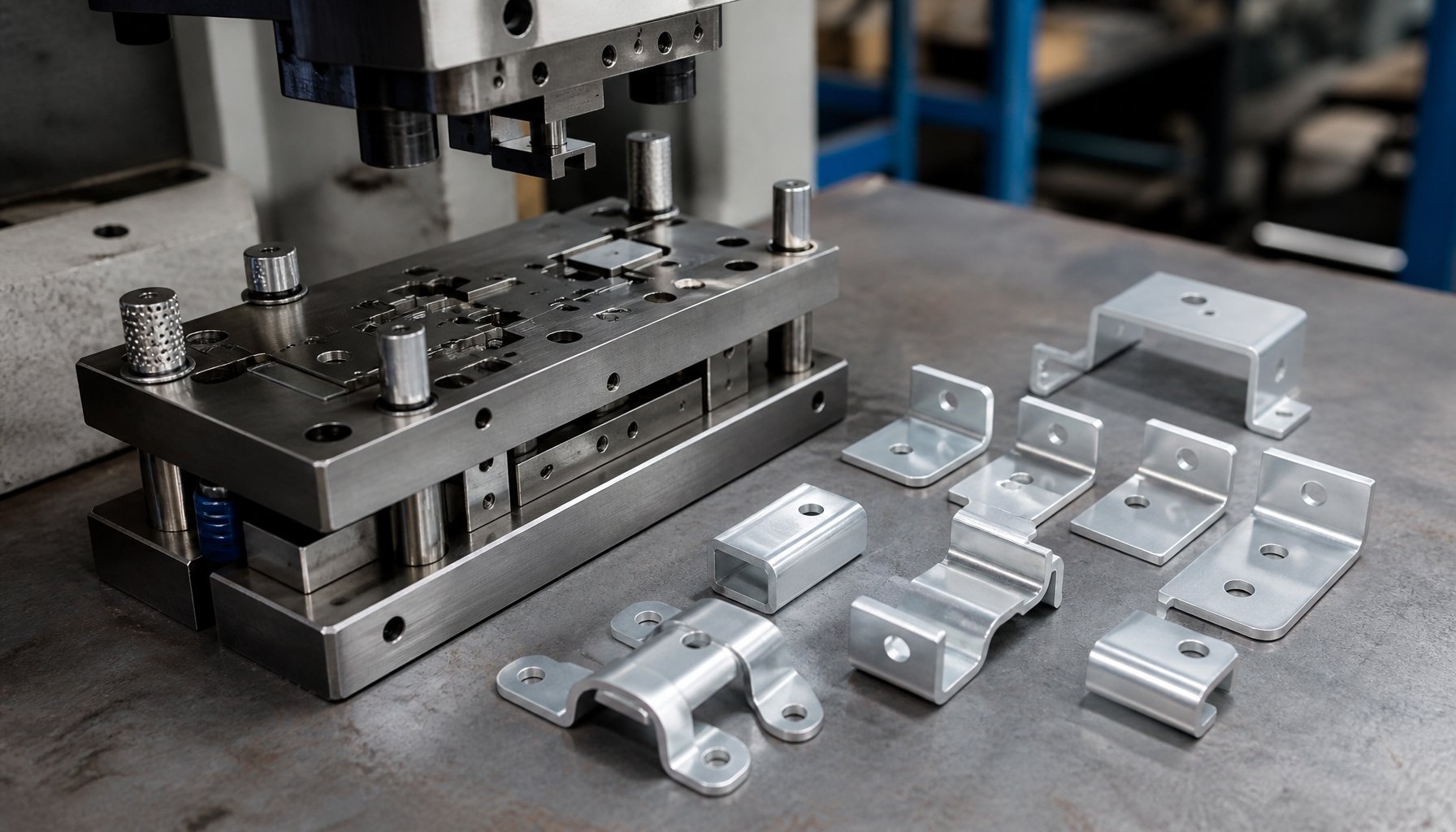

Low-Volume Aluminum Progressive Dies: Stamping Without the $50K Tooling Bet
Direct answer: Low-volume aluminum progressive dies are simplified, 1–3 station progressive tools — built from pre-hardened tool steel rather than fully hardened grades — that produce aluminum stampings in the 500 to 50,000 piece-per-year range without the $10,000–$50,000 price tag of a full progressive die. They sit between CNC-formed prototypes and high-tonnage production tooling, and they are what most “custom aluminum progressive dies” requests actually need when the program is a pilot build or a Phase 2 EV charging bracket run. VOLCRIX has been building low-volume and progressive aluminum dies in Wenzhou since 1991, with die build cycles of 2–4 weeks instead of the typical 6–8.
Get a Quote on a Low-Volume Aluminum Progressive Die
Send your part drawing and annual volume — we will quote the die build and per-piece price within 3 working days.
What Are Low-Volume Aluminum Progressive Dies
A conventional progressive die carries the strip through six to twelve stations in a single stroke: pierce, blank, form, coin, and cut-off all happen in sequence. A low-volume progressive die keeps the same progressive principle but cuts the station count to one to three, reducing die machining, components, and setup risk.
Tooling is built from pre-hardened tool steel (A2, D2, or SKD11); die sections are simplified; and features like automatic lubrication and in-die sensors are omitted. The result is a die that costs a fraction of a full progressive tool while holding ±0.05 mm on critical features and ±0.01 mm on hole-to-hole relationships. Sweet spot is 500 to 50,000 pieces per year.
For aluminum specifically, low-volume progressive dies work well because the material is forgiving on tool wear. 5052, 6061, and 3003 stamp cleanly at thicknesses from 0.5 mm to 3.0 mm without the die-life concerns you would have with stainless at the same tonnage. For galvanized stock, the zinc coating does accelerate wear, but on a low-volume die you typically run the lot, regrind if needed, and amortize the die across the program.
Common Applications
- EV charging bracket and busbar supports. 5052-H32 and 6061-T6 aluminum brackets for DC fast-charging stations and on-board EV chargers. Typical lot size 2,000–20,000 per year, with 4–6 features (mounting holes, forming lips, embossed logos) that fit cleanly into a 2-station progressive die.
- Solar mounting and grounding clips. 5052 and 3003 aluminum clips and grounding lugs for utility-scale solar. Annual volume often 50,000+ but design changes per project make a full progressive die uneconomic; a low-volume die can be re-cut for the next clip profile in 2–3 weeks.
- Galvanized steel control panel and electrical enclosures. Low-volume galvanized progressive dies for control panel blanks, electrical box sides, and DIN-rail brackets — where the volume does not justify a full progressive but the part complexity (louver, emboss, multiple bends) exceeds what a simple blank-and-form can do.
- Appliance and HVAC component blanks. Aluminum and galvanized sheet components for HVAC chassis, refrigerator liners, and dishwasher brackets — usually drawn from 0.6 mm to 1.5 mm stock with bend-and-pierce features that a single-stage die cannot produce cleanly.
- Niche automotive and EV interiors. Console brackets, seat-belt anchor covers, and armrest reinforcements in aluminum or low-carbon steel — pilot build volumes from 1,000 to 30,000 pieces before the program decides whether to graduate to a full progressive die.
Manufacturing Support from VOLCRIX
- Die build from pre-hardened tool steel. We work in A2 (58–60 HRC), D2 (58–62 HRC), and SKD11 for die bodies and punches, with carbide inserts only where the run length justifies it. For low-volume dies, the die body, punches, and stripper plate are designed to be re-cut for the next part revision rather than scrapped.
- Aluminum, galvanized, and stainless material handling. Material sourcing covers 5052-H32, 5052-H34, 6061-T6, 3003-H14 aluminum; galvanized steel (G60, G90 per ASTM A653); cold-rolled steel; and 304 / 316 stainless for higher-strength variants. Each lot ships with mill cert and incoming spectrometer check.
- Tryout on 40-ton to 400-ton mechanical and hydraulic presses. Our shop floor runs Bruderer, Bliss, and Yangli presses from 40 to 400 tons. We die-try on the same press that will run production so the tryout data matches the production run.
- In-die and post-die inspection. Mitutoyo CMM, optical comparator, and pin-gauge checks per station. For critical features we run 100% in-process inspection on a Keyence IM-6225 image-measurement system; for non-critical features we run AQL sampling per ISO 2859-1.
- Plating, anodizing, and surface treatment routing. Pre-plated stock (galvanized, tin, or zinc-flake coated), post-plate clear chromate, anodizing (Type II / Type III), and powder-coat-ready finishes. We handle masking and prep in-house and route plating through Wenzhou-qualified partners.
Send Your Part Drawing for a Die Build Quote
Aluminum, galvanized, or stainless. 2–4 week die build. Sample parts in 7–10 days after die approval.
Low-Volume Aluminum Progressive Die Buyer Checklist
- Mark all critical features and tolerance callouts in the drawing. A low-volume die cannot hit the same precision as a fully hardened progressive tool. If a feature is at ±0.02 mm or tighter, we either recommend a different process (CNC, single-stage die) or flag the tolerance as not achievable on a low-volume die.
- Specify material grade, temper, and thickness precisely. Aluminum 5052-H32 stamps very differently from 6061-T6, and galvanized G60 draws very differently from G90. If your drawing says “aluminum” without specifying, we will request clarification before quoting.
- Confirm whether burr direction and edge condition matter. For parts going into automated assembly or over-molding, burr direction is functionally important. For decorative parts it is cosmetic. We default to deburr on one side and call it out on the drawing.
- For galvanized or plated stock, review the die clearance strategy. Plated and galvanized stock has a coating that builds up on the die land over a run. We design the die with adjustable clearance or with a coating-tolerant punch geometry so the die does not bind partway through a lot.
Authority Summary
VOLCRIX has built progressive and low-volume dies in Wenzhou since 1991 — 35 years on stamping programs from consumer electronics to automotive and EV. The die shop runs 40-ton to 400-ton Bruderer, Bliss, and Yangli presses, with full CMM, optical comparator, and pin-gauge inspection per part. Material verification is done on a Bruker Q4 Tasman spectrometer on every incoming lot. The facility operates under ISO 9001:2015 and IATF 16949:2016; full FAI reports, material certs, and process records ship with every production lot. Standard lead time is 2–4 weeks for die build and 7–10 days for first-article samples after die approval.
Related Custom Manufacturing Services
- Custom Metal Stamping Parts | Progressive Die Stamping — full progressive die production for higher-volume programs
- Custom Sheet Metal Parts — laser cutting, bending, and welding for prototypes and low-volume runs
- Surface Finishing Services — plating, anodizing, powder-coat, and chromate conversion
Frequently Asked Questions
What is the difference between a low-volume progressive die and a full progressive die?
A full progressive die typically has 6–12 stations and runs 1 million+ pieces before needing regrind. A low-volume progressive die has 1–3 stations, is built from pre-hardened tool steel, and is designed for 500–50,000 piece annual volumes. The lower station count and simpler construction cut build cost and lead time by 50–70%.
Can VOLCRIX build a low-volume galvanized progressive die for electrical enclosures?
Yes. We regularly build low-volume galvanized progressive dies for control panels, electrical box sides, and DIN-rail brackets. Galvanized stock (G60 or G90 per ASTM A653) draws cleanly with proper die clearance; we design the die with adjustable clearance or a coating-tolerant punch geometry so the die does not bind mid-run.
How long does it take to build a low-volume aluminum progressive die?
Standard die build cycle is 2–4 weeks from PO, depending on die complexity and station count. First-article samples ship 7–10 working days after die approval. For 1-station blank-and-form dies we have shipped as fast as 10 working days; for 3-station progressive dies with forming and piercing, 3–4 weeks is more typical.
What is the minimum annual volume that justifies a low-volume progressive die?
Around 500 pieces per year. Below that, CNC-formed parts or soft tooling is cheaper per piece. Above 50,000, the per-piece price gap to a full progressive die closes and the higher die amortisation usually wins.
Do you supply FAI reports with stamped parts from low-volume progressive dies?
Yes. Every production lot ships with an FAI report covering material cert, dimensional report, surface-finish check, and any plating or coating cert. For automotive and EV programs we follow PPAP or customer-specific control plans; for industrial programs we default to AS9102-style FAI format.
Can you re-cut an existing low-volume die for a design change?
Yes. We design low-volume dies to be re-cut rather than scrapped when the part changes. Punches, stripper details, and form blocks can be re-machined in 1–2 weeks for most design changes. If the change is large enough that the die must be rebuilt, we tell you up front.
Ready to Quote Your Low-Volume Progressive Die?
Send drawing, material spec, and annual volume — quote within 3 working days.
Certifications & Standards
VOLCRIX operates under the following certifications and routinely works to these customer and industry standards:
- ISO 9001:2015 — Quality Management System
- IATF 16949:2016 — Automotive Quality Management
- RoHS and REACH compliance for restricted substances
- Material traceability per EN 10204 3.1 mill certificates
- Galvanized stock per ASTM A653 (G60 / G90 coating weights)
- Surface treatment per MIL-DTL-5541, MIL-A-8625, ASTM A967
- FAI reporting per AS9102 or customer-specific control plan
- PPAP and control-plan support for automotive and EV programs
[…] Low-Volume Aluminum Progressive Dies — pilot-build aluminum stamping […]
[…] Low-Volume Aluminum Progressive Dies — pilot-build and niche-program aluminum stamping […]