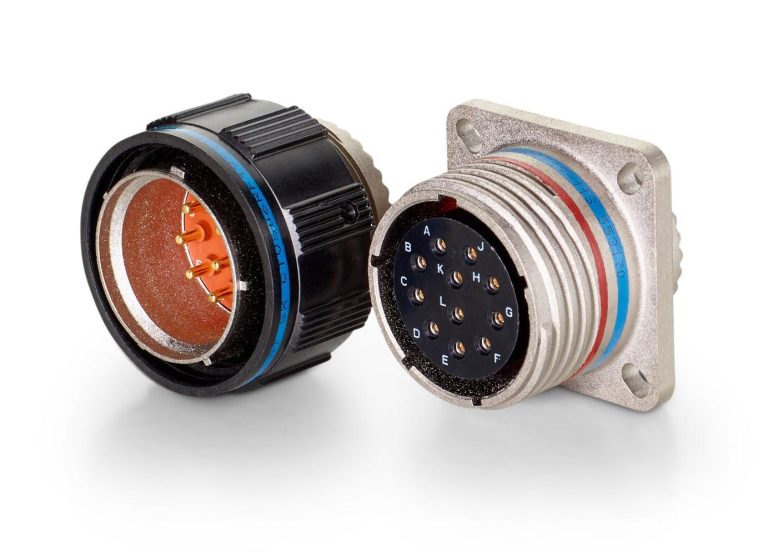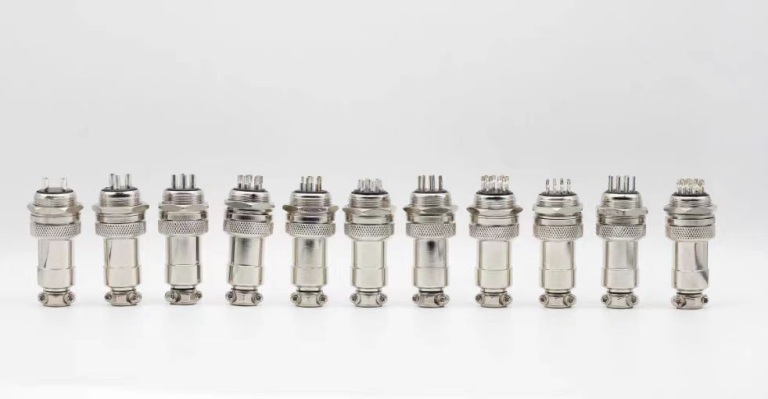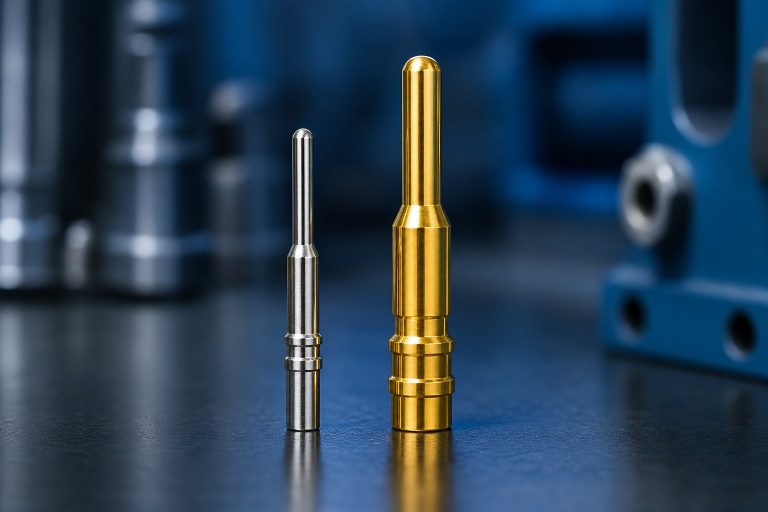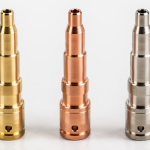
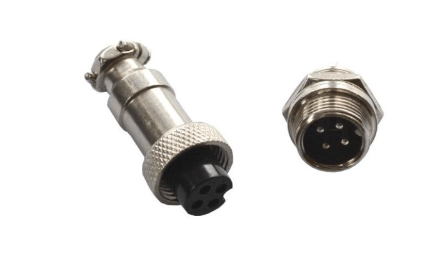

GX16 and GX20 are two of the most widely used circular aviation connector series in industrial equipment, robotics, and automation. For buyers sourcing replacement pins or planning custom connectors, the difference between these two sizes matters — not just in diameter, but in pin capacity, current rating, and machined contact geometry. This guide compares GX16 vs GX20 connector pins so you can specify the right one for your application.
GX16 vs GX20 Connector Pins | Spec Comparison for Custom Machined Contacts
Direct answer: VOLCRIX supplies custom GX16 and GX20 connector pins as bar turned components for electronic connectors, machined from brass C3604, C26000, or tellurium copper C14500. Both series share M×0.75 thread and solder-cup terminations, but differ in shell diameter, current rating, and pin count. We hold ±0.01 mm on contact OD with 0.4 µm Ra on the engagement zone. Send your drawing to our quoting form, or WhatsApp us at +86 188 6828 5255.
GX16 / GX20 Connector Pin RFQ — DFM Review in 24 Hours
Send your pin drawing or mating connector — process recommendation and quote within 1 working day.
GX16 vs GX20: The Basics
| Parameter | GX16 | GX20 |
|---|---|---|
| Shell diameter | 16 mm | 20 mm |
| Pin count (typical) | 2 to 7 pins | 2 to 12 pins |
| Pin diameter | 1.0 mm to 2.5 mm | 1.5 mm to 3.5 mm |
| Rated current (per pin) | 5 A to 10 A | 10 A to 25 A |
| Rated voltage | 250 V AC / 350 V DC | 500 V AC / 700 V DC |
| Termination | Solder cup / screw | Solder cup / screw / crimp |
| Locking thread | M16 × 0.75 | M20 × 0.75 |
| Operating temp | -40 °C to +85 °C | -40 °C to +125 °C |
The deciding factor for most buyers is the combination of rated current and pin count. If you need more than 7 pins or more than 10 A per pin, GX20 is the only realistic option. If your connector is 5-10 A and 2-7 pins, GX16 fits and saves roughly 30% on shell cost.
Common Applications for GX16 and GX20 Connector Pins
GX16 and GX20 are the workhorses of industrial circular connectors. The four bar turned components for electronic connectors applications we run most often at VOLCRIX:
- Industrial robotics and CNC machine tool feedback. GX16 pins in 4-pin and 5-pin configurations for encoder feedback, servo motor resolvers, and limit-switch wiring on CNC machines, robotic arms, and automated assembly cells. Threaded lock prevents vibration disconnect.
- Automation controller signal wiring. GX20 pins in 7-pin and 9-pin configurations for PLC I/O blocks, distributed control systems, and sensor harnesses. Rated 25 A per pin suits solenoid valves and small motor drives on the same harness.
- Test and measurement equipment. GX16 pins in 2-pin and 3-pin configurations for multimeter probes, oscilloscope leads, bench-top power supply outputs, and laboratory test fixtures. Solder-cup termination suits short-run test leads.
- Audio, broadcast, and stage equipment. GX16 and GX20 pins for balanced audio XLR-style fan-outs, DMX lighting control, and broadcast camera interconnects. Brass pin with gold plating (0.5–1.0 µm over nickel 1.5 µm) is standard for low-noise audio contacts.
Manufacturing Support from VOLCRIX for GX16 / GX20 Pins
When a GX16 or GX20 pin drawing lands on our engineering desk, we check whether it is stock geometry or proprietary. Stock pins run on Star SR-20 with standard tooling; proprietary pins need full tool build and PPAP. Here is what we deliver on every program:
- Material selection for signal and power pins. Brass C3604 (free-machining, best for high-volume signal pins); C26000 (cartridge, better for crimp); tellurium copper C14500 (90% IACS, higher current); phosphor bronze C54400 (spring temper, female socket contacts). All materials ship with mill cert per EN 10204 3.1 and incoming spectrometer check on Bruker Q4 Tasman.
- Star SR-20 and SR-20R Swiss turning with sub-spindle. For GX16 and GX20 pins we run Star SR-20 / SR-20R Swiss turning machines with sub-spindle pickoff. Main-spindle ±0.005 mm; sub-spindle ±0.01 mm for closed-end crimp zone. Cycle times 8–25 s per pin.
- Solder-cup, crimp, and screw terminations in one setup. We can combine multiple termination styles in one pin — solder cup on one end, screw thread on the other — by adding secondary milling or threading on the SR-20R sub-spindle. This avoids a separate op and keeps the pin concentric within ±0.01 mm.
- Plating options for contact and corrosion performance. Gold 0.5–1.0 µm over nickel 1.5–2.5 µm for low-level signal/audio (ASTM B488); tin 5–8 µm over copper flash for solderable terminations (ASTM B545); silver 3–5 µm over nickel for higher-current pins (ASTM B700). Thickness verified on Fischer XDLM XRF.
- 100% pin inspection and batch Hi-Pot testing. Each lot is verified on Zeiss Contura CMM (pin OD, length, thread profile), 100% continuity-checked, and Hi-Pot tested at 1000 V AC for 60 s on request. Cpk ≥ 1.33 reported on critical features. FAI per AS9102.
Send Your GX16 / GX20 Pin Drawing — Get a Quote in 24 Hours
Stock pin or proprietary modification — we will tell you which fits, what the cycle time is, and what the unit price lands at.
GX16 / GX20 Connector Pin Buyer Checklist
Four items to confirm before sending your bar turned components RFQ:
- Confirm the pin count and the rated current per pin. This decides GX16 (5-10 A, 2-7 pins) or GX20 (10-25 A, 2-12 pins). If between the two, GX20 with smaller pin diameter and derated current is often safer — it leaves room for future current upgrade without changing the connector housing.
- Specify the mating connector series. GX16 and GX20 are not pin-compatible — a GX16 pin will not seat in a GX20 socket. Confirm the mating connector brand and series (e.g. “compatible with GX16-4 Binder 581” or “GX20-7 Hirschmann CA-Series”) so we can validate geometry against published datasheets.
- Specify plating stack and thickness. Gold over nickel for signal/audio, tin over copper flash for solder terminations, silver over nickel for power. The spec should be explicit (e.g. “Au 0.75 µm min over Ni 2.0 µm min per ASTM B488”).
- Plan for vibration and locking torque. GX16 and GX20 use a threaded locking ring. Specify the locking torque range (typically 0.5–1.5 N·m for hand assembly, up to 3 N·m for tool-tightened vibration environments).
Authority Summary
VOLCRIX has been machining bar turned components for electronic connectors from Wenzhou since 1991 — 35 years across industrial automation, robotics, audio, test, and aerospace pins. Our Swiss turning facility runs 60 Star machines (SR-20, SR-20R, SR-38, SB-20R) and Doosan/Mazak turning centers for larger diameters. Material traceability is enforced per EN 10204 3.1, with incoming verification on Bruker Q4 Tasman spectrometer. We hold ISO 9001:2015 and IATF 16949:2016 and ship under PPAP for industrial automation programs. For GX16/GX20 pins specifically, we routinely turn brass C3604 and C14500 to ±0.01 mm with gold, tin, or silver plating, and ship 100% continuity-checked lots.
Related Custom Manufacturing Services
- Aviation Connector Pins | Custom Machined Contacts — aerospace-grade MIL-DTL-38999 and GX series contact pins
- Custom Electronic Contact Pins — signal-level and power contact pins for industrial connectors
- MIL-DTL-38999 Contacts vs GX Series Pins — aerospace vs industrial connector pin comparison
Frequently Asked Questions
Can I use a GX16 pin in a GX20 connector?
No. GX16 and GX20 have different shell diameters (16 mm vs 20 mm), thread pitches (M16×0.75 vs M20×0.75), and pin diameters. A GX16 pin will not seat or latch in a GX20 socket. If between sizes, choose GX20 with smaller pin and derated current instead of mixing the series.
What brass grade should I specify for GX16 / GX20 contact pins?
Brass C3604 (free-machining) is the default for high-volume signal pins — cuts cleanly at 200+ m/min and holds ±0.01 mm. Brass C26000 (cartridge) is used where crimp termination needs more ductility. For higher-current pins, switch to tellurium copper C14500 (90% IACS). Avoid C26000 for female socket contacts — use phosphor bronze C54400 (spring temper).
What tolerances can VOLCRIX hold on GX16 and GX20 connector pins?
Standard OD tolerance is ±0.01 mm on critical contact diameters, ±0.005 mm on Star SR-20R with in-process gauging. Length tolerance ±0.05 mm. Thread profile per ISO 261 (M16×0.75 or M20×0.75) verified with thread gauges. Surface finish 0.4 µm Ra on the contact engagement zone. Cpk ≥ 1.33 reported on critical features.
What plating is best for low-noise audio GX16 / GX20 connector pins?
Gold 0.75 µm over nickel 2.0 µm (per ASTM B488) is the standard for low-noise audio. Gold resists oxidation and keeps contact resistance below 5 mΩ after thousands of mating cycles. For high-humidity or outdoor audio, add MIL-DTL-5541 Class 1A chromate or thicker gold (1.0 µm).
What is the typical lead time for a custom GX16 / GX20 pin order?
Stock pin geometry 5-10 days samples, 2-3 weeks for 50,000-piece production. Proprietary pin 7-15 days samples after PO, 3-4 weeks production. High-volume above 500,000 pieces per month on dedicated Star machines with 4-6 week qualification.
Can VOLCRIX supply the full GX16 / GX20 connector assembly, including housing and locking ring?
Yes. We supply bar turned contact pins plus machined housing bodies and locking rings, and partner with Wenzhou-based injection molders for full connector body assembly if needed.
Compare VOLCRIX Pin Pricing with Your Current Supplier
Send your pin drawing or mating connector sample — we will quote the gap in 24 hours.
Certifications & Standards
VOLCRIX operates under the following certifications and routinely works to these customer and industry standards:
- ISO 9001:2015 — Quality Management System
- IATF 16949:2016 — Automotive Quality Management
- Material traceability per EN 10204 3.1 mill certificates
- Brass and copper grades per UNS C3604, C26000, C14500, ASTM B16 / B36
- Plating per ASTM B488 (gold), B545 (tin), B700 (silver), MIL-DTL-5541 (chromate)
- Thread geometry per ISO 261 (M16×0.75, M20×0.75)
- PPAP and AS9102 FAI support for industrial automation and aerospace programs