
Xiaomi Pengcheng N90 Max 7-Car Stack Test: What It Means for OEM Seat Slide Rail Manufacturing
Direct answer: When Xiaomi stacked seven Pengcheng N90 Max SUVs vertically with 17 metric tons pressing on the bottom vehicle and the cabin survived intact, every interior component got validated — including the seat slide rail. OEM-grade EV seat rails must deliver 200 kg dynamic load, 50,000 cycle life, ±0.1 mm tolerance across 400-600 mm length, and PPAP level 3 documentation. VOLCRIX has manufactured precision automotive slide rails and stamping components since 1991 on 40 stamping presses with progressive die capability.
Need OEM-grade seat slide rails or EV stamping components?
Free DFM review · Quote within 24 hours · PPAP level 3 documentation
Industry Reference: Xiaomi Pengcheng N90 Max 7-Car Stack Test

On September 11, 2026, Xiaomi released the results of a landmark 7-car vertical stack crush test on the Pengcheng N90 Max. Seven vehicles were stacked vertically with a total weight of 17 metric tons pressing on the bottom car. The bottom vehicle’s passenger cabin remained intact — A, B, C, and D pillars showed no visible deformation, and all four doors opened normally after the test.
The N90 Max uses a body-in-white “armor cage” structure with 90.4 percent high-strength steel and aluminum, including 16 sections of 2,200 MPa steel. A 2,510 mm internal roll cage is embedded through the A to C pillars. A one-piece hot-formed door ring spans 3,289 mm long and 1,556 mm high, covering A, B, C, D pillars across all three rows.
Source: 凤凰网汽车 — 小米澎程 N90 Max 顶压测试过程
This level of structural integrity raises the bar for every interior component. The seat slide rail must match. A seat rail failure inside a vehicle that survives a 17-ton stack test would be unacceptable.
What an OEM-Grade Seat Slide Rail Must Deliver
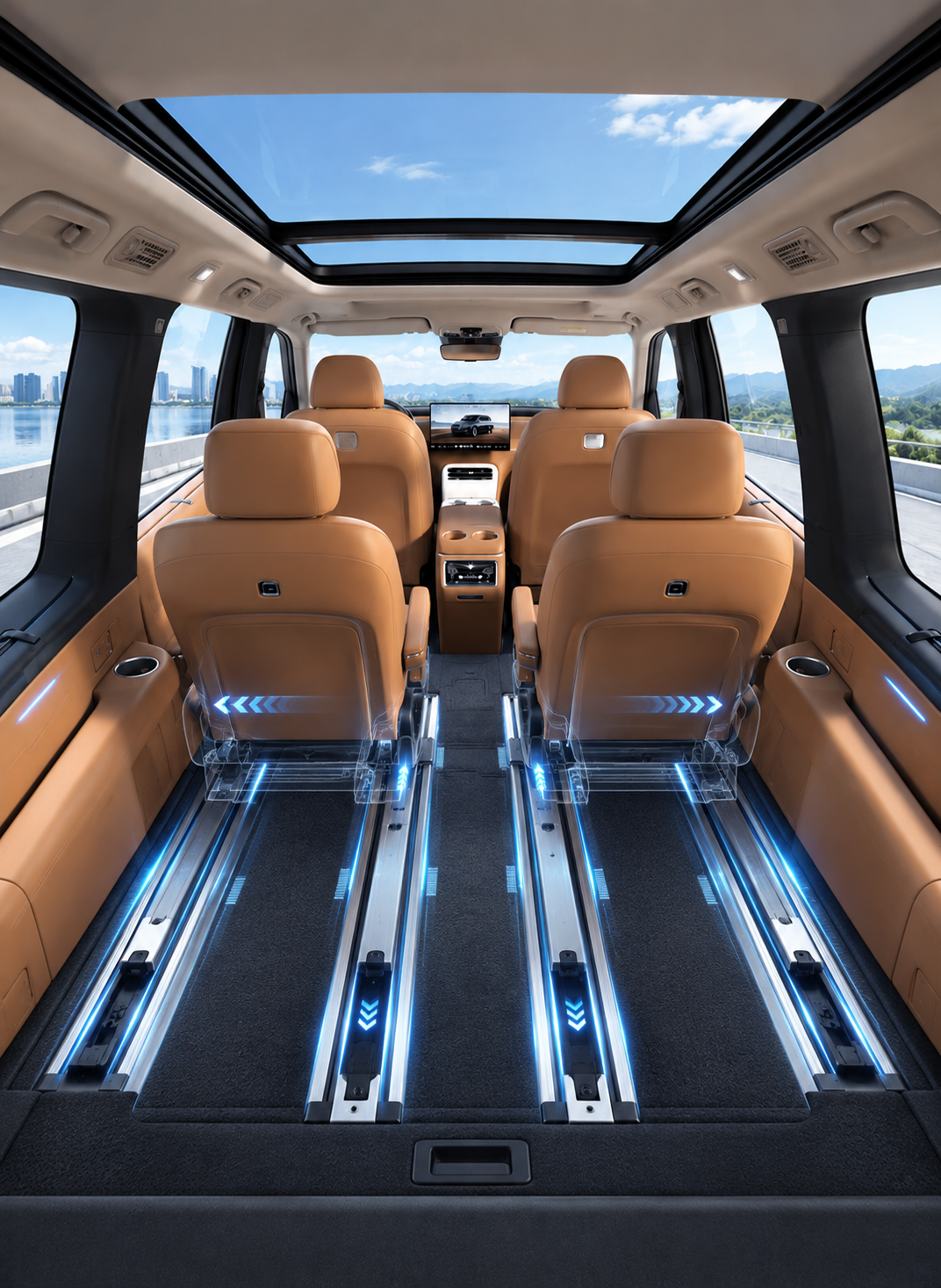
A modern EV seat slide rail is not a piece of bent sheet metal. It is a precision mechanical assembly designed to handle passenger load, airbag deployment force, vibration, and 10-plus years of daily adjustment.
The five specifications that matter for OEM seat rails used in premium EV programs:
- Dynamic load capacity — 150 kg for passenger seats, 200 kg for driver seats, 300 kg distributed for rear bench rails. Anything below this rating fails within 2 to 3 years of normal use.
- Cycle life — 50,000 to 100,000 full-extension cycles is the OEM baseline. Aftermarket rails typically fail at 10,000 to 20,000 cycles due to thinner material and skipped shot peening.
- Material grade — Cold-rolled steel SPCC with electro-zinc plating per ASTM B633 for economy. S50C carbon steel with black oxide plus hot-dip galvanizing for premium. Stainless steel SUS304 reserved for marine and specialty vehicles.
- Tolerance stack — A typical rail is 400 to 600 mm long with 8 to 12 mounting positions. Each position at ±0.1 mm tolerance stacks across the assembly. Loose tolerances cause seat wobble. Tight tolerances increase tooling cost 30 to 50 percent.
- PPAP submission — Full AIAG PPAP level 3 documentation: FAI report, material certificates per heat lot, control plan, PFMEA, MSA studies, and Cpk capability studies. Without full PPAP, no rail ships to an OEM assembly line.
How VOLCRIX Produces OEM-Grade Seat Rails and Slide Assemblies
VOLCRIX has manufactured precision automotive components since 1991 in Yueqing, Wenzhou. Our facility runs 40 stamping presses from 5 tons to 200 tons for progressive die stamping of rail bodies, 60+ Japanese Star Swiss turning machines for precision rail pins and mounting hardware, and 60 spring coiling machines for return springs and detent mechanisms.
Material capability covers the full automotive spectrum:
- SPCC cold-rolled steel — standard automotive rail material, electro-zinc plated per ASTM B633
- S50C carbon steel — high-strength applications, black oxide plus hot-dip galvanizing
- SUS304 stainless steel — corrosion-resistant for marine and specialty vehicles
- 17-4PH precipitation hardening — high-stress mounting hardware
- C36010 free-machining brass — rail pins and threaded inserts
Quality verification runs on Zeiss CMM for dimensional inspection, spectrometer for material verification per heat lot, XRF for plating thickness per ASTM B568, and full PPAP level 3 documentation for OEM automotive programs.
Lead times: 7-15 working days for prototype, 15-25 working days for production repeat orders, 4-6 weeks for new tooling.
Common Applications
- EV passenger seat slide rails — for Xiaomi Pengcheng, BYD, NIO, XPeng, and Li Auto premium EV programs requiring 50,000 cycle life
- Driver seat slide rails with memory function — for executive sedan programs with motorized rail actuators
- Rear bench seat slide rails — for 6-seat and 7-seat SUV/MPV configurations with 300 kg distributed load
- Sunroof slide rails — for panoramic sunroof mechanisms with 30,000 cycle life and weather sealing
Manufacturing Support from VOLCRIX
- 40 stamping presses — from 5 tons to 200 tons capacity for progressive die stamping of rail bodies, mounting brackets, and reinforcement plates
- 60+ Japanese Star Swiss turning machines — for precision rail pins, threaded inserts, and ball bearing retainer pins
- 60 spring coiling machines — for rail return springs, detent mechanisms, and memory function return springs
- In-house plating coordination — electro-zinc plating per ASTM B633, hot-dip galvanizing per ASTM A123, black oxide per MIL-DTL-13924
Buyer Checklist
- Define dynamic load requirement — 150 kg for passenger, 200 kg for driver, 300 kg distributed for rear bench
- Specify cycle life target — 50,000 cycles for OEM, 100,000 for premium executive vehicles, 30,000 for sunroof applications
- Indicate material grade — SPCC + Zn plating for economy, S50C + hot-dip galvanizing for premium, SUS304 for corrosion resistance
- Specify dimensional tolerance — ±0.1 mm on mounting positions, ±0.2 mm on overall length, verified on Zeiss CMM
- Request PPAP level 3 documentation — FAI report, material certificates, control plan, PFMEA, MSA studies, Cpk capability
Related Custom Manufacturing Services
- Custom Precision Hinges — automotive hinge manufacturing with progressive die stamping
- Automotive Metal Stamping — high-volume automotive stamping components
- Precision Shafts — Swiss turned shaft manufacturing for motor and drive applications
- Custom Metal Stamping Parts — progressive die stamping for OEM automotive programs
FAQ
What was the Xiaomi Pengcheng N90 Max 7-car stack test?
On September 11, 2026, Xiaomi released a 7-car vertical stack crush test on the Pengcheng N90 Max. Seven vehicles were stacked vertically with a total weight of 17 metric tons pressing on the bottom car. The bottom vehicle’s passenger cabin remained intact — A, B, C, D pillars showed no visible deformation, and all four doors opened normally. The N90 Max uses an armor cage body structure with 90.4 percent high-strength steel and aluminum, 16 sections of 2,200 MPa steel, a 2,510 mm internal roll cage embedded through A to C pillars, and a one-piece hot-formed door ring spanning 3,289 mm long and 1,556 mm high.
What load capacity must an OEM seat slide rail deliver?
OEM seat slide rails for EV programs must deliver 150 kg dynamic load capacity for passenger seats, 200 kg for driver seats, and 300 kg distributed for rear bench rails. The dynamic load includes passenger weight plus airbag deployment force. Rails rated below these thresholds typically fail within 2 to 3 years of normal daily use. Premium executive vehicles may require 250 kg driver seat load rating for memory function actuators.
What cycle life should OEM seat slide rails achieve?
OEM seat slide rails must achieve 50,000 to 100,000 full-extension cycles for premium EV programs. Aftermarket replacement rails achieve only 10,000 to 20,000 cycles due to thinner material and skipped shot peening. Premium executive vehicles with memory function may require 100,000 cycles. Sunroof slide rails typically require 30,000 cycles due to less frequent adjustment.
What materials work best for automotive seat slide rails?
Common automotive seat slide rail materials include cold-rolled steel SPCC with electro-zinc plating per ASTM B633 for economy applications, S50C carbon steel with black oxide plus hot-dip galvanizing for premium applications, and stainless steel SUS304 for corrosion-resistant marine and specialty vehicles. Mounting hardware uses 17-4PH precipitation hardening stainless for high-stress applications and C36010 free-machining brass for threaded inserts.
Does VOLCRIX supply seat slide rails to EV OEMs?
VOLCRIX manufactures precision automotive slide rail components including rail bodies, mounting brackets, rail pins, threaded inserts, and return springs for EV OEM programs. Our facility runs 40 stamping presses with progressive die capability, 60+ Swiss turning machines for precision rail pins, and 60 spring coiling machines for return spring and detent mechanisms. We provide full PPAP level 3 documentation per IATF 16949 for OEM automotive programs and are ISO 9001 and IATF 16949 certified since 1991.
Need OEM-grade seat slide rails or EV stamping components?
Free DFM review · Quote within 24 hours · PPAP level 3 documentation
Certifications, Standards & Compliance
- ISO 9001:2015 — Quality management system
- IATF 16949 — Automotive quality management
- ASTM B633 — Electrodeposited zinc coating specification
- ASTM A123 — Hot-dip galvanizing specification
- MIL-DTL-13924 — Black oxide coating specification
- ASTM A1008 — Cold-rolled steel sheet specification
- AIAG PPAP — Production Part Approval Process level 3
- RoHS 3 (EU 2015/863) — Restriction of Hazardous Substances
For specific compliance questions contact our sales team.