
Automotive Metal Stamping: Precision Parts for Modern Vehicle Manufacturing
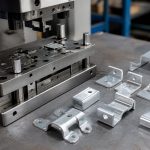
Short answer: Automotive metal stamping produces high-volume precision components — body brackets, EV battery parts, structural reinforcements, and chassis clips — using progressive dies running at 60–1,200 strokes per minute. VOLCRIX operates progressive die stamping lines from 25 to 630 tons, certified to IATF 16949 and equipped with in-die sensors for 100% in-process monitoring. Typical tolerances are ±0.02 mm on critical features, with annual volumes from 50,000 to 50 million pieces per part number.

Industry Reference: Xiaomi Pengcheng N90 Max 7-Car Stack Test
On September 11, 2026, Xiaomi released the results of a landmark 7-car vertical stack crush test on the Pengcheng N90 Max. Seven vehicles stacked vertically with a total weight of 17 metric tons pressing on the bottom car. The bottom vehicle’s passenger cabin remained intact — A, B, C, D pillars showed no visible deformation, and all four doors opened normally after the test.
The N90 Max uses a body-in-white “armor cage” structure with 90.4 percent high-strength steel and aluminum, 16 sections of 2,200 MPa steel, a 2,510 mm internal roll cage embedded through A to C pillars, and a one-piece hot-formed door ring spanning 3,289 mm long and 1,556 mm high.
Source: 凤凰网汽车 — 小米澎程 N90 Max 顶压测试过程
This level of structural integrity raises the bar for every interior component, including the seat slide rail. A seat rail failure inside a vehicle that survives a 17-ton stack test would be unacceptable.
For the full engineering analysis of OEM-grade seat slide rails used in the Xiaomi N90 Max and similar premium EV programs, see our detailed guide: Xiaomi Pengcheng N90 Max 7-Car Stack Test: What It Means for OEM Seat Slide Rail Manufacturing.

Common Applications We Support
- EV battery enclosures and cell holders — aluminum and cold-rolled steel brackets, busbar supports, and module frames for prismatic and cylindrical cell formats.
- Body-in-white structural brackets — A-pillar, B-pillar, and seat belt anchor reinforcements stamped from HSLA 340–590 grades at draw depths up to 80 mm.
- Chassis and suspension components — control arm brackets, spring seats, and exhaust hangers produced on 400–630 ton transfer presses.
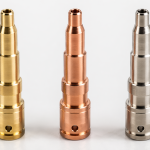
- Precision electrical contacts — terminals, sensor housings, and connector shells stamped from C11000 copper and C26000 brass at ±0.01 mm tolerances.
How VOLCRIX Supports Your Stamping Program
- In-house tool design and build. Our tool room runs 5 CNC milling centers, 4 CNC wire EDMs, and 2 CNC surface grinders — we build dies in-house from S7, D2, SKD11, and carbide insert tooling. Typical die build lead time is 4–6 weeks.
- Progressive and transfer die capability. Lines from 25 to 630 tons, with coil feeding up to 200 mm width and material thickness from 0.15 mm to 6.0 mm.
- In-die sensing and 100% in-process inspection. Every critical station uses load monitors and vision systems to flag defects before they propagate downstream. We retire parts mid-stroke rather than run a defective batch for 30 minutes.
- Tryout and PPAP capability. We run first-article tryout on a 200-ton press dedicated to tool commissioning, with PPAP Level 3 documentation accepted by major Tier-1 suppliers.
Stamping is one of those processes where the difference between a good shop and a great shop is invisible from the outside. It looks like a press, a die, a coil of steel. But inside the press, the way the draw bead geometry is tuned, the way the trim is sequenced, the way the slug is pulled back into the strip — that is what determines whether you get 3 million parts without a tooling event or whether you fight the die every 50,000 strokes. We have been doing this long enough to know where the landmines are, and we design around them in the tooling.
Materials and Grades We Run Daily
| Material | Typical Application | Thickness Range |
|---|---|---|
| DC01 / DC04 cold-rolled steel | Brackets, covers, brackets | 0.5–3.0 mm |
| HSLA 340 / 590 | Structural reinforcements | 1.0–4.0 mm |
| Stainless 304 / 316 | Exhaust hangers, sensor shields | 0.6–3.0 mm |
| Aluminum 5052 / 5754 | EV battery enclosures, lightweight brackets | 0.8–4.0 mm |
| C11000 copper | Electrical contacts, busbars | 0.3–2.0 mm |
| C26000 brass | Connector shells, terminals | 0.3–1.5 mm |
| Beryllium copper C17200 | Spring contacts, EV battery sensing | 0.15–0.8 mm |
For EV battery applications, aluminum is increasingly the material of choice for weight reduction, but it brings its own stamping challenges: springback is higher, tooling wear is faster, and surface scratch risk demands softer die coatings. We have run aluminum 5754 at production volumes above 10 million pieces annually without cracking, by using a combination of generous draw radii, optimized blank holder force, and PVD-coated tooling.
Tolerances and Inspection
Stamping tolerances are tighter than most buyers expect. Modern automotive stampings routinely hold ±0.05 mm on dimensions and ±0.02 mm on critical features. Here is what we publish and measure:
- Dimensional tolerances: ±0.02 mm on critical features (holes, locating tabs); ±0.05 mm on general features; ±0.1 mm on reference dimensions.
- Hole position: ±0.05 mm true position on critical alignment holes; ±0.1 mm on standard features.
- Flatness / planarity: ≤ 0.1 mm on parts under 100 mm; ≤ 0.2 mm on larger stampings.
- Burr height: ≤ 0.05 mm on critical edges; ≤ 0.1 mm on standard features. We deburr in-die where geometry allows.
- Surface roughness: As-stamped finish typically Ra 1.6 μm; polished or rolled finishes available down to Ra 0.4 μm.
- Hardness: Verified by lot on incoming material and after any forming operations. We do not accept material certificates as a substitute for in-house hardness checks.
Our inspection workflow uses a Keyence optical comparator for fast 2D dimensional verification, a Zeiss CMM for 3D features and capability studies, and a portable Hitachi X-MET spectrometer for incoming material verification. Every production lot carries an FAI report at start-up and AQL 1.0 sampling afterward.
Progressive Die vs. Transfer Die vs. Deep Draw
Buyers often ask which process they need. Here is the decision matrix we walk through with every automotive stamping RFQ:
- Progressive die — best for parts that fit within the coil width and require multiple operations in a single strip. Material feeds station-to-station; each station does one operation. Ideal for terminals, brackets, and clips at 60–400 strokes per minute.
- Transfer die — used when the part is larger than the coil width or requires operations that need the part lifted off the strip. Material is transferred between stations by mechanical fingers or robots. Used for body panels, structural reinforcements, and large brackets.
- Deep draw die — used when draw depth exceeds the part diameter. Requires multiple draw and redraw operations to avoid tearing. We run deep draw dies for cylindrical battery cells, sensor housings, and motor laminations.
- Four-slide / multi-slide — used for complex wire forms and small stampings where the geometry is non-planar. Common in sensor clips and electrical contact assemblies.
If your annual volume is below 100,000 pieces and your tolerances are generous (±0.1 mm or wider), a single-station die or a short-run four-slide may be more cost-effective than a full progressive die. We will always recommend the right tool for the job, even if it costs less, because we want to be your supplier for the long term.
Buyer Checklist Before You Issue the RFQ
- ☑ They hold IATF 16949 certification, not just ISO 9001. Automotive production needs the automotive-specific QMS, not a generic one.
- ☑ They have an in-house tool room, not just a press shop. Tooling feedback is faster and tooling changes are cheaper when the tool room is in the same building as the press.
- ☑ They run in-die sensing on critical features. Vision systems and load monitors catch defects before they leave the press, not 30 minutes later at the inspection station.
- ☑ They have a 200-ton or larger press for tryout. Commissioning a die on the production press is the most expensive mistake in stamping. A dedicated tryout press saves weeks of schedule.
- ☑ They will accept your standard PPAP and control plan. Suppliers who insist on their own format add weeks to your launch timeline.
Related Custom Manufacturing Services
Most automotive stamping programs sit inside a larger part family. Here are the related services we run on the same shop floor:
- Automotive Parts Manufacturing — Tier-1 capable stamping, machining, and assembly for passenger and commercial vehicles.
- Sheet Metal Parts Manufacturing — laser cutting, bending, and welding for larger structural components beyond the stamping die envelope.
- Custom Metal Stamping Service — the parent capability page covering tooling design, prototyping, and serial production.
- Die Casting Parts — for aluminum and zinc parts that are better suited to casting than stamping.
Why VOLCRIX for Automotive Metal Stamping
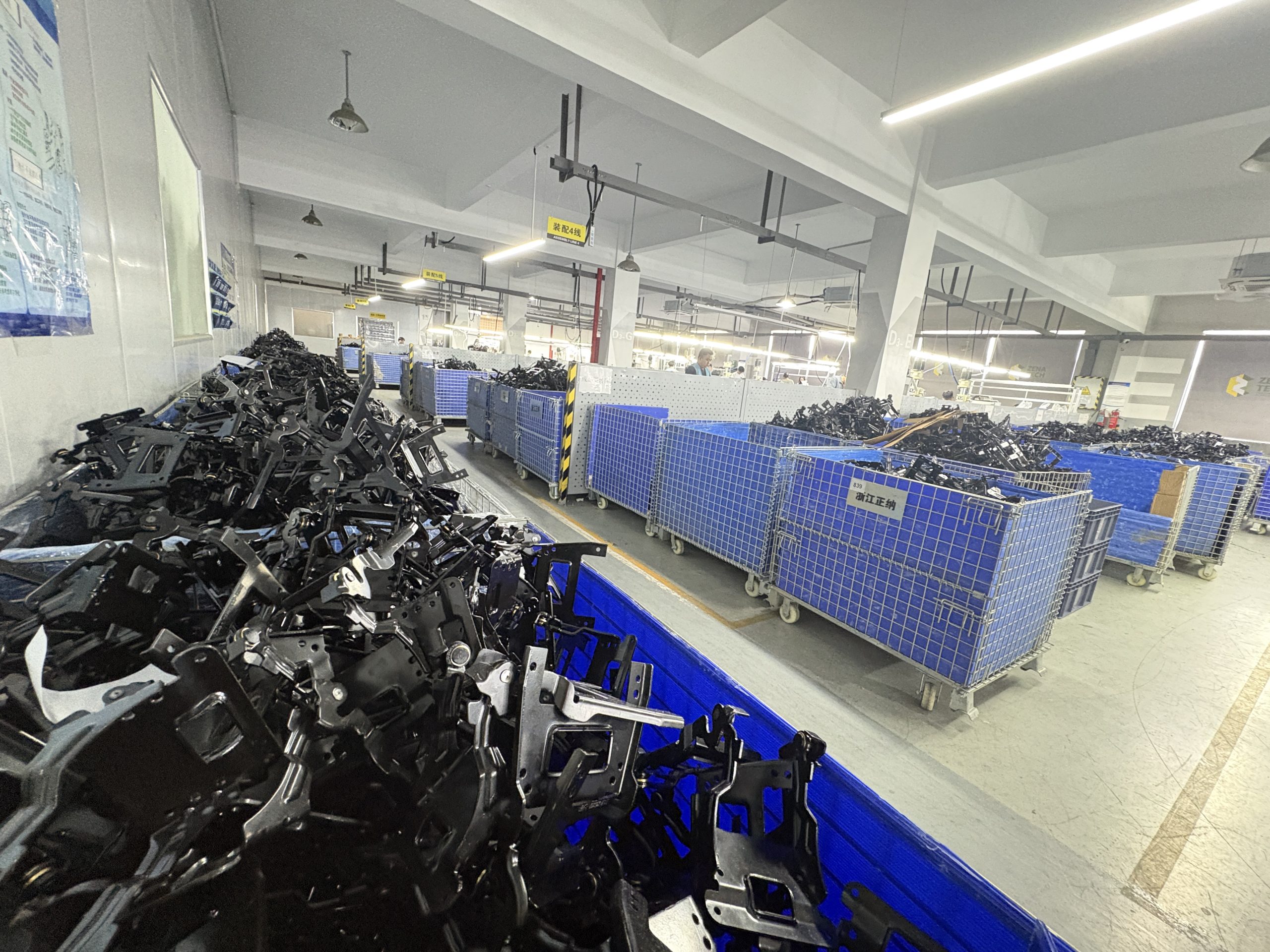
VOLCRIX is a custom metal stamping shop in Wenzhou, China, operating since 2008 under ISO 9001 and IATF 16949 quality systems. We run a 4,500 m² shop floor with 25 mechanical and hydraulic presses from 25 to 630 tons, supported by a full in-house tool room with CNC milling, wire EDM, and surface grinding. We also run a dedicated 200-ton tryout press for die commissioning. Every production lot carries an FAI report, dimensional inspection log, and full material traceability.
Our typical lead times for automotive stamping programs: 4–6 weeks for tooling build, 7–15 days for prototypes (including tryout parts), and 25–40 days for serial production after PPAP sign-off. We have shipped stamped components to Tier-1 suppliers in Germany, the United States, Mexico, and Japan, with PPAP Level 3 packages accepted by all major OEMs we have audited. We hold no inventory of finished stampings — every shipment is made to order against your print, so you never inherit somebody else’s work-in-progress or material.
If you are sourcing an automotive stamping for a passenger car, commercial truck, or EV program and want a quote within 24 hours, send your 3D model and 2D drawing to sales@volcrix.com or message us on WhatsApp. We will reply same day.
Frequently Asked Questions
What is the typical tooling cost for an automotive stamping die?
A simple single-station progressive die for a small bracket starts around $3,000–$8,000 USD. A multi-station progressive die with in-die sensing for a structural bracket runs $25,000–$80,000 USD. A transfer die for a large body panel can exceed $150,000 USD. We provide a formal tool quote with the RFQ, and we share die design in 3D for review before any steel is cut.
What is the minimum annual volume you accept?
For stamping programs we typically require a minimum of 50,000 pieces per year to justify tooling amortization. For programs below 50,000 pieces we recommend single-station dies, four-slide tooling, or laser-cut + bent sheet metal parts instead. We will always recommend the most cost-effective process for your volume.
Can you run aluminum and high-strength steel in the same die?
Generally no — aluminum and high-strength steel have very different forming characteristics. A die designed for HSLA 590 will crack aluminum 5052. We design dies for the specific material grade and thickness you intend to run, and we mark the die with the material specification. If you need flexibility, we run two separate dies or a family die with interchangeable inserts.
Do you provide PPAP and IMDS documentation?
Yes. We provide PPAP Level 1 through Level 4 packages depending on customer requirement, including FAI reports, capability studies (Cpk >= 1.33), control plans, PFMEAs, and material certificates. We submit IMDS entries directly for programs that require it, and we accept customer-specified PPAP templates.
Certifications and Standards
- ISO 9001:2015 — Quality Management System
- IATF 16949:2016 — Automotive Quality Management
- ISO 14001:2015 — Environmental Management System
- CE Marking — European Conformity for relevant product lines
- RoHS Compliance — Restriction of Hazardous Substances
- REACH Compliance — EU chemical safety regulation
- EN 10204 3.1 — Material certification for metallic products
- AIAG APQP — Advanced Product Quality Planning reference