
Metal Stamping for EV, Electronics & Medical: Industry Applications Guide
Direct answer: VOLCRIX manufactures precision metal stampings for three primary industrial verticals — EV (electric vehicles and charging infrastructure), electronics (consumer, industrial, and connector applications), and medical (diagnostic equipment, surgical instruments, and implantable device components). We supply automotive chassis stamping parts, EV battery contacts, EMI shields, connector terminals, sensor housings, and surgical instrument stampings under ISO 9001, IATF 16949, and ISO 13485 quality systems. Press capacity from 25 to 630 tons supports lot sizes from 10,000 to 10 million pieces.
The phrase “metal stamping components supplier” covers an enormous range of parts — from thin copper lead frames for IC packaging to thick steel automotive chassis stampings. Each industry vertical has its own design rules, material preferences, and certification requirements. This guide breaks down what changes when a stamping is destined for an EV battery module vs. a medical diagnostic device, and what that means for your RFQ.
Across our industry-specific stamping programs, the most common failure modes have been: plating thickness variance on EV battery contacts (±20% of nominal where the spec calls for ±10%), burr height on cut edges exceeding cosmetic limits on visible automotive surfaces, and passivation drift on medical stainless parts. Each of these is caught in our standard FAI process; the issue is when a customer skips FAI on a re-order and assumes the process is stable. It usually is, but not always.
Industry vertical drives not only the material and tolerance spec, but also the documentation set, the audit trail, and the inspection cadence. A medical part requires ISO 13485 traceability and ASTM A967 passivation verification; an automotive part requires IATF 16949 PPAP and IMDS material declaration; an EV battery part requires IEC 62196-3 compliance documentation. Knowing which vertical the part is destined for at the RFQ stage saves a documentation scramble later.
For high-volume progressive stamping for automotive components — typically above 500,000 pieces per year per part number — the right tooling decision often determines whether the program is profitable for both sides. Press tonnage must match the strip width and material thickness; station count must match the feature complexity; plating throughput must match the stamping throughput. A program where any of these are out of balance usually runs into delivery issues within the first six months.
Common Applications by Industry Vertical
- EV and electric vehicle charging. Stamped copper busbars for battery pack interconnects, fuse terminals, contact clips for high-voltage harnesses, stamped lead frames for power module packaging, and chassis reinforcement plates. Typical materials are C11000 copper, C18150 (CuCrZr), and 6061-T6 aluminum; typical thickness 0.5–3.0 mm; plating tin or nickel.
- Automotive — body, chassis, and interior. Automotive chassis stamping parts including reinforcement plates, seat belt anchors, hinge plates, console box reinforcement brackets, and door latch components. Materials are typically DC04, SPCE, HSLA340, and stainless 304; thickness 1.0–3.0 mm.
- Electronics — connectors, EMI shields, and consumer devices. Stamped electrical connectors, battery contacts, SIM card contacts, EMI/RFI shields, heat sink plates, and structural brackets for consumer electronics. Materials are brass C2600, C2680, stainless 304, and phosphor bronze; thickness 0.1–0.8 mm.
- Medical — diagnostic, surgical, and implantable device components. Surgical instrument stampings, diagnostic device sub-assemblies, implantable device titanium stampings, and instrument tray stampings. Materials are 304 and 316L stainless, titanium Grade 2 and Grade 5; finish to medical-grade passivation and electropolishing.
- Industrial automation and sensor housings. Sensor housings, encoder stampings, connector shells, and bracket components for industrial controls. Materials are stainless 304, cold-rolled steel, and aluminum 5052; thickness 0.5–2.0 mm.
Manufacturing Support from VOLCRIX
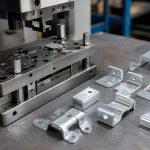
- Progressive die stamping for high-volume precision parts. VOLCRIX runs 40 stamping presses from 25 to 630 tons. Press selection is driven by material thickness, strip width, and feature complexity. Our high-speed presses produce small connector contacts at rates up to 1,200 strokes per minute.
- Deep drawing for cylindrical and box-shaped parts. Motor housings, sensor cans, and battery cell housings are produced on multi-stage deep draw dies with maximum draw depth of 200 mm on cups up to Ø300 mm.
- In-house tool design, build, and tryout. All tooling is designed in-house on AutoForm and built in our tool room. New tooling lead time is 4–6 weeks; sample production is on the same die set as production volume.
- Industry-specific plating and finishing. Tin, nickel, gold, silver, tin-nickel, zinc, and powder coating are managed per industry. Medical parts receive passivation per ASTM A967 and electropolishing per ASTM B912. EV parts receive plating per IEC 62196-3.
- Industry-specific quality systems. IATF 16949 for automotive and EV programs (PPAP, IMDS, control plans). ISO 13485 for medical programs (DHF, DMR, traceability per FDA 21 CFR 820). ISO 9001 baseline across all programs.
Industry-Specific Buyer Checklist
- State the end industry in the RFQ — EV, automotive, electronics, medical, or industrial. “Stamped bracket” means different things in different verticals. An automotive chassis bracket needs IATF 16949 PPAP. A medical bracket needs ISO 13485 traceability. An electronics bracket needs RoHS compliance. The end industry drives the entire documentation set.
- Mark all critical dimensions, surface finish zones, and inspection requirements. EV battery contacts have critical plating thickness on the contact zone. Medical parts have critical surface finish (Ra < 0.4 µm on instrument contact surfaces). Electronics shields have critical flatness across the EMI seal zone. The drawing's inspection notes drive the FAI scope.
- Specify the certification package required — PPAP, DHF, or standard FAI. Automotive and EV programs require IATF 16949 PPAP levels 1–5. Medical programs require ISO 13485 design history file (DHF) and device master record (DMR). Standard FAI is sufficient for industrial and consumer electronics.
- For EV and automotive programs, review the strip layout and press tonnage before tool build. Progressive die layout and press selection drive cycle time, material utilization, and tooling cost. A well-designed layout on a properly selected press can reduce per-piece cost by 20–40% over a marginal design.
- For medical and implantable device programs, specify biocompatibility and finishing requirements. Medical parts often require ISO 10993 biocompatibility testing, passivation per ASTM A967, electropolishing per ASTM B912, and cleanroom packaging. Implantable titanium stampings require additional validation per the customer’s regulatory pathway.
Related Custom Manufacturing Services
VOLCRIX supplies metal stamping components for multiple industry verticals. Browse related services:
Custom Metal Stamping Parts | CNC Machined Parts | Custom Die Casting Parts
Frequently Asked Questions About Metal Stamping by Industry
What certifications does VOLCRIX hold for stamping in different industries?
VOLCRIX holds ISO 9001:2015 baseline, IATF 16949 for automotive and EV programs (with PPAP, IMDS, control plans), and ISO 13485 for medical device manufacturing (with DHF and DMR documentation). RoHS, REACH, and conflict mineral declarations are available across all programs.
What is the difference between automotive chassis stamping and EV battery stamping?
Automotive chassis stampings are typically structural parts in HSLA or mild steel at 1.0–3.0 mm thickness, with cosmetic requirements on visible surfaces and IATF 16949 documentation. EV battery stampings are typically high-current copper or aluminum at 0.5–2.0 mm, with critical plating thickness on contact zones and PPAP documentation.
Can VOLCRIX stamp medical-grade stainless and titanium?
Yes. VOLCRIX stamps 304 and 316L stainless for medical diagnostic and surgical instrument applications. We stamp titanium Grade 2 and Grade 5 for implantable device components. Medical parts receive ASTM A967 passivation, ASTM B912 electropolishing, and cleanroom packaging per the customer’s requirements.
What stamping materials are used for electronics connectors?
Brass C2600 and C2680 for general-purpose connectors. Phosphor bronze C51000 and C52100 for spring contacts requiring higher cycle life. Copper C11000 (ETP) and C18150 (CuCrZr) for high-current EV charging pins. Beryllium copper C17200 for high-cycle, high-stress applications. Stainless 304 for harsh-environment connectors.
What lot sizes does VOLCRIX support for metal stamping?
Prototype runs from 100 to 5,000 pieces via soft tooling (laser cut + CNC bend or short-run dies). Production runs from 10,000 to 10 million pieces via progressive die stamping. Lot size drives tooling cost amortized per piece; we will recommend the appropriate tooling strategy based on your annual volume.
Does VOLCRIX handle high-volume progressive stamping for automotive components?
Yes. Our 40 stamping presses — including 200-ton, 400-ton, and 630-ton presses — support high-volume progressive stamping for automotive components such as chassis reinforcements, EV battery contacts, structural brackets, and seat belt anchors. Press tonnage is matched to strip width, material thickness, and feature complexity.
What plating options are available for stamped metal parts?
Electroplating options include tin, nickel, gold, silver, tin-nickel, zinc, and selective plating. Mechanical finishes include deburring, vibratory finishing, tumbling, and shot peening. Conversion coatings include chromate (RoHS-compliant trivalent), passivation (stainless and titanium), and anodizing (aluminum only). Painting options include powder coat, e-coat, and wet paint.
Certifications, Standards & Compliance
VOLCRIX metal stamping products are built to the following international standards and customer specifications:
- ISO 9001:2015 — Quality management system across all manufacturing processes
- IATF 16949 — Automotive quality management (replaces ISO/TS 16949)
- ISO 13485 — Medical device quality management
- ASTM A240 — Standard specification for chromium and chromium-nickel stainless steel plate, sheet, and strip
- ASTM A967 — Standard specification for chemical passivation treatments for stainless steel parts
- ASTM B912 — Standard specification for passivation of stainless steel using electropolishing
- IEC 62196-2 / 62196-3 — EV charging connector standards (for EV programs)
- RoHS 2 (EU 2015/863) — Restriction of hazardous substances in electrical equipment
For specific compliance questions (IMDS, REACH, FDA 21 CFR 820, conflict minerals, country-of-origin), contact our sales team with your drawing and requirements.