
Automotive Armrest Hinge: Precision Stay Hinge for Console Box Damping
Short answer: An automotive armrest hinge is a precision stay hinge (also called a pivot hinge or friction hinge) that controls the opening and closing motion of a center console armrest, glove box, or interior storage compartment. VOLCRIX manufactures custom stay hinges in stainless steel (SUS301, SUS304) and spring steel (SUS631, 65Mn) for EV and passenger vehicle interiors, with torque ratings from 0.5 Nm to 8 Nm and cycle life tested to 50,000+ open/close operations. Annual volumes typically run 100,000 to 5 million pieces per part number.
Common Applications We Support
- Center console armrest hinges — friction stay hinges for opening/closing console lids on passenger cars, SUVs, and EVs. Torque ratings typically 1.0–3.5 Nm at room temperature.
- Glove box dampers — controlled-descent hinges for glove boxes that must drop slowly and stay flat. Torque ratings 0.5–1.5 Nm with soft-stop at full open position.
- Seat back release hinges — for rear seat folding mechanisms, often rated to 8 Nm to support the weight of the seat back during fold-flat operation.
- Interior storage bin hinges — for overhead bins, door pockets, and rear cargo covers. Smaller torque ratings (0.3–1.0 Nm) but high cycle life requirements.
How VOLCRIX Supports Your Hinge Program
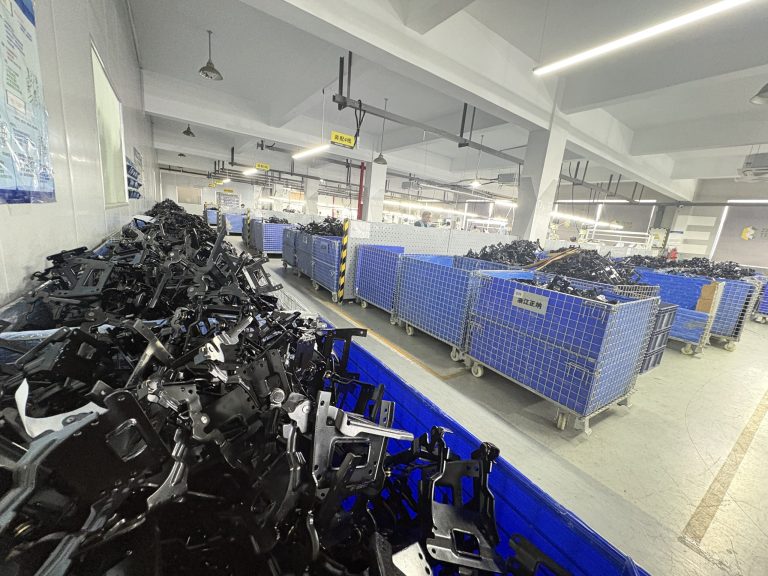
- Multi-slide and four-slide stamping capability. We run 8 four-slide machines and 6 multi-slide presses for high-speed hinge production at 60–200 strokes per minute.
- In-house heat treatment and stress relief. Spring steel hinges require stress relieving after forming to hit the rated torque consistently. We run 3 vacuum heat treatment furnaces for batch processing.
- Torque testing on every production lot. Each lot is tested on a calibrated torque analyzer to verify opening and closing torque within ±15% of nominal. Failure rates above 1% trigger a full lot review.
- Surface finishing options. Black oxide, zinc plating, nickel plating, and electrophoretic painting (e-coating) for corrosion resistance up to 240 hours in salt spray testing.
Stay hinges look simple, but the difference between a hinge that feels premium and a hinge that feels cheap comes down to torque consistency across the full open-to-close arc. A good hinge holds the same torque at 30 degrees as it does at 90 degrees, and the same torque after 50,000 cycles as it does on day one. We achieve that by combining precision stamping, controlled heat treatment, and 100% torque verification — not by sampling one hinge per shift and shipping the rest.
Materials and Heat Treatment
| Material | Typical Use Case | Heat Treatment | Surface Finish |
|---|---|---|---|
| SUS301 stainless | Premium interior hinges (corrosion resistant) | As-rolled (spring temper) | Bright or passivated |
| SUS304 stainless | Standard interior hinges | As-rolled | Bright or passivated |
| SUS631 (17-7PH) | High-strength hinges (EV premium) | CH900 condition (precipitation hardened) | Bright or black oxide |
| 65Mn spring steel | Cost-sensitive applications | Quench & temper | Zinc or black oxide |
| S50C carbon steel | Structural hinges (non-appearance) | Quench & temper | Zinc or e-coat |
| Aluminum 5052 | Lightweight applications | As-rolled (H32) | Anodized |
For most automotive armrest hinge applications, SUS301 or SUS631 stainless is the right choice. Both deliver consistent torque, resist corrosion in the interior cabin environment, and accept a wide range of decorative finishes. SUS631 (17-7PH) is more expensive but offers higher strength at elevated temperatures, which matters for hinges near heated seats or in direct sun exposure.
Tolerances, Torque, and Cycle Life
Stay hinge performance is measured by three parameters: torque consistency, cycle life, and corrosion resistance. Here is what we publish and verify:
- Dimensional tolerances: ±0.05 mm on pivot hole diameter; ±0.1 mm on overall length and width; ±0.05 mm on knuckle position.
- Torque ratings: ±15% of nominal torque at room temperature; ±20% at 80°C and -30°C. Measured at 90-degree open and full close positions.
- Cycle life: Tested to 50,000 open/close cycles minimum, with no more than 20% torque degradation. Premium specifications call for 100,000 cycles.
- Corrosion resistance: 96 hours minimum in neutral salt spray (ASTM B117); 240 hours for premium specifications with zinc-nickel plating.
- Operating temperature: -40°C to +80°C standard; -40°C to +120°C for cabin-near-engine applications.
- Surface roughness: Ra 1.6 μm on mating surfaces; Ra 3.2 μm on non-mating surfaces.
Our inspection workflow uses a Keyence optical comparator for fast 2D dimensional verification, a Zeiss CMM for 3D features, and a calibrated torque analyzer (Mecmesin AFG-100N) for torque verification on every production lot. Salt spray testing is performed in our on-site salt spray chamber per ASTM B117. Every shipment includes an FAI report, dimensional inspection log, and torque test data in PDF format.
Process Selection: Stamped vs. Wire-Formed Hinges
Stay hinges come in two main architectures: stamped flat hinges and wire-formed hinges. Here is how to choose between them:
- Stamped hinges — produced from strip stock by progressive die stamping, then folded into shape. Best for high-volume applications (above 200,000 pieces per year). Tighter dimensional control, lower per-piece cost at volume, but higher tooling cost.
- Wire-formed hinges — produced by bending wire stock around a mandrel. Best for low-volume or prototype applications (below 100,000 pieces per year). Lower tooling cost, faster prototype turnaround, but less torque consistency across production lots.
- Combination hinges — for premium applications, we produce hybrid designs combining stamped leaves with wire-formed pivots. Common in EV armrest applications where torque consistency matters most.
If your annual volume is above 200,000 pieces, a stamped hinge is almost always the right answer. Below that, we will run the tooling ROI with you — sometimes a wire-formed hinge with a short-run stamping operation is the best compromise.
Buyer Checklist Before You Issue the RFQ
- ☑ They hold IATF 16949 certification. Interior hinge production is automotive production. The QMS has to match.
- ☑ They have an in-house torque tester. Torque consistency is the defining performance parameter. If they are sending torque verification out for testing, they are not controlling it.
- ☑ They run in-house salt spray testing. 240 hours of salt spray adds 10 days to your schedule if outsourced. In-house testing cuts that to 24 hours.
- ☑ They will accept your standard PPAP and control plan. Interior hinge programs require PPAP for OEM launches. The supplier who insists on their own format adds weeks to your timeline.
- ☑ They give you a quote in 24 hours, not 5 business days. Responsiveness on RFQ predicts responsiveness on quality escapes.
Related Custom Manufacturing Services
- Automotive Parts Manufacturing — Tier-1 capable stamping, machining, and assembly for passenger and commercial vehicles.
- Custom Metal Stamping Service — the parent capability page covering tooling design, prototyping, and serial production.
- Custom Precision Springs — for torsion springs, compression springs, and wire forms used in conjunction with hinges.
- Sheet Metal Parts Manufacturing — laser cutting, bending, and welding for larger structural components.
Why VOLCRIX for Automotive Armrest Hinges
VOLCRIX is a custom metal stamping and precision machining shop in Wenzhou, China, operating since 2008 under ISO 9001 and IATF 16949 quality systems. We run a 4,500 m² shop floor with 25 mechanical and hydraulic presses from 25 to 630 tons, plus 8 four-slide machines and 6 multi-slide presses for high-speed hinge production. Our heat treatment facility handles stress relieving and precipitation hardening in-house, with vacuum furnaces for stainless grades. Every production lot carries an FAI report, dimensional inspection log, torque test data, and full material traceability.
Our typical lead times for stay hinge programs: 7–15 days for prototypes, 25–40 days for serial production after PPAP sign-off. We have shipped hinges to Tier-1 automotive interior suppliers in China, Germany, the United States, and Mexico, with PPAP Level 3 packages accepted by all major OEMs we have audited. We hold no inventory of finished hinges — every shipment is made to order against your print, so you never inherit somebody else’s work-in-progress or material.
If you are sourcing an automotive armrest hinge or stay hinge for an interior program and want a quote within 24 hours, send your 3D model and 2D drawing to sales@volcrix.com or message us on WhatsApp. We will reply same day.
Frequently Asked Questions
What is the typical torque rating for an automotive armrest hinge?
Most center console armrest hinges run between 1.0 and 3.5 Nm at room temperature. Larger seat-back hinges can go up to 8 Nm to support the weight of the seat back. Smaller glove box and storage bin hinges run 0.3 to 1.5 Nm. Torque ratings depend on the armrest weight, the desired feel, and the operating angle. We can help you specify the right torque for your application.
How many open/close cycles will a stay hinge survive?
Standard automotive stay hinges are rated to 50,000 cycles minimum. Premium specifications (for EV interiors and luxury vehicles) call for 100,000 cycles or more. We test every lot on a cycle rig that runs at 15 cycles per minute until the rated cycle count is reached or the torque degrades by more than 20%.
Can you produce hinges with custom finishes?
Yes. We offer black oxide, zinc plating, zinc-nickel plating, nickel plating, and electrophoretic painting (e-coating) for corrosion resistance up to 240 hours in salt spray testing. We can also supply hinges in bright or passivated stainless finish. Custom colors via powder coating are available for low-volume programs.
What is the typical lead time for a custom hinge program?
For prototypes, we can deliver 50–100 pieces in 7–15 working days. For serial production, lead time is typically 4–6 weeks for tooling build plus 25–35 days for first production after PPAP sign-off. Tooling cost for a stamped stay hinge starts around $5,000–$15,000 USD depending on complexity.
Certifications and Standards
- ISO 9001:2015 — Quality Management System
- IATF 16949:2016 — Automotive Quality Management
- ISO 14001:2015 — Environmental Management System
- CE Marking — European Conformity for relevant product lines
- RoHS Compliance — Restriction of Hazardous Substances
- REACH Compliance — EU chemical safety regulation
- EN 10204 3.1 — Material certification for metallic products
- ASTM B117 — Neutral salt spray testing reference