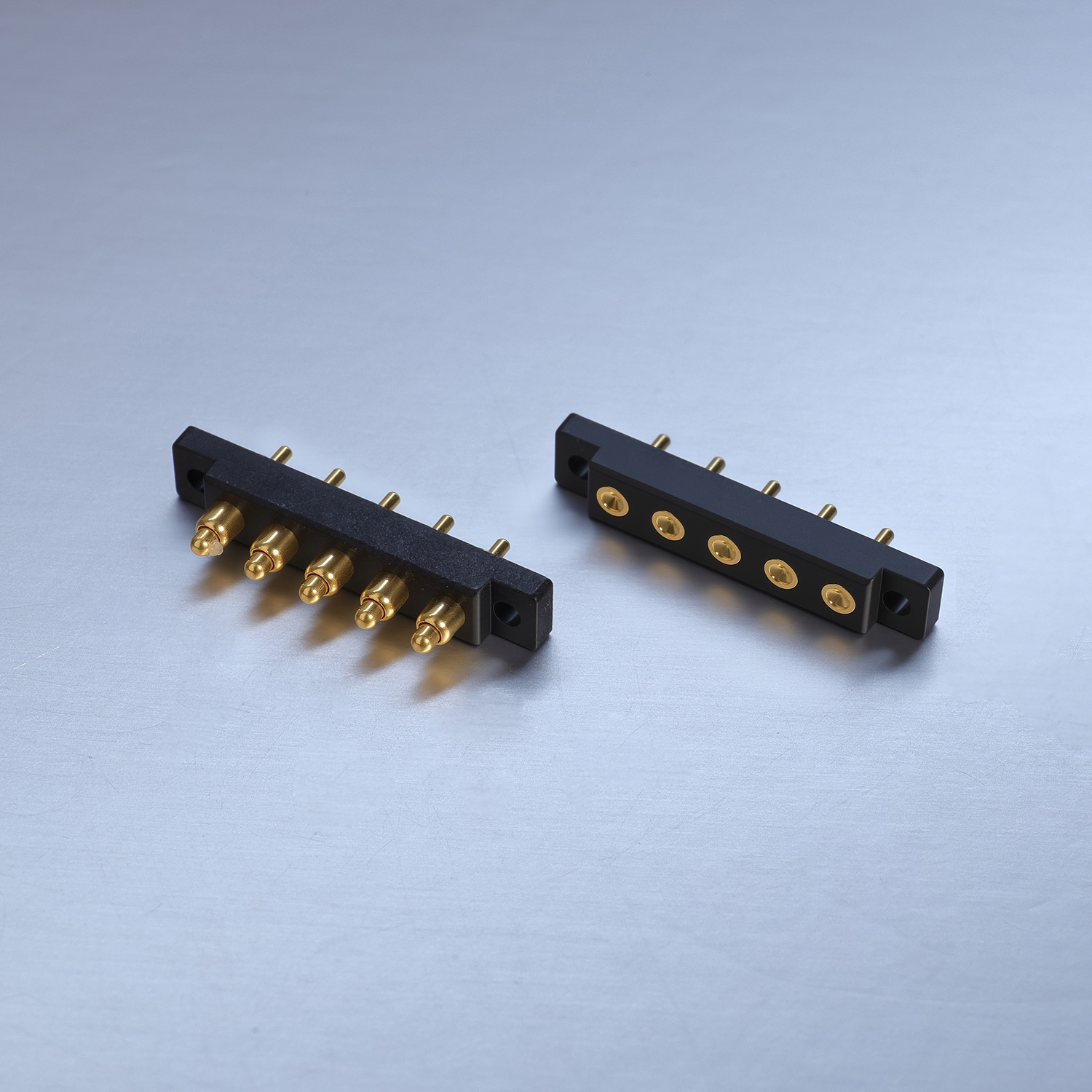

Precision Pogo Pin Manufacturing for Modern Electronic Devices
Direct answer: Precision pogo pins are spring-loaded test contacts used in PCB in-circuit test fixtures, semiconductor test sockets, battery charging contacts, and consumer electronics docking stations. VOLCRIX manufactures precision pogo pins from C36000 brass, beryllium copper, and C18150 Cr-Zr copper with internal spring force up to 200g, gold or nickel plating, and diameters from 0.5 mm to 5 mm. Pin diameters held to plus or minus 0.01 mm with Zeiss CMM verification.
Ready to Start Your Precision Pogo Pins Project?
Free DFM review · Quote within 24 hours · Prototype in 7–15 days
Advanced application: for high-speed AI server interconnect applications using Micro Pogo pins at 224 Gbps, see our Micro Pogo pin manufacturing guide for AI servers.
Common Applications
- PCB in-circuit test ICT fixtures — for testing assembled PCBs during manufacturing — pogo pins provide temporary electrical contact between test points and the test fixture
- Semiconductor test sockets — for final test of integrated circuits — pogo pins handle high-speed signals with controlled impedance and 100,000+ mating cycles
- Battery charging contacts — for handheld devices, medical equipment, and industrial tools — spring-loaded pogo pins enable quick-connect charging without mechanical wear on mating surfaces
- Docking station connectors — for laptops, tablets, industrial tablets, and medical carts — pogo pins provide reliable power and data transfer without exposed mating connectors
- Magnetic charging connectors — for MagSafe-style magnetic charging — pogo pins combined with magnets enable self-aligning, breakaway charging connections
- Wearables and IoT device contacts — for smartwatches, fitness trackers, and IoT sensors — miniature pogo pins for charging cradles and test programming interfaces
Manufacturing Support from VOLCRIX
- 60+ Japanese Star Swiss turning machines — with diameter range from 0.5 mm to 25 mm for precision pogo pin components including plunger, barrel, and spring
- Tight tolerance machining — plus or minus 0.01 mm on plunger and barrel outer diameter, plus or minus 0.005 mm on premium applications verified on Zeiss CMM
- Specialized copper alloys for spring pins — beryllium copper for high-cycle springs up to 1 million cycles, C18150 Cr-Zr copper for high-current applications, C36000 brass for cost-effective consumer applications
- In-house spring manufacturing — 60 spring machines producing the internal contact spring from music wire 0.05 mm to 0.5 mm diameter with controlled spring force 20g to 200g
- Gold and nickel plating coordination — 30 micro-inch gold over 100 micro-inch nickel for low contact resistance, or 50-100 micro-inch nickel for cost-effective applications
Buyer Checklist
- Specify pin diameter and length with plus or minus 0.01 mm tolerance — diameter typically 0.5 mm to 5 mm, length 5 mm to 30 mm
- Define spring force in grams at working height — typically 30g, 50g, 80g, 100g, 150g, or 200g depending on application
- Indicate mating cycle requirement — 10,000 cycles for consumer, 100,000 cycles for ICT fixtures, 1 million cycles for semiconductor test
- Specify plating requirement — gold over nickel for low resistance, nickel for cost, or hard gold for high-cycle applications
- Confirm electrical rating — current rating (typically 0.5A to 5A per pin), contact resistance limit (typically less than 30 milliohm), and rated voltage
Related Custom Manufacturing Services
- Custom Precision Pins — connector pins, contact pins, spring pins, locating pins
- Connector Pin Manufacturer Guide — complete guide for OEM buyers on connector pin selection
- Custom Electronic Contact Pins — precision contact pins for electronics assemblies
- Press-Fit Terminals and Pins Guide — design and application guide for press-fit pins
FAQ
What is a pogo pin and how does it work?
A pogo pin is a spring-loaded electrical contact consisting of three precision components: the plunger the moving contact tip, the barrel the hollow outer body, and the spring internal compression spring providing contact force. When the plunger is pressed against a mating surface or test point, the spring compresses and maintains consistent contact force typically 30g to 200g. The plunger tip is typically pointed or flat, and the barrel has a closed end with wire termination options solder cup, wire wrap, or SMT.
What is the difference between a pogo pin and a spring pin?
Pogo pin and spring pin are often used interchangeably. Pogo pin specifically refers to spring-loaded test pins originally developed for in-circuit test fixtures. Spring pin is a broader term covering any spring-loaded contact including pogo pins, battery contacts, and magnetic charging connectors. Both use the same basic design plunger, barrel, spring but vary in size, force, and plating depending on application.
What materials are used for pogo pins?
Pogo pin plungers and barrels are typically machined from C36000 brass free-machining, easy to Swiss turn with tight tolerances. High-cycle pogo pins use beryllium copper for the plunger and barrel due to its excellent spring properties and fatigue resistance. The internal spring is music wire or stainless steel wire. High-current pogo pins use C18150 Cr-Zr copper for thermal stability. Plating is typically 30 micro-inch gold over 100 micro-inch nickel for low contact resistance.
What is the typical spring force for pogo pins?
Spring force is the contact force applied by the pogo pin plunger at its working height. Common spring forces include 30g for low-force applications smartphone test, 50g for general purpose ICT, 80g for battery charging contacts, 100g for handheld device charging, 150g for industrial docking, and 200g for high-current applications. Higher spring force provides better electrical contact but increases mechanical wear and reduces mating cycle life. Select spring force based on application current, vibration, and mating cycle requirements.
What is the typical mating cycle life of a pogo pin?
Consumer-grade pogo pins: 10,000 to 50,000 mating cycles. Industrial ICT test pins: 100,000 to 500,000 mating cycles. Semiconductor test pins: 1 million to 10 million mating cycles. Mating cycle life is determined by plunger material beryllium copper for high cycle, plating gold over nickel for low wear, spring material music wire vs stainless steel, and contact force lower force equals longer life. VOLCRIX builds to customer-specified cycle life with FAI cycle testing available on request.
Can pogo pins be used for high-current charging applications?
Standard pogo pins are rated for 0.5A to 5A continuous current, suitable for low-current signaling and battery charging up to 25W 5V 5A. For higher-current applications above 5A per pin, VOLCRIX manufactures high-current pogo pins with C18150 Cr-Zr copper plungers and barrels, silver plating instead of gold, and larger pin diameters 3 mm to 5 mm. High-current pogo pins can handle up to 30A continuous with proper thermal management. For applications above 30A, magnetic connector systems with multiple pogo pins in parallel are recommended.
Ready to Start Your Precision Pogo Pins Project?
Free DFM review · Quote within 24 hours · Prototype in 7–15 days
Certifications, Standards & Compliance
VOLCRIX products are built to international standards and customer specifications:
- ISO 9001:2015 — Quality management system across all manufacturing processes
- IATF 16949 — Automotive quality management (replaces ISO/TS 16949)
- ASTM B488 — Standard specification for electrodeposited coatings of gold for engineering uses
- ASTM B689 — Standard specification for electrodeposited engineering nickel coatings
- ASTM B545 — Standard specification for electrodeposited coatings of tin
- ASTM B700 — Standard specification for silver plating
- IEC 61010-031 — Safety requirements for electrical equipment for measurement, control, and laboratory use — Part 031: Safety requirements for hand-held probe assemblies
- MIL-DTL-38999 — Military specification for circular electrical connectors
- RoHS 3 (EU 2015/863) — Restriction of Hazardous Substances in electrical and electronic equipment
- REACH (EC 1907/2006) — Registration, Evaluation, Authorisation and Restriction of Chemicals
For specific compliance questions contact our sales team with your drawing and requirements.