

Progressive Die Stamping: Process, Benefits, and Applications for Custom Metal Stamping Parts
Direct answer: Progressive die stamping is a high-volume metal forming process where a metal strip is fed through a multi-station die that cuts, pierces, bends, and draws the part in one continuous stroke. Compared to single-station or transfer die stamping, progressive die stamping delivers faster cycle times (0.3 to 2 seconds per part), tighter tolerance control (plus or minus 0.025 mm achievable), and lower per-piece cost above 50,000 annual volume. VOLCRIX has been building and running progressive dies for automotive, EV, and industrial customers since 1991.
Common Applications
- EV battery and drivetrain components — busbars, cell contacts, terminal shields, and structural stampings for 400V and 800V battery packs using copper C11000 and aluminum 6061-T6.
- Automotive electrical and safety systems — wire harness terminals, sensor housings, fuse clips, and grounding brackets in brass C26000 and phosphor bronze C51000.
- Industrial machinery and switchgear — structural brackets, mounting plates, and contact stampings in cold-rolled steel, galvanized steel, and 304 stainless.
- Consumer electronics and appliances — EMI shielding contacts, spring clips, and grounding hardware in beryllium copper C17200 and 301 stainless.
Manufacturing Support from VOLCRIX
- In-house die design and build. our tool room handles progressive die design, CNC machining of die components, heat treatment, wire EDM, and tryout in a single integrated workflow.
- Press line from 25 to 200 tons. 40 mechanical and servo presses cover everything from small connector terminals (Bruderer high-speed) to 200-ton structural automotive parts.
- DFM feedback on every RFQ. within 24 hours, our engineers review bend radii, grain direction, draw ratios, and tolerance feasibility against your print.
- Material sourcing with mill traceability. we procure coil and sheet stock to ASTM, EN, and JIS standards with full mill certificates (EN 10204 3.1) on every heat.
- Finishing under our quality system. zinc, nickel, tin, gold plating, powder coating, e-coating, and passivation are coordinated through certified partners audited by our SQE team.
How Progressive Die Stamping Works Step by Step
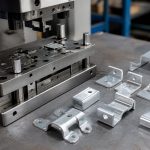
A progressive die is a precision tool with multiple stations arranged along the path of a metal strip. With each press stroke, the strip advances one station-pitch and every station performs its assigned operation. What looks like a single stamping is actually 6 to 12 simultaneous operations happening in sequence. Here is what happens inside the die on a typical terminal or bracket:
- Station 1: Pilot hole and blank. The strip is located by a pilot pin that engages a previously punched hole. The first station typically establishes strip position and begins the outline.
- Stations 2 to 4: Piercing. Holes, slots, and features are punched in sequence to distribute cutting force across multiple hits rather than one heavy hit.
- Stations 5 to 7: Bending. V-dies and punches bend features to specified angles. Sequential bending allows tighter angle tolerance than bending in a single hit.
- Station 8: Drawing (if required). A shallow draw forms cup features or recessed areas. Multi-stage drawing splits deep draws across stations to control material flow.
- Station 9: Trimming and piercing finish. The part is separated from the carrier strip and final features are added.
- Station 10: Stripping and ejection. The finished part is ejected from the die while the carrier strip continues to be recoiled for recycling.
Materials Suited to Progressive Die Stamping
Progressive die stamping handles a wide range of metals, but each material has its own personality in the die. Here is how we think about material selection for a new program:
- Low-carbon cold-rolled steel (SPCC, DC01). The workhorse of progressive die stamping. Low cost, predictable springback, accepts all common platings.
- Galvanized steel (SECC, SGCC, DC51D+Z). Pre-coated for corrosion resistance. Common in HVAC, switchgear, and automotive body panels. Bend radii must respect coating adhesion.
- Stainless steel (304, 316, 301, 430). Corrosion-resistant and springy. Work hardens during stamping, so we use higher tonnage and shorter die life expectations.
- Aluminum (5052-H32, 6061-T6, 7075-T6). Lightweight for EV and aerospace. Larger die clearance required; 7075 is sensitive to draw direction and speed.
- Copper and brass (C11000, C26000, C36000). Electrical and electronic applications. Soft, gummy, tends to stick to dies — we use specialized lubrication and strip coatings.
- Pre-plated and pre-painted stock. Tin, nickel, and pre-painted (PCM) coils can be stamped directly, eliminating a separate plating step.
Tolerances and Achievable Precision
Tolerance in progressive die stamping comes from three factors: die precision, press repeatability, and material consistency. Here is how we engineer each factor to deliver the precision your drawing requires:
- Die clearance. We hold die clearance to within 5 percent of material thickness per side. Tighter clearance produces cleaner cuts but accelerates punch wear.
- Strip positioning. Pilot pins locate the strip at every station. Pilot pin diameter is held within 0.01 mm and engages a previously punched hole with zero clearance.
- Press repeatability. Our Bruderer high-speed presses hold slide position within 0.01 mm; mechanical presses to within 0.02 mm.
- Bend angle control. Air bends allow plus or minus 0.5 degrees; bottomed bends with precision ground tooling allow plus or minus 0.25 degrees.
- Flatness and flat-length tolerance. Controlled by die design and material grain direction. We design tooling to compensate for springback on a per-material basis.
From Drawing to Production: Our Workflow
Every program at VOLCRIX follows the same disciplined path from RFQ to serial production. Here is the workflow that gets a new progressive die stamping from your inbox to your receiving dock:
- Day 1: RFQ review. Send your 3D model or 2D drawing plus annual volume target. Our engineering team responds within 24 hours with quotation, written DFM feedback, and clarifying questions.
- Day 2 to 5: DFM refinement. We work through any drawing issues — missing tolerances, ambiguous features, material specifications — until the print is die-ready.
- Day 6 to 10: Soft prototype (optional). For design validation, we produce 5 to 20 sample pieces by laser cutting or 3D-printed soft tooling. This step often catches issues that would otherwise surface during hard die tryout.
- Day 11 to 35: Hard tooling build. Progressive die design, CNC machining of die plates, wire EDM for sharp internal corners, heat treatment, assembly, and tryout in our 40-ton tool room press.
- Day 36 to 40: First article samples. We send 10 to 30 sample pieces with full dimensional report (FAIR), material certificate, and initial capability data.
- Day 41 onward: PPAP and serial production. For automotive programs, PPAP Level 3 documentation is submitted. Serial production releases on a kanban or scheduled release pattern.
Buyer Checklist Before You Issue the RFQ
- Define annual volume before quoting — tooling cost is amortized over volume; knowing whether you need 5,000 or 500,000 pieces per year changes the die material, surface treatment, and quotation.
- Mark critical dimensions with GD&T — position and profile tolerances with datums give the die maker a clearer target than plus or minus dimensions on every feature.
- Specify material grade and temper — SPCC versus SPCD versus SECC, full hard versus half hard — the choice affects press tonnage, die clearance, and bend springback.
- Identify plating and finish requirements — salt spray hours, plating thickness, RoHS status, and cosmetic expectations all drive finishing sequence and cost.
- Call out grain direction for formed parts — deep drawn and heavily bent parts behave differently along versus across the grain; specify which direction when strength or appearance depends on it.
Related Custom Manufacturing Services
Custom Metal Stamping Parts | Custom Precision Stamping | High Volume Metal Stamping Production | EV Battery Busbar Stamping
Why VOLCRIX for This Program
Since 1991, VOLCRIX has run a single factory in Yueqing, Wenzhou, focused on precision metal forming and machining for export B2B programs. The reason buyers come back: every step happens under one roof, with one quality system, and one accountability chain.
- 33 years of progressive die experience. VOLCRIX has been building and running progressive dies in the same Yueqing, Wenzhou factory since 1991. Our tool makers average 15 years of die-building experience.
- 40 presses under one roof. From 25-ton Bruderer high-speed presses to 200-ton Minster mechanical presses, capacity lives under one roof with one quality system.
- IATF 16949 certified quality system. Every automotive program is run under our IATF-certified system with PPAP capability studies, control plans, and PFMEAs in standard OEM format.
- Zeiss CMM and Keyence vision inspection. First article inspection on a Zeiss Contura CMM, in-process checks on Keyence IM-7000 vision systems, AQL 1.0 sampling per ISO 2859-1.
- One roof from blanking to plated part. Stamping, in-house tool maintenance, and plating coordination happen in one factory with one accountability chain. No hand-offs between unrelated suppliers.
- 500+ active export customers. North American automotive Tier 1s, European industrial OEMs, and Asian electronics brands ship from our factory on weekly release schedules.
Frequently Asked Questions
What is progressive die stamping and how does it differ from single-station stamping?
Progressive die stamping uses one die with multiple stations arranged in sequence along the strip. Each station performs one operation (pierce, blank, bend, draw), and the strip indexes from station to station with each press stroke. Single-station stamping does one operation per press hit and requires the part to be moved between presses. Progressive dies are faster and more consistent at high volume, but require higher upfront tooling investment.
When is progressive die stamping the right choice over other forming processes?
Progressive die stamping is right when you need 50,000 or more pieces per year of a part with multiple features, tight tolerances, and consistent quality. For very small runs (under 5,000 pieces), laser cutting, single-station tooling, or 3D-printed prototypes are usually more economical. For very deep drawn parts, transfer dies may outperform progressive dies.
What tolerances can progressive die stamping achieve?
Standard progressive die tolerance is plus or minus 0.05 mm on flat dimensions and plus or minus 0.1 mm on bend-to-bend. Within a single die station, we hold plus or minus 0.01 mm to 0.025 mm on critical features. Bend angle tolerance is typically plus or minus 0.5 degrees, plus or minus 0.25 degrees with precision bottoming dies.
What is the typical lead time for building a new progressive die?
From approved drawing to first-article samples, progressive die build takes 25 to 35 working days for tools up to 600 mm in length. Expedited programs using our standardized die bases can shave 7 to 10 days. We always recommend building in two weeks of buffer for die tryout, sample approval, and any drawing revisions.
Do you build progressive dies for low-volume stainless steel and aluminum runs?
Yes. We build low-volume stainless steel progressive dies, low-volume galvanized progressive dies, low-volume aluminum progressive dies, and low-volume carbon steel progressive dies. For low-volume runs (500 to 20,000 pieces), we often pair a hardened production die with shorter die life expectations, which keeps tooling cost down.
What kinds of materials work best in progressive die stamping?
Cold-rolled steel, hot-rolled steel, galvanized steel, stainless steel (304, 316, 301, 430), aluminum (5052, 6061, 7075), copper and copper alloys (C11000, C26000, C51000, C17200), and pre-plated or pre-painted coil stock all run well in progressive dies. Material thickness typically ranges from 0.2 mm to 6 mm.
How does progressive die stamping compare in cost to laser cutting or machining?
At volumes above 50,000 pieces per year, progressive die stamping is almost always the lowest cost per piece. Below 5,000 pieces, laser cutting or CNC machining is usually cheaper because you avoid tooling cost. Between 5,000 and 50,000 pieces, the answer depends on part complexity — we can help you model both options.
Do you provide samples and prototypes before hard tooling?
Yes. We offer soft tool prototypes (laser cut or 3D-printed soft tooling) for design validation in 5 to 10 working days, then bridge to hardened progressive dies for serial production. Bridge production using soft tooling typically covers the first 1,000 to 5,000 pieces while your hard die is being built.
Certifications and Standards
VOLCRIX operates under the following certified quality and compliance systems:
- ISO 9001:2015 — Quality Management System
- IATF 16949:2016 — Automotive Quality Management
- ISO 14001:2015 — Environmental Management System
- ISO 45001:2018 — Occupational Health and Safety
- RoHS — Restriction of Hazardous Substances compliance for EU exports
- REACH — EU chemicals compliance for exported components
- CE marking support for finished assemblies where applicable
- Conflict minerals (3TG) disclosure and CFSI template on request