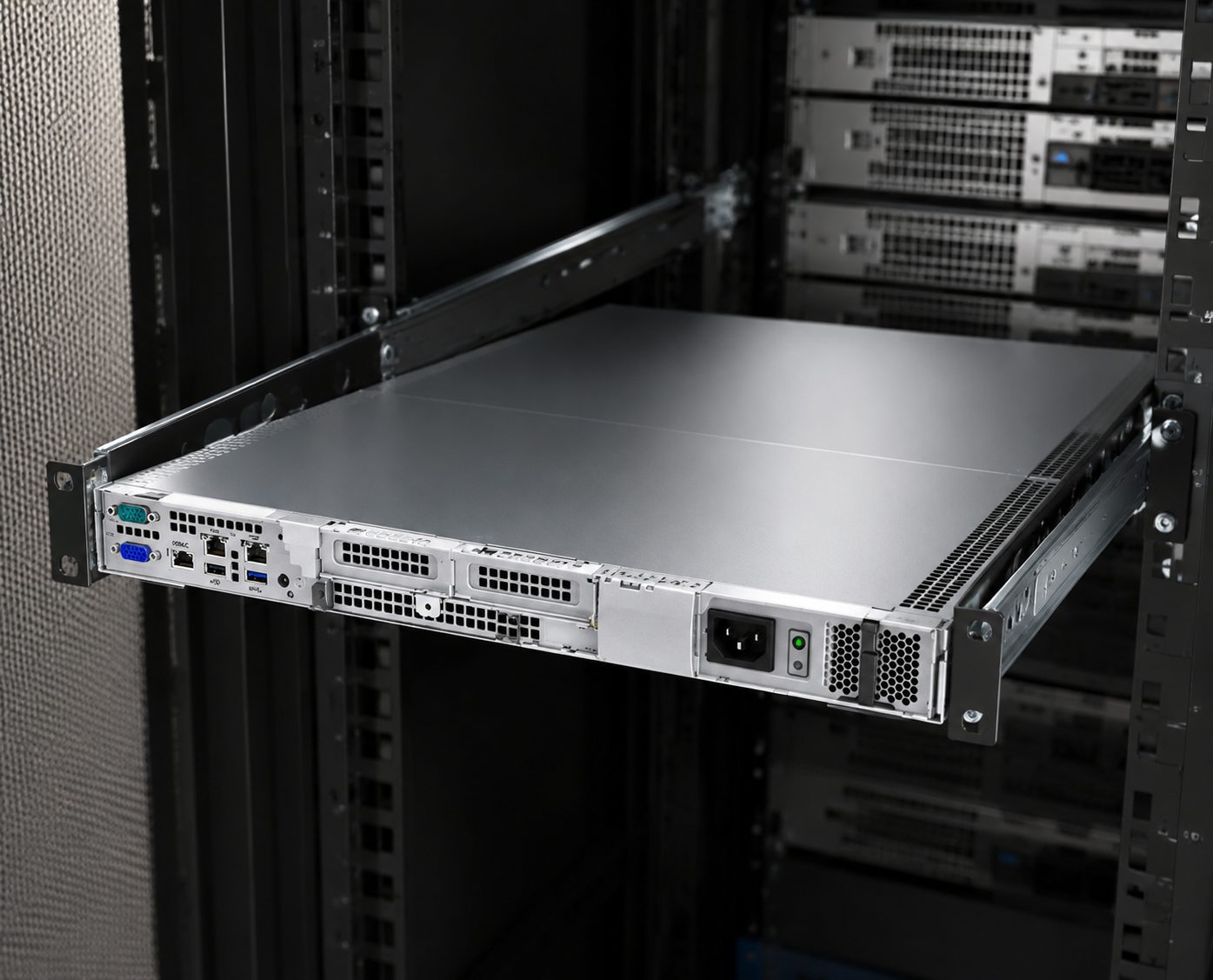

The transition from general-purpose compute to AI training and inference clusters has changed the mechanical requirements for server rack infrastructure. A standard 1U server weighs 25-35 lb. An NVIDIA DGX H100 or comparable 4U GPU server runs 130-160 lb empty, and over 200 lb fully populated. The slide rail becomes a structural component, not an accessory.
This article covers the specifications that matter when sourcing slide rails for AI server cabinets: static and dynamic load ratings, section geometry, ball bearing stages, material selection, and compliance with EIA-310 mounting patterns.
Ready to Start Your Project?
Free DFM review · Quote within 24 hours · Prototype in 7–15 days
Load Ratings: Static versus Dynamic
Server rack slides are rated for two distinct load conditions per ANSI/EIA-310 and IEC 60297.
Static load rating refers to the maximum weight the rail supports when the server is stationary and fully extended for service access. For AI workloads, this is the critical number. A 4U GPU server with four dual-slot accelerators, redundant power supplies, and a full complement of drives can exceed 180 lb. The rail pair must support this weight at full extension without measurable deflection beyond 0.5 mm per foot.
Dynamic load rating refers to the maximum weight the rail supports during insertion and withdrawal. This value is typically 60-70 percent of the static rating. The ball bearing stages experience point loading during travel that does not occur at rest.
Industry practice among data center equipment manufacturers specifies a safety factor of 1.5 to 2.0 between the server weight and the rail’s static load rating. For a 200 lb GPU server, the specified rail pair should carry no less than 300 lb static.
Slide Rail Construction
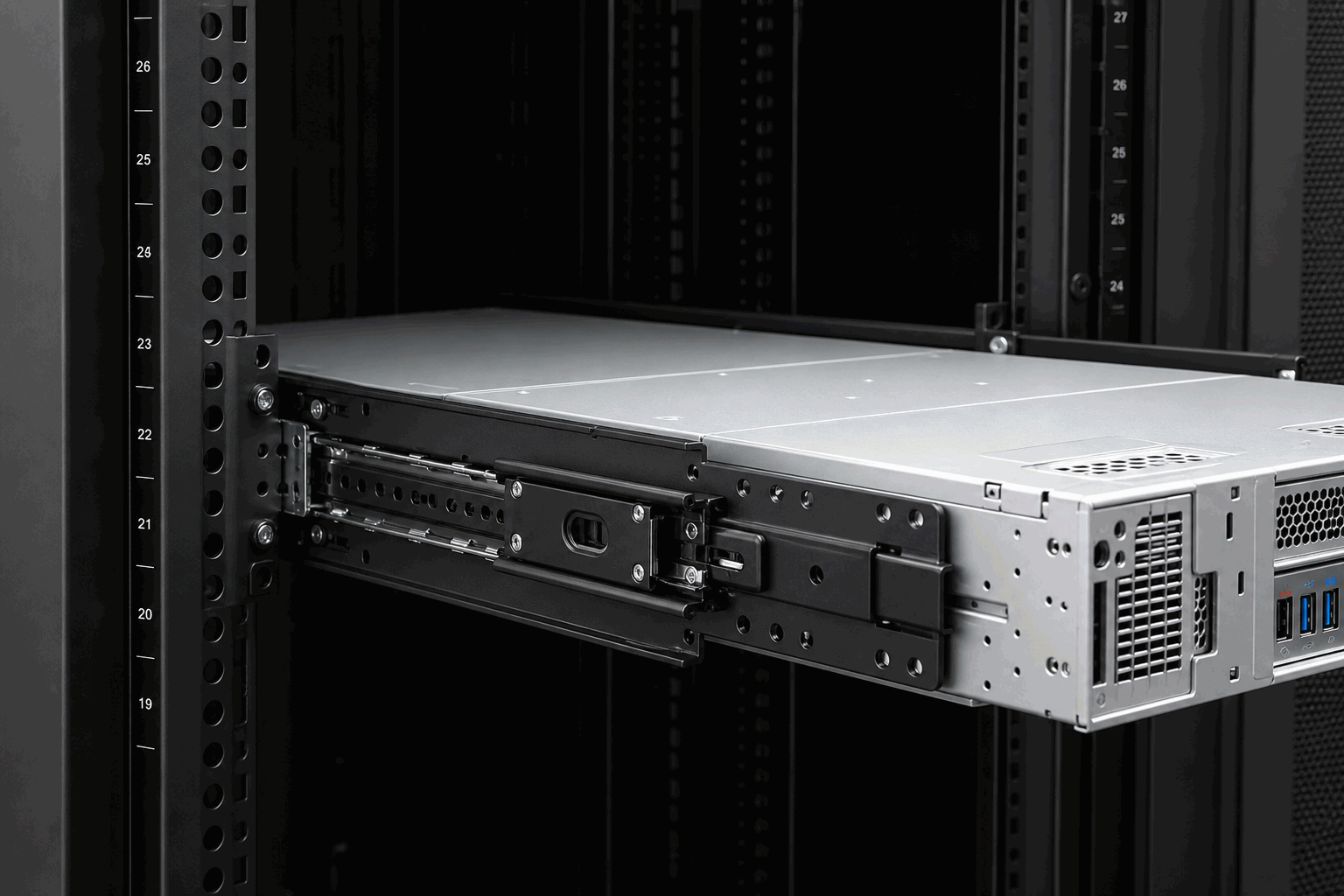
Three-stage telescopic slides are the standard for 2U through 6U AI servers. Each stage consists of a formed steel section riding on ball bearing carriages. The three-stage design allows full extension of the server chassis beyond the rack face, providing access to internal components without removing the unit from the cabinet.
Section geometry varies by load class:
Light duty (up to 100 lb per pair). Section height typically 35-40 mm. Material thickness 1.2-1.5 mm formed steel. Two or three ball bearing carriages per stage.
Medium duty (100-200 lb per pair). Section height 40-50 mm. Material thickness 1.5-2.0 mm. Three ball bearing carriages per stage, typically with captive retainers.
Heavy duty (200-400+ lb per pair). Section height 50-65 mm. Material thickness 2.0-2.5 mm. Four or five ball bearing carriages per stage. Reinforced raceways. Some designs incorporate a locking mechanism that engages when the slide is fully extended, preventing accidental dislodging during service.
Ball bearing count and diameter directly correlate with load capacity. Standard slides use 2.5-3.5 mm diameter balls. Heavy-duty slides step up to 4.0 mm with 30-40 percent more balls per carriage.
EIA-310 Mounting Interface
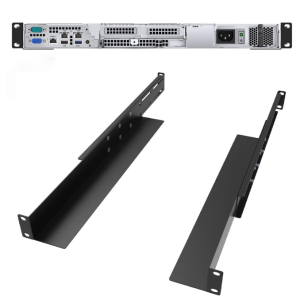
The EIA-310-D standard defines the 19-inch rack mounting pattern. The critical dimensions for slide rail compatibility are the distance between the front and rear mounting planes (mounting depth) and the vertical hole spacing.
Mounting depth for AI servers typically falls between 660 mm and 915 mm (26 to 36 inches). Slides must be adjustable to accommodate this range. Four-post racks support the full weight through both front and rear flanges. Two-post racks are unsuitable for GPU server installations.
The vertical mounting pattern uses the universal square-hole or threaded-round-hole formats. Square-hole racks accepting cage nuts are the dominant standard in North American data centers. Threaded-hole racks are common in European telecommunications environments. Slides intended for the North American AI data center market should include cage-nut-compatible brackets.
Slide Rail Materials
The structural elements of a server slide rail are formed from cold-rolled steel strip. The grade most commonly specified is SPCC or DC01 equivalent, with a minimum yield strength of 180 MPa.
Material thickness selection follows the expected load:
1.2 mm (18 gauge). Slides rated to 70-100 lb per pair. Suitable for 1U network switches, patch panels, and lightweight 1U servers.
1.5 mm (16 gauge). Slides rated to 130-150 lb per pair. Suitable for 2U storage servers and mid-range compute nodes.
2.0 mm (14 gauge). Slides rated to 200-250 lb per pair. Minimum recommendation for 4U AI servers.
2.5 mm (12 gauge). Slides rated to 300-400 lb per pair. Used for 6U and larger GPU chassis, UPS modules, and high-density storage shelves.
Finish and Corrosion Protection
Data center environments are controlled for temperature and humidity. Corrosion requirements are moderate. Standard finish is electro-galvanized steel (zinc plating, 5-8 micron) with a clear or yellow chromate conversion coating.
Optional treatments for edge-of-row or non-conditioned environments include:
Zinc-nickel plating (8-12 micron). Provides 3-5x the salt spray resistance of standard zinc. Specified for racks in modular data centers or edge deployments.
E-coat (electrophoretic deposition). Applied over zinc plating. A 15-25 micron organic coating that covers edges and internal surfaces uniformly. Used by several major OEM slide suppliers.
The ball bearing carriages are lubricated with lithium-soap grease rated for a service temperature range of -20 C to 80 C. Grease migration at elevated temperatures is a known failure mode in slides installed above heat exhaust zones. Specifying high-drop-point grease (NLGI grade 2 or 3) mitigates this.
Tool-less versus Screw-Mount
Tool-less slides use spring-loaded latch pins that engage the rack’s square holes. They reduce installation time from minutes per rail to seconds. The trade-off is a lower load ceiling. Most tool-less designs are rated to 150 lb per pair, limited by the latch pin engagement geometry.
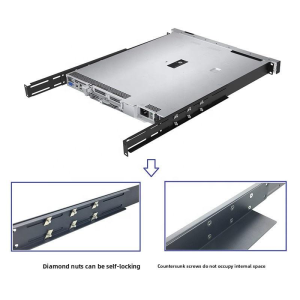
For AI servers exceeding 150 lb, screw-mount slides are the standard approach. Four M5 or 10-32 screws per bracket distribute the load into the rack rail directly, bypassing the limitations of latch pins. Screw-mount slides also reduce vertical play in the installed position, which matters when aligning liquid cooling couplings.
Cable Management Arm Compatibility
GPU servers require more cable volume per unit than compute servers. Each GPU accelerator draws power and data cabling. A fully populated 4U GPU server can have 8-12 individual cable runs per side.
Slides intended for AI deployments should provide adequate clearance alongside the server chassis for cable management arms (CMAs). The slide’s narrowest cross-section (the space between the server sidewall and the rack rail, typically 8-12 mm) must accommodate the CMA hinge bracket. Some AI chassis manufacturers now specify 15 mm minimum clearance for CMA routing.
Field Testing and QC
Production slide rails are tested to UL 2416 or equivalent. The standard test protocol includes 10,000 insertion-withdrawal cycles at 100 percent of the static load rating followed by visual inspection for ball bearing wear, raceway deformation, and fastener retention.
For products manufactured to VOLCRIX specifications, each production lot is sampled at AQL 1.0 level II per ANSI/ASQ Z1.4. Inspection covers:
Section width and height to +/- 0.3 mm.
Mounting hole pattern to +/- 0.5 mm over the slide length.
Ball bearing carriage free travel.
Latch pin engagement force (tool-less models).
Plating thickness by XRF.
VOLCRIX manufactures heavy-duty slide rails for AI server cabinets using progressive die stamping and roll forming. Standard production includes EIA-310-compatible slides rated from 100 lb to 350 lb per pair, in 1.5 mm, 2.0 mm, and 2.5 mm cold-rolled steel with zinc or zinc-nickel plating.
Custom slide designs are produced from customer prints, with in-house tooling for section forming, ball bearing cage stamping, and assembly fixturing. Lead time for custom production tooling is 4-5 weeks.
Frequently Asked Questions
What is the difference between static and dynamic load rating on server slides?
Static load is the weight the slide supports at full extension while stationary. Dynamic load is the weight it supports during insertion and withdrawal. Dynamic rating is roughly 60-70 percent of static.
What gauge steel is used for AI server slide rails?
For GPU servers in the 150-250 lb range, 2.0 mm (14 gauge) cold-rolled steel is the minimum. For heavier chassis up to 400 lb, 2.5 mm (12 gauge) is standard.
Can tool-less slides support GPU servers?
Most tool-less slides are rated to 150 lb maximum. AI servers frequently exceed this. Screw-mount slides are the recommended approach for GPU server deployments.
What finish is standard for data center slide rails?
Electro-galvanized zinc with clear chromate, 5-8 micron. For edge deployments, zinc-nickel or e-coat is recommended.
How are slide rails tested for durability?
UL 2416 specifies 10,000 cycle testing at full static load, followed by inspection of bearing wear and structural deformation.
Frequently Asked Questions
Ready to Start Your Project?
Free DFM review · Quote within 24 hours · Prototype in 7–15 days
What is the difference between static and dynamic load rating on server slides?
Static load is the weight the slide supports at full extension while stationary. Dynamic load is the weight it supports during insertion and withdrawal. Dynamic rating is roughly 60-70 percent of static.
What gauge steel is used for AI server slide rails?
For GPU servers in the 150-250 lb range, 2.0 mm (14 gauge) cold-rolled steel is the minimum. For heavier chassis up to 400 lb, 2.5 mm (12 gauge) is standard.
Can tool-less slides support GPU servers?
Most tool-less slides are rated to 150 lb maximum. AI servers frequently exceed this. Screw-mount slides are the recommended approach for GPU server deployments.
What finish is standard for data center slide rails?
Electro-galvanized zinc with clear chromate, 5-8 micron. For edge deployments, zinc-nickel or e-coat is recommended.
How are slide rails tested for durability?
UL 2416 specifies 10,000 cycle testing at full static load, followed by inspection of bearing wear and structural deformation.
Need custom AI server rack rails for your data center? View our AI server rack rail manufacturing capabilities →
For hinge and slide rail assemblies, see our precision hinges page →