
Custom Stamped Brackets & Housings: Structural Parts for OEM Applications
Open any OEM assembly — a vehicle door module, a base station radio, a battery pack, a commercial appliance — and you will find the same structural skeleton: custom stamped brackets carrying loads, stamped housings shielding electronics — or, when volumes are lower and tolerances tighter, CNC machined aluminum housings machined straight from your drawing, and connector shells terminating cables. These parts rarely get the attention paid to machined components, yet they decide cost, weight, and fit of the whole program.
Stamping is the highest-volume structural forming process available. A progressive die produces finished parts at hundreds of strokes per minute with repeatability machining cannot match at scale. This guide covers the four families of stamped structural parts and the design rules that keep them manufacturable.
Custom Stamped Brackets
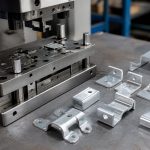
Brackets are the workhorses of OEM structures. L-brackets make simple right-angle mounts, Z-brackets offset a component to clear neighboring parts, and U-brackets wrap around edges for channel retention. Mounting brackets and sensor brackets cover the rest: ABS wheel-speed sensor mounts, throttle position sensor brackets, HVAC pressure switch brackets, relay and fuse holders.
A bracket’s function is dimensional — it positions a component in three axes and carries a defined static or dynamic load. That is why design-for-stamping starts with the flat pattern, not the bent view. Keep bend lines perpendicular to the sheet grain on fatigue-critical flanges, and keep flange height at roughly 2.5× material thickness so the forming tool can reach a clean 90° bend. The classic bracket program runs SPCC, DC01, or SUS304 strip, 0.5–3.0 mm thick, through a progressive die that pierces, coins, and bends in one pass.
Stamped Housings
Enclosures, covers, and box shapes move from weldments to stamped housings when volume justifies tooling. A progressive die with forming stations produces a four-sided box in a single pass: the blank is pierced, drawn or folded, and flanged to net shape. Add drawn pockets for connector cutouts, embossed ribs for stiffness, and pierced vents for airflow.
Stamped housings win on wall-thickness consistency and cost per piece. A 1.0–1.5 mm cold-rolled steel housing with embossed ribbing typically meets the stiffness of a 2.0 mm flat sheet at lower material cost. Material selection matters here — see our metal stamping materials guide for SPCC vs SUS304 vs 5052 trade-offs, including corrosion and plating.
Connector Shells & Backshells
Connector shells and backshells are stamped where machined versions cost too much. RF connector housings, D-sub backshells, circular connector shells, and EMI shielding cans all form well in strip: shell halves, cable-entry ferrules, and latch features are pierced and formed, then plated for conductivity and corrosion resistance.
For RF and signal-integrity work, the material is usually beryllium copper or phosphor bronze (C5191, C17200) at 0.2–0.5 mm, chosen for spring temper and stable contact force. For shielding shells, the priority is a low-resistance seam — dimple or lance-and-form tabs hold halves together and maintain continuous electrical contact. Plating (tin, nickel, or selective gold) is specified against the mating system, not the part alone.
Stamped Hinge Manufacturing
Stamped hinge manufacturing covers three families. Bent hinges form a knuckle around a rolled or pierced pivot; living hinges rely on material elasticity (stainless or spring steel) for a fatigue-rated flex; multi-part hinge assemblies join two or more stamped leaves with a rivet or pin in a secondary operation.
The rolled knuckle is the detail that decides die life. A knuckle diameter of 2.5–3× material thickness forms reliably; tighter rolls need special tooling and show springback variation. Multi-part assemblies — think an automotive armrest hinge or a laptop hinge bracket — combine stamping with riveting and lubricant selection for a specified cycle life, tested to 10,000+ cycles when the OEM requires it.
Sheet Metal Stamping Parts Fabrication
Sheet metal stamping parts fabrication rarely stops at the press. Parts that ship to OEM lines combine stamping with bending, welding, and assembly: a bracket gets a tapped hole, a housing gets a welded stud or PEM nut, a shell gets a gasket before reaching the connector line.
VOLCRIX keeps these operations under one roof: CNC press brakes for low-volume bends, resistance and TIG welding for studs and seams, tapping and insert installation, and subassembly with rivets or fasteners. One supplier means one PPAP package and one corrective-action loop when a field issue surfaces.
Design-for-Stamping Guidelines
The rules below keep parts manufacturable at high speed and low tooling risk. They follow common practice per DIN 6935 for bend allowances and ISO 2768-m for general tolerances:
| Parameter | Rule of thumb | Notes |
|---|---|---|
| Wall thickness | 0.3–4.0 mm | Progressive dies favor 0.5–2.0 mm |
| Inside bend radius | ≥ 1× thickness (mild steel) | 1.5× for 5xxx aluminum; 2× for hardened stainless |
| Hole-to-edge distance | ≥ 1.5× thickness | Prevents edge distortion and punch breakage |
| Tolerances | ±0.05 mm standard; ±0.01 mm critical | Critical dims from progressive dies, CMM-verified |
Two more rules matter in practice: keep slot width at or above material thickness, and avoid tight radii on load-bearing flanges — a radius that cracks in the die will crack in the field. For a deeper treatment of what ±0.01 mm actually buys you, read our precision stamping tolerances guide.
Why Choose VOLCRIX
VOLCRIX builds custom stamped brackets, housings, shells, and hinges for OEM programs in automotive, EV, telecom, and industrial electronics. The shop runs progressive dies up to 200 tons, holds ±0.01 mm on critical features, and inspects with CMM under an IATF 16949 quality system — with PPAP and IMDS support for tier-one programs.
- Progressive and transfer dies up to 200 tons for high-volume runs
- ±0.01 mm on critical stamped dimensions, verified by CMM
- IATF 16949 certified; PPAP, IMDS, and control plans on request
- In-house secondary operations: bending, welding, tapping, assembly
- Materials: SPCC, DC01, SUS304/316, 5052/6061 aluminum, C5191, C17200
A capable company stamping complex parts will offer DFM feedback on bend radii, hole placement, and tolerance stacking before you commit to tooling.
For low-volume or highly complex geometries, we offer custom CNC machined drive enclosures as an alternative to stamped housings.
If your application needs a machined housing for motor drives or power electronics, we machine it from aluminum or stainless in the same facility.
For applications that need a customized precision aluminum housing, we machine or stamp it in-house with your exact mounting pattern and surface finish. This OEM customized aluminum housing capability covers motor drives, power electronics, and telecom enclosures in one facility.
Beyond enclosures, VOLCRIX supports an aluminium housing manufacturer workflow alongside CNC aluminum plates and milled plate work — letting OEM buyers consolidate stamped, machined, and finished structural components with a single engineering team.
FAQ
What materials are best for custom stamped brackets and housings?
Mild steel (SPCC, DC01) covers most brackets and housings at the lowest cost. Use SUS304 or SUS316 where corrosion matters, 5052 or 6061 aluminum when weight is critical, and C5191 phosphor bronze or C17200 beryllium copper for connector shells that need spring temper and conductivity. Material choice interacts with bend radius and plating, so confirm both with your stamper before tooling.
What is the minimum bend radius for stamped sheet metal parts?
As a working rule, the inside bend radius should be at least one times material thickness for mild steel (per DIN 6935), about 1.5× for 5xxx aluminum, and 2× for hardened stainless. Tighter radii are possible but increase springback variation and tool wear — price the tooling, not just the part.
What tolerances can VOLCRIX hold on stamped brackets and housings?
General dimensions follow ISO 2768-m, typically ±0.1 mm. Critical progressive-die features — hole diameters, pilot-to-feature spacing — are held to ±0.01 mm and verified with CMM on first articles plus in-process checks under IATF 16949.
Can stamping be combined with bending, welding, and assembly in one supplier?
Yes. VOLCRIX runs progressive and transfer dies up to 200 tons and finishes parts in-house with CNC bending, resistance and TIG welding, tapping, insert installation, and subassembly. You get one PPAP file, one corrective-action loop, and one purchase order.
Get a quote for custom stamped brackets, housings, and connector shells → — send a drawing or STEP file and get a DFM review, tooling estimate, and unit price within 48 hours.