
FABTECH 2026: Robotic Bending, Tooling Shortage, and What It Means for Stamped Part Buyers
Direct answer: FABTECH 2026 ran October 21-23 at the Las Vegas Convention Center, back in Las Vegas after a decade. The theme was not new machines – it was automation aimed at the labour shortage. Qualified press brake operators and certified welders are harder to hire, so robotic bending cells, automatic tool changers and offline programming moved out of Tier-1 automotive programs into ordinary job shops.
Need Stamped Parts From a Shop That Already Automates?
40 presses 5-200 tons · progressive dies · PPAP first article · Quote in 24h
What Actually Changed at the Show
Press brake automation is not new. What changed is who buys it. Three years ago a robotic bending cell was a Tier-1 automotive investment, justified by one high-volume part family. At FABTECH 2026 the pitch was aimed at shops that cannot fill a second shift.
The logic is simple. If you cannot hire an operator, you either turn work away or automate the operation. Turning work away is not a strategy, so the shop buys a cell.
| Technology | What It Solves | Where It Still Fails |
|---|---|---|
| Robotic bending cell | Operator shortage on repeat part families | Setup and programming time per new part |
| Automatic tool changer | Changeover time between jobs | Tooling inventory and wear tracking |
| Offline programming | Machine idle time while teaching the robot | Simulation accuracy vs real springback |
| Laser + punch combination | Separate cut and form steps | Thick material, tight tolerance forms |
The Number Behind the Pitch
The metal fabrication skill cluster in the US – welders, structural iron and steel workers, fitters, layout workers – employs roughly 600,000 people. The pipeline replacing them is smaller than the retirement wave. That is why the show floor talked about recruiting as much as about machines.
FABTECH ran a Leadership Exchange series on exactly this: industry veterans discussing the issues shaping the year, with sessions on building the next generation of skilled workers and a State of the Metal Fabrication Business panel.
Robotic Bending vs Progressive Die: Not Competitors
These two get compared as if one replaces the other. They solve different problems.
| Robotic Bending | Progressive Die Stamping | |
|---|---|---|
| Throughput | One part at a time, seconds to minutes | Strokes per minute, tens to hundreds |
| Tooling cost | Low – standard tooling, grippers | High – dedicated die, often $2K-50K+ |
| Volume fit | Low volume, high mix | High volume, stable design |
| Changeover | Program change, minutes | Die change, hours |
| Design change | Reprogram | Modify or rebuild the die |
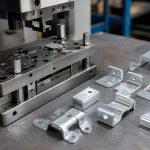
A shop doing both is normal. Bending handles the prototype and the low run; when the design stabilises and volume grows, the part moves to a progressive die. The transition is where annual volume justifies tooling amortisation – commonly 2,000 to 10,000 pieces depending on complexity.
What This Means for Buyers Sourcing Stamped Parts
The labour shortage in Western fabrication is a sourcing signal, not just an industry story. When a fabricator cannot staff a second shift, they outsource the parts that do not fit their remaining capacity.
That favours suppliers who can take on tooling risk and documentation, not suppliers who only quote a piece price. Three questions separate them.
- How is the first article measured? A supplier with CMM and a documented PPAP-style package can absorb a program transfer. One who sends a photo cannot.
- Is the tooling built in-house? A supplier who builds their own progressive dies controls the die-making process. One who buys dies is a press operator with a supply chain.
- What happens when the design changes? Die modification cost and lead time is the real risk in a transfer, and it is the number that never appears in a quotation.
Where VOLCRIX Sits
We are not a fabrication shop competing with the companies exhibiting at FABTECH. We are the supplier those shops and their OEM customers transfer volume to.
- 40 stamping presses, 5 to 200 tons, with progressive die capability
- Tooling built and maintained in-house – die design, tryout and modification under one roof
- 60+ Japanese Star Swiss machines for turned parts, 3/4/5-axis CNC for milled features
- Zeiss CMM and spectrometer per heat lot; PPAP-style first article package
- ISO 9001:2015 and IATF 16949 – the second one is what automotive transfers actually require
What we do not do: robotic bending cells for one-off parts, welding-heavy weldments, or sheet metal enclosures above a certain size. If that is what you need, we will say so rather than quote.
About VOLCRIX
VOLCRIX has made precision metal components in Yueqing, Wenzhou since 1991 — 35 years. 40 stamping presses 5-200 tons, 60+ Swiss machines, 3/4/5-axis CNC.
ISO 9001:2015 and IATF 16949. Spectrometer per heat lot, Zeiss CMM. 500+ customers in 40+ countries.
Frequently Asked Questions
What was the main theme at FABTECH 2026?
Automation aimed at the labour shortage. Qualified press brake operators and certified welders are increasingly difficult to recruit, so robotic bending cells, automatic tool changers and offline programming moved from Tier-1 automotive programs into job shops. The show ran October 21-23 at the Las Vegas Convention Center.
Does a robotic bending cell make sense for a small stamping shop?
Only above a threshold. A cell combines an industrial arm, a CNC press brake and gripper tooling, plus offline programming to keep the arm fed. It pays back when a part family repeats at volume, the blank is large enough to handle reliably, and a skilled operator is the binding constraint. Below that, the setup and programming time per part family eats the savings.
Why does labour shortage matter to a Chinese stamping supplier?
It changes what Western buyers ask for. When a fabricator cannot staff a second shift, they outsource the part rather than the process. That favours suppliers who can absorb tooling, run progressive dies and ship PPAP documentation – not suppliers who only quote a piece price.
What is the difference between robotic bending and progressive die stamping?
Robotic bending forms one part at a time on a press brake, flexible but slow per piece. Progressive die stamping runs a coil through a multi-station tool, very fast per piece but the tooling is dedicated to one part. Bending suits low volume and high mix; progressive dies suit high volume with a stable design.
How does a buyer verify a supplier actually automates, not just claims it?
Ask three things: how many presses run with coil feeders rather than hand-fed blanks, whether tooling is built in-house or bought, and how a first article is measured. A supplier who builds their own progressive dies has to control the die-making process, which is a different capability from running a press.
Need Stamped Parts From a Shop That Already Automates?
40 presses 5-200 tons · progressive dies · PPAP first article · Quote in 24h
Related Pages
- Custom Metal Stamping Parts
- Low-Volume Aluminum Progressive Dies
- Precision Stamping Tolerances
- Automotive Metal Stamping Parts
Sources
- FABTECH 2026, Las Vegas Convention Center, October 21-23, 2026
- FABTECH Leadership Exchange – State of the Metal Fabrication Business 2026
- US metal fabrication skill cluster employment data, 2026
- MetalForming Magazine – cellular robotic press brake coverage