
Machined Contacts for Industrial Connectors: Turning, Packaging and What Buyers Should Specify
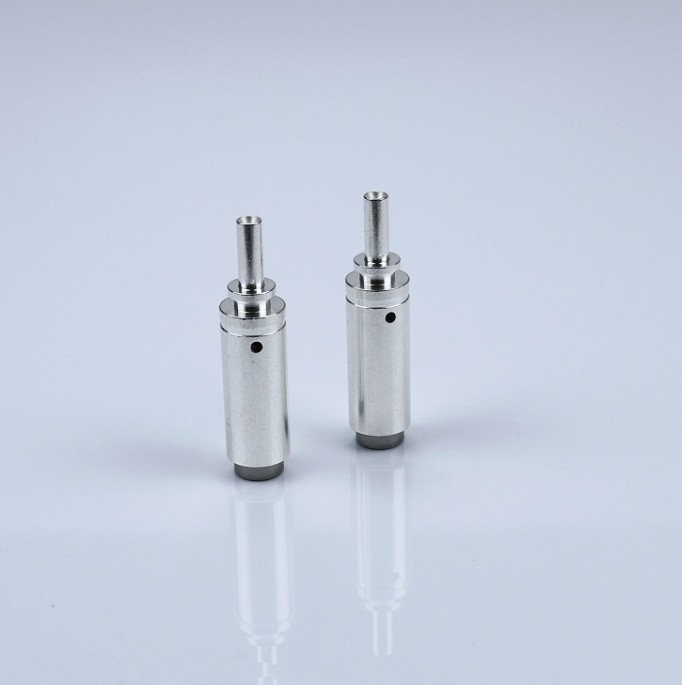
Direct answer: A machined contact is turned from solid bar on a Swiss-type lathe, giving one continuous piece of metal instead of a formed strip. That matters for three reasons: concentricity holds tighter, insertion force repeats more consistently, and no dedicated tool is needed – so 5,000 pieces is viable. The constraint most buyers discover late is packaging. Automated crimping machines want contacts on reel, and a turned contact comes off a lathe one at a time.
Need Machined Contacts for Industrial Connectors?
60+ Swiss machines · ±0.01 mm · reel or loose pack · Quote in 24h
Machined vs Stamped: The Real Difference
Both make a contact. They fail differently.
| Machined (Turned) | Stamped | |
|---|---|---|
| Starting material | Solid bar stock | Sheet strip |
| Structure | One piece, continuous grain | Formed and rolled, seam present |
| Tooling | Program only – no dedicated die | Dedicated die, $2K-50K+ |
| Volume fit | 5,000 upward, flexible | 100,000+, design frozen |
| Concentricity | Held by the spindle, typically 0.01 mm | Depends on strip feed and form accuracy |
| Plating | Barrel or rack, per lot | Strip or selective reel-to-reel |
| Packaging for automation | Loose, or on carrier tape | Reel as standard |
The last row is where projects go wrong. A buyer specifies a turned contact for quality reasons, then discovers the crimping line is set up for reel feed and cannot use a bowl feeder at the required rate.
The Packaging Problem, and Why It Is Solvable
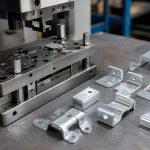
Stamped contacts leave the die attached to a carrier strip. The strip is the packaging – it feeds the crimp machine directly. A turned contact has no strip. It drops into a bin, and every subsequent step has to re-orient it.
Two solutions exist. A vibrating bowl separates and orients contacts one at a time, which is slower and can damage plated surfaces through contact-to-contact tumbling. A plastic carrier tape holds each contact in a fixed position at a fixed pitch, which feeds like a stamped reel.
The second is what automation wants, and it is an extra manufacturing step: after turning and plating, contacts are loaded into a tape. Not every turning shop offers it, and the ones that do charge for it. Ask before you specify.
What Actually Decides Contact Quality
Four parameters carry most of the risk. Everything else is secondary.
- Concentricity of pin to crimp barrel – a 0.02 mm eccentricity on a 1.5 mm pin shows up as a misaligned mating face in a multi-pin housing. Held by how the part is chucked, not by the lathe’s rated accuracy.
- Pin diameter – typically ±0.01 mm. This sets contact resistance and insertion force together; you cannot tune one without moving the other.
- Surface roughness on the mating zone – Ra 0.4 or better before plating. A rough surface survives plating and becomes the wear surface.
- Crimp barrel geometry – the wire crimp and insulation crimp are separate features with separate tolerances. A contact that passes a pull test can still fail a cross-section.
| Parameter | Typical Spec | What It Controls |
|---|---|---|
| Pin diameter | ±0.01 mm | Contact resistance, insertion force |
| Concentricity | 0.01-0.02 mm | Mating alignment |
| Surface roughness (mating zone) | Ra ≤0.4 µm | Wear, plating adhesion |
| Crimp barrel ID | Per wire gauge, ±0.02 mm | Pull strength, cross-section |
| Plating thickness | Au 0.4-1.0 µm over Ni 1.5-3 µm | Corrosion, cycles, resistance |
Alloy Choice, Briefly
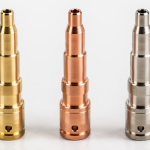
Alloy in one paragraph: brass for general purpose and cost. Phosphor bronze for socket contacts that must hold spring tension. Beryllium copper for high cycle count and vibration. Tellurium copper where high current and machinability both count. For high-current contacts the alloy and plated surface together decide temperature rise – a 2 mm brass pin and a 2 mm tellurium copper pin do not carry the same current at the same rise.
How VOLCRIX Makes Them
- 60+ Japanese Star Swiss machines – the machine type this part was designed for; bar feed to 32 mm
- ±0.01 mm on turned diameters, verified by CMM and optical comparator
- In-house tooling and cam/program development – no waiting on an outside shop for a change
- Carrier tape loading available for automation feed, quoted separately from loose pack
- Plating coordination – silver, gold, tin, nickel through qualified partners, thickness verified by XRF
- ISO 9001:2015 and IATF 16949 – the second matters if the contact goes into a vehicle harness
We do not make the connector housing, the die-cast shell, or the cable assembly. We make the turned contact, and we can supply it taped for your crimp line.
About VOLCRIX
VOLCRIX has made precision metal components in Yueqing, Wenzhou since 1991 — 35 years. 60+ Japanese Star Swiss machines, 40 stamping presses 5-200 tons, 3/4/5-axis CNC.
ISO 9001:2015 and IATF 16949. Spectrometer per heat lot, Zeiss CMM. 500+ customers in 40+ countries.
Frequently Asked Questions
What is a machined contact and how does it differ from a stamped contact?
A machined contact is turned from solid bar on a Swiss-type lathe, so the pin or socket is one piece of metal with continuous grain. A stamped contact is punched and formed from strip. Machined contacts cost more per piece but hold concentricity, finish and insertion force more consistently, and need no dedicated tool at low volume.
Why do machined contacts need reel packaging?
Automated crimping machines feed contacts either from a vibrating bowl or from a reel with a carrier strip. The reel is faster and gentler – no tumbling, no contact-to-contact damage, better positional accuracy at the crimp station. Stamped contacts have always been available on reel because they come off a strip. Machined contacts come off a lathe one at a time, so putting them on a plastic carrier tape is an extra operation that most turning shops cannot do.
What tolerance matters most on a machined contact?
Two: concentricity of the pin diameter to the crimp barrel axis, and the pin diameter itself. Concentricity drives insertion alignment in a multi-pin housing – a 0.02 mm eccentricity on a 1.5 mm pin shows up as a misaligned mating face. Pin diameter drives contact resistance and insertion force, typically held to ±0.01 mm. Surface roughness on the mating zone matters next, usually Ra 0.4 or better before plating.
Which copper alloy should I specify for a connector contact?
Brass for general purpose and cost-sensitive parts. Beryllium copper or phosphor bronze where spring force retention matters, such as socket contacts that must hold tension through many mating cycles. Tellurium copper where machinability and conductivity both count. For high-current contacts above 50 A, the alloy choice and the plated surface together decide the temperature rise, not the diameter alone.
Can machined contacts be supplied with plating?
Yes, and the plating choice is usually the customer’s call. Silver for lowest contact resistance and high current, but it tarnishes. Gold for signal contacts and low insertion force, with nickel underplate as a diffusion barrier. Tin for cost, with the caveat that tin whiskers and fretting corrosion become a risk in vibration environments. We coordinate plating with qualified partners and verify thickness by XRF.
Need Machined Contacts for Industrial Connectors?
60+ Swiss machines · ±0.01 mm · reel or loose pack · Quote in 24h
Related Pages
- Custom Electronic Contact Pins
- 10 Key Parameters for EV Charging Pins
- Swiss Turning vs Stamping
- Connector Pin Buyer Guide
- Custom Brass Turned Parts
Standards Referenced
- IEC 61984 — connectors, safety and tests
- IEC 60352-2 — crimped connections
- MIL-DTL-22520 — crimp cross-section
- ASTM B16 / B139 — brass, phosphor bronze bar
- ISO 9001 / IATF 16949