
Swiss Turning vs CNC Machining vs Metal Stamping: Which Process Is Right
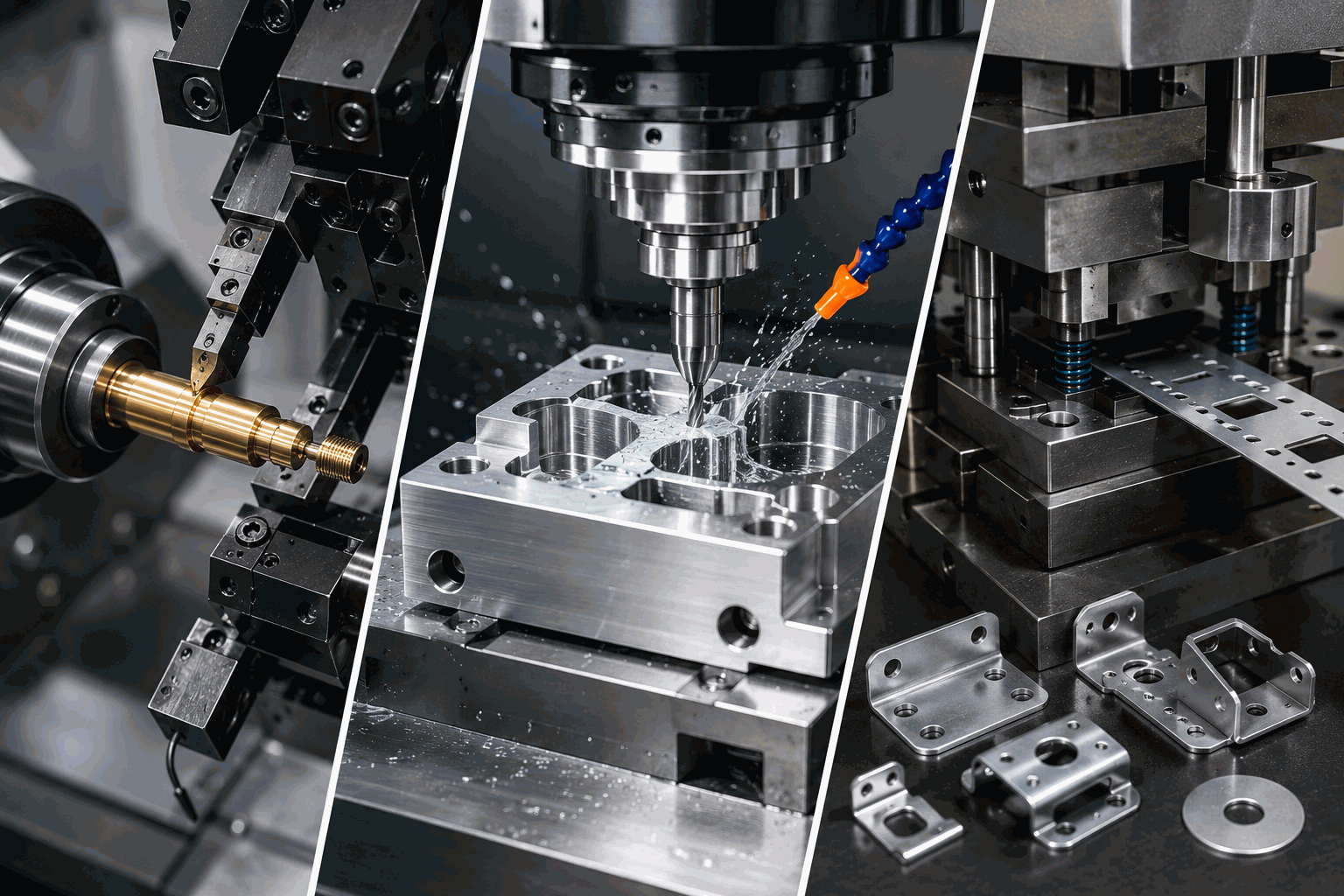
Direct answer: Swiss turning is best for small precision parts under 25 mm diameter with high length-to-diameter ratios and tolerances to plus or minus 0.01 mm. CNC machining is best for larger parts above 25 mm, complex geometries, and low-volume prototypes. Metal stamping is best for flat or formed parts in high volumes above 50,000 pieces annually. VOLCRIX operates all three processes in-house — 60+ Japanese Star Swiss turning machines, 40 stamping presses, and CNC machining capability.
Ready to Start Your Manufacturing Process Selection Project?
Free DFM review · Quote within 24 hours · Prototype in 7–15 days
Common Applications
- Precision connector pins and contacts — Swiss turning process — for small precision parts under 25 mm diameter with tight tolerances and high length-to-diameter ratios
- Complex geometric parts and prototypes — CNC machining process — for larger parts above 25 mm with complex 3D features, lower volume production, or rapid prototyping
- Flat sheet metal brackets and enclosures — metal stamping process — for flat parts formed from sheet metal strip, high-volume production above 50,000 pieces annually
- Battery contacts and electronic terminals — metal stamping process — for flat precision parts formed from copper alloy strip with high conductivity and tight bend tolerances
Manufacturing Support from VOLCRIX
- 60+ Japanese Star Swiss turning machines — for small precision parts under 25 mm diameter with high length-to-diameter ratios and tight tolerances
- 40 stamping presses from 5 tons to 200 tons — with progressive die and transfer die capability for high-volume flat part production above 50,000 pieces annually
- CNC machining centers with 5-axis capability — for complex 3D geometries, prototypes, low-volume production, and parts requiring multiple setups
- Free DFM review for process selection — engineering analysis with every RFQ to recommend optimal process per part requirements — Swiss turning vs CNC vs stamping
Buyer Checklist
- Define annual production volume — below 1000 pieces favors CNC, 1000-50,000 favors Swiss turning, above 50,000 favors metal stamping
- Specify part size and geometry — small diameter under 25 mm favors Swiss turning, large or complex favors CNC, flat 2D favors stamping
- Indicate tolerance requirements — plus or minus 0.01 mm or tighter favors Swiss turning, plus or minus 0.05 mm or looser can be achieved by any process
- Specify material — strip or coil material favors stamping, bar stock favors Swiss turning or CNC, plate or block favors CNC machining
Related Custom Manufacturing Services
- Sheet Metal Parts Manufacturing — metal stamping and sheet metal fabrication
- Swiss Turning Parts — Star Swiss turning precision parts
- Custom Precision Pins — Swiss turned connector pins
- Custom Brass Turned Parts — brass precision machining
FAQ
What is the difference between Swiss turning and CNC machining?
Swiss turning and CNC machining are both subtractive manufacturing processes that remove material from a workpiece using rotating cutting tools. The key differences: Swiss turning uses a sliding headstock that moves the bar stock past a fixed tool cluster, allowing machining of small diameter parts with very high length-to-diameter ratios up to 30:1. Swiss turning is ideal for parts under 25 mm diameter with continuous features along the length. CNC machining uses a chuck that holds the bar stock stationary while cutting tools move along multiple axes. CNC machining is ideal for larger parts above 25 mm, complex 3D geometries, and lower volume production.
When should I use metal stamping instead of machining?
Use metal stamping instead of machining when: production volume above 50,000 pieces annually makes stamping tooling investment cost-effective, part geometry is flat or 2D — bend, form, draw, pierce, blank features from sheet metal strip, material is supplied as coil or strip, tolerances can be achieved through stamping typically plus or minus 0.05 mm to plus or minus 0.1 mm. Stamping produces 10-100 pieces per minute vs 1-10 pieces per minute for machining. Avoid stamping for complex 3D geometries, low-volume production, or parts requiring tight tolerances.
What is the cost difference between Swiss turning CNC and stamping?
Swiss turning cost: 0.10-2.00 USD per piece typical for small precision parts, tooling cost 1,000-3,000 USD for new CNC Swiss turning setup, 4-8 week lead time for tooling. CNC machining cost: 1.00-20.00 USD per piece typical for prototypes and low-volume production, no tooling cost for prototypes, faster lead time 7-15 days. Metal stamping cost: 0.05-0.50 USD per piece typical for high-volume production, tooling cost 10,000-50,000 USD for progressive die, 6-12 week lead time for tooling.
Can I combine multiple processes for one part?
Yes. Combination manufacturing is common for complex parts requiring features from multiple processes. Examples: Swiss-turned connector pin with stamped retention feature, CNC machined housing with stamped cover plate, stamped bracket with machined bushing insert. Combination manufacturing allows optimal process selection per feature, reducing total cost and lead time while maintaining quality. VOLCRIX supports combination manufacturing with Swiss turning, CNC machining, and stamping capability under one roof, eliminating coordination friction and reducing total program lead time.
Ready to Start Your Manufacturing Process Selection Project?
Free DFM review · Quote within 24 hours · Prototype in 7–15 days
Certifications, Standards & Compliance
VOLCRIX products are built to international standards and customer specifications:
- ISO 9001:2015 — Quality management system
- IATF 16949 — Automotive quality management
- ISO 2768 — General tolerances for parts
- ASME Y14.5 — Dimensioning and tolerancing standard
- AIAG PPAP — Production Part Approval Process
- ASTM A484 — Stainless steel general requirements
- ASTM B49 — Copper rod drawing stock
- ASTM B301 — Free-machining brass
For specific compliance questions contact our sales team.