
Ghost Slide Rails: Concealed Track Hardware for Floating Doors
Direct answer: A ghost slide rail is a concealed top-hung track that disappears into the ceiling or door head, so the door floats with no visible hardware. The system is an aluminum track (usually 6063-T5), two or more trolleys with bearing wheels, a damper for soft close, and brackets rated typically 80 kg per panel. Governing requirements: head beam strength, channel tolerance, trolley spacing, load rating. VOLCRIX machines and stamps this hardware in Wenzhou — 35 years, ISO 9001 and IATF 16949.
Need Ghost Slide Rail Hardware?
Concealed tracks · Trolleys · Dampers · Quote in 24h
How a Ghost Door Works
A normal sliding door hangs from a track you can see, or runs on a floor track you can trip over. A ghost door does neither: the track is recessed into the head, and below the door there is only air.
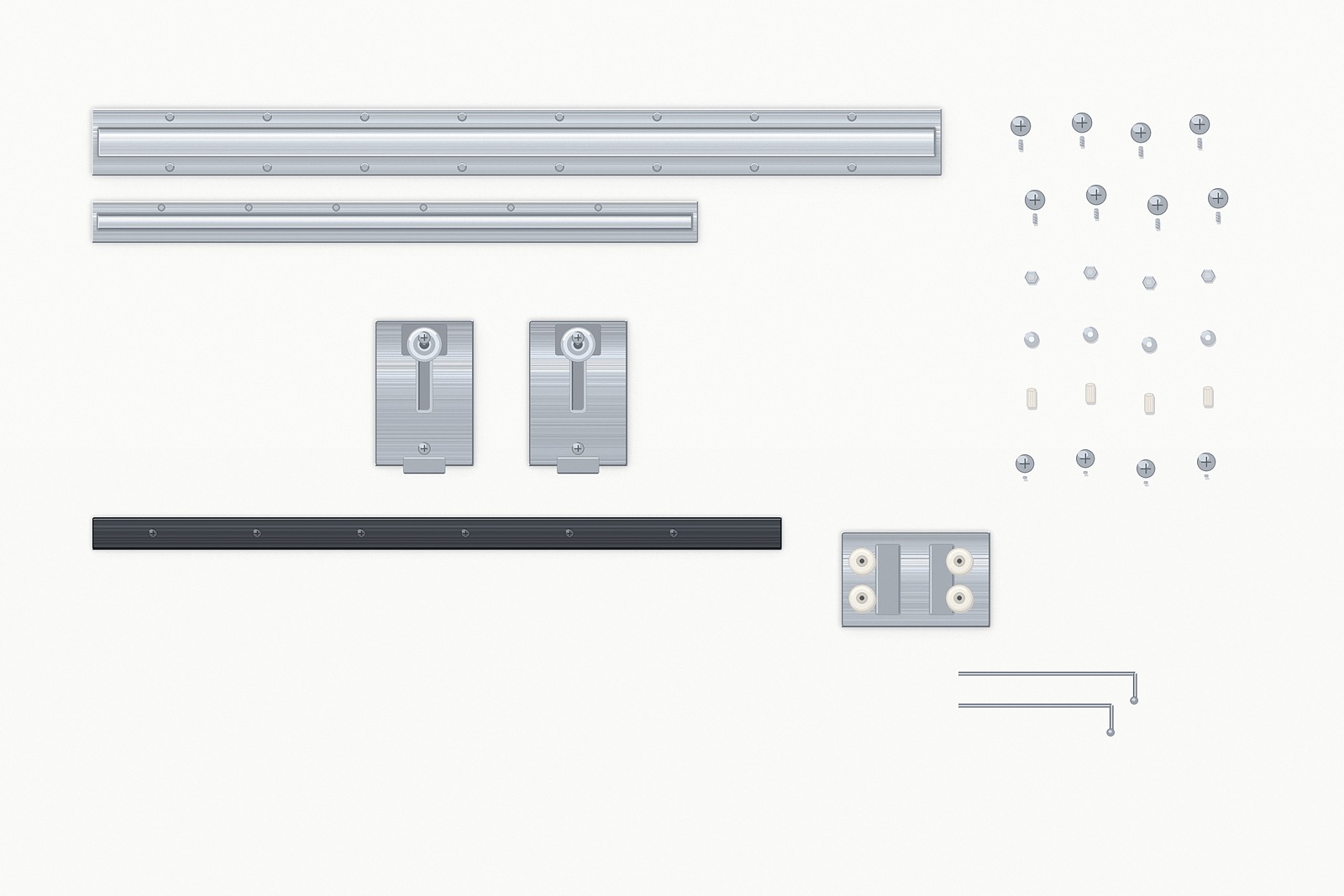
The panel hangs from two trolleys riding inside a C-channel machined into the extrusion. Because the trolley sits inside the section rather than below it, the door top finishes within a few millimetres of the ceiling.
That moves all the engineering into three places: the head beam carrying the load, the channel locating the wheels, and the trolley spacing controlling how much the panel swings at the bottom.
Load Rating and Track Section
| Element | Typical Spec | Why It Matters |
|---|---|---|
| Load rating | 80 kg/panel residential; 100-150 kg commercial | Static; solid core 900×2100 mm door runs 30-40 kg |
| Track alloy | 6063-T5; steel above 100 kg | Above 100 kg the aluminum web deflects at the trolley |
| Channel width | ±0.1 mm | Too wide, the panel wobbles; too narrow, it binds |
| Door width | 700-1500 mm residential | Wider panels need wider trolley spacing and a heavier section |
| Head clearance | 60-100 mm recess plus adjustment | The track must vanish into a structural beam, not drywall |
Trolleys: Where Stability Comes From
With no bottom track, lateral stability comes entirely from the trolley assembly.
Spacing. Trolleys close together give the panel a short lever arm, so it swings freely. For a 900 mm panel the spacing is usually 400 to 600 mm; narrow spacing on a tall door is the most common cause of a wobbling bottom.
Wheel quality. The wheel runs inside a channel the customer never sees, so it is easy to under-specify. A plain nylon wheel in an 80 kg system will flat-spot; a bearing wheel with a POM or steel tyre holds its roundness.
| Component | Options | Selection Logic |
|---|---|---|
| Wheel | POM, PA66, steel with bearing | POM for quiet residential; steel bearing above 80 kg |
| Hanger plate | Zinc-plated steel, stainless | Stainless for bathrooms and humid rooms |
| Height adjust | Eccentric cam, threaded bolt, shim | Cam gives ±3-5 mm on site without removing the door |
| Anti-jump | Retaining pin above the wheel | Stops the trolley lifting out on a slammed door |
Soft Close: Why a Ghost Door Needs One
A floating door with no bottom guide swings on its hangers. Without a damper, a pushed door reaches the jamb at speed and the impact goes into the trolleys and track. A concealed damper catches the panel in the last 50 to 100 mm.
Two details get missed. The damper needs a defined engagement zone in the track, so door width must be known at quoting stage. And a double-acting damper costs little more than single-acting and removes the asymmetric feel customers notice immediately.
What VOLCRIX Manufactures, and What We Do Not
In-House Capability
- Trolley housings, hanger plates — progressive die stamping, 40 presses 5-200 tons
- Trolley wheels — POM/PA66 molding; steel wheels with bearings
- Axles, pins, adjustment cams — 60+ Japanese Star Swiss machines
- Brackets, stops, anti-jump pins, end caps — ±0.05 mm
- Damper springs — 60 coilers, controlled rate for soft-close timing
- Finishing — zinc plating, black oxide, passivation, powder coating
- Inspection — CMM on channel-critical features, salt spray, cycle testing
We manufacture the hardware. We do not extrude the aluminum track section — that is a separate process with its own die cost, and we buy qualified profile when a program needs the complete system. We do not assemble door units.
About VOLCRIX
VOLCRIX has made precision metal components in Yueqing, Wenzhou since 1991 — 35 years. 60+ Japanese Star Swiss machines, 40 stamping presses 5-200 tons, 60 spring coilers, 20 injection molding presses, 3/4/5-axis CNC.
ISO 9001:2015 and IATF 16949. Spectrometer per heat lot, Zeiss CMM. 500+ customers in 40+ countries.
Frequently Asked Questions
What is a ghost slide rail?
A concealed top-hung track for sliding doors. The track recesses into the ceiling or door head and the trolleys ride inside it, so nothing shows below the door. Residential kits are typically rated 80 kg per panel for wood doors up to 1,500 mm wide and 2,700 mm high.
What load can a ghost door track carry?
Residential kits run 80 kg per panel, a static figure. A solid core door 900 by 2,100 mm in 40 mm board weighs 30 to 40 kg. Above 100 kg the section moves from 6063-T5 extrusion to steel or a reinforced profile, because the aluminum web deflects under trolley point load.
How much clearance is needed above a ghost door?
The track must recess fully into the head, needing 60 to 100 mm of head depth plus adjustment, and the beam must be solid enough to carry the door weight plus dynamic factor. Drywall will not hold it. Plan this at frame stage.
Can a ghost door have soft close?
Yes, and it should. A concealed damper sits in the track and catches the panel in the last 50 to 100 mm. A floating door with no bottom guide swings on its hangers, so without a damper a pushed door strikes the jamb and the impact goes into the trolleys.
Why do floating doors wobble at the bottom?
With no bottom track, lateral stability comes entirely from trolley spacing and channel clearance. Trolleys set too close, or a channel wider than the wheel, let the panel swing. Fixes: wider spacing, a floor guide pin, or holding the channel to plus or minus 0.1 mm.
Need Ghost Slide Rail Hardware?
Concealed tracks · Trolleys · Dampers · Quote in 24h
Related Pages
Standards Referenced
- EN 13126-16 — sliding hardware durability, strength, corrosion
- EN 13126 series — durability grades 3-5 (5,000-20,000 cycles)
- ASTM B117 / ISO 9227 — salt spray
- ASTM B221 — aluminum extruded shapes (6063)
- ISO 9001:2015 / IATF 16949