
Liquid Cooling Hardware for AI Data Centers: Manufacturing Guide for OEM Buyers (2026)
Direct answer: Liquid cooling hardware for AI data centers centres on four metal components — the cold plate that sits on the GPU package, the UQD quick disconnect that lets a technician pull a server without draining the loop, the manifold that distributes coolant to every rack position, and the mounting hardware that holds the assembly together. The critical manufacturing constraints are flatness on the cold plate (typically 0.05 mm, tightening to 0.02 mm at the die interface), 316L stainless for anything touching coolant, and helium leak detection down to 1×10⁻⁹ mbar·L/s. VOLCRIX manufactures these components in Wenzhou, China — 35 years, ISO 9001 and IATF 16949.
Need Liquid Cooling Hardware Manufactured?
Cold plate baseplates · UQD connector bodies · Manifolds · Mounting brackets · Quote in 24 hours
Why Liquid Cooling Stopped Being Optional
A rack that once dissipated 10 to 15 kW now dissipates 40, 80, or beyond 120 kW. Air has a volumetric heat capacity roughly 3,500 times lower than water, so the arithmetic stops working: you cannot push enough air through the cabinet without spending more energy on fans than on compute.
The Four Hardware Families in a Liquid Cooling Loop
1. Cold Plates
A cold plate is a heat exchanger bolted onto the GPU package, with coolant running through internal channels. Three methods dominate: machined channel plus bonded lid (highest performance), skived fin (high density, no bond line, constrained geometry), and tube-in-plate (cheapest, lowest performance). For 700 to 1,500 W accelerators, machined-and-bonded dominates — the hard part is not cutting channels but bonding without porosity on a baseplate flat enough for the interface material.
Typical Cold Plate Specification
- Baseplate material: C11000 copper (oxygen-free copper where hydrogen brazing is used), or 6061-T6 aluminium for lower-cost, lower-flux applications
- Flatness at die interface: 0.02 mm to 0.05 mm across the footprint
- Surface roughness: Ra 0.8 to 1.6 micrometres on the die-attach face
- Channel depth tolerance: plus or minus 0.05 mm
- Wall thickness minimum: 1.0 mm between channel and outer surface
- Bonding method: vacuum brazing, friction stir welding, or diffusion bonding
- Pressure test: 1.5x working pressure, typically 4.5 MPa for data centre loops
- Leak test: helium, down to 1×10⁻⁹ mbar·L/s for critical assemblies
- Coolant compatibility: PG25 / PG50 propylene glycol solutions, deionised water with inhibitor packages
2. UQD Quick Disconnects
A UQD lets a technician pull a server from a live rack without draining the loop. It is a small part with disproportionate consequences: a connector that drips on hot-swap takes down more compute than the server being serviced.
| Size | Nominal Bore | Typical Application | Notes |
|---|---|---|---|
| UQD02 | ~2 mm | Low-flow branch lines, single-server feeds | Compact; highest pressure drop per unit flow |
| UQD04 | ~4 mm | Server-level coolant feed and return | Most common size in rack-level deployments |
| UQD06 | ~6 mm | Rack manifold connection | Balances flow capacity against hose stiffness |
| UQD08 | ~8 mm | Trunk lines, row-level distribution | Where flow capacity dominates; consider LQC for larger |
3. Manifolds
The manifold distributes coolant across every server position in a rack. It looks like a block with holes drilled in it, and is not. Industrial-grade manifolds hold flow deviation between ports within a few percent — otherwise servers at the end of the row run hotter than those at the inlet, and the operator finds out as thermal throttling months after commissioning.
| Manifold Type | Location | Port Count | Material |
|---|---|---|---|
| In-rack manifold | Inside the cabinet, one per rack | 20-50 pairs typically | 304L / 316L stainless, sometimes aluminium |
| In-row manifold | In the row, serving several racks | Higher, with larger bore trunk | 316L stainless |
| Row distribution unit | End of row, feeds multiple in-rack manifolds | Low port count, large bore | 316L stainless |
4. Mounting Hardware
- Spring-loaded mounts: controlled compression, typically 30 to 60 psi at the die.
- Manifold brackets: so the connector body sees no bending moment from hose weight.
- Blind-mate alignment: guides the server into engagement so the UQD mates without side loading — the most common cause of seal damage in the field.
Need Liquid Cooling Hardware Manufactured?
Cold plate baseplates · UQD connector bodies · Manifolds · Mounting brackets · Quote in 24 hours
Material Selection: Why 316L Dominates
Anything touching coolant is usually 316L stainless: chloride resistance (molybdenum resists pitting as inhibitors deplete), no ion shedding (plated steel changes loop conductivity), low carbon (L holds carbon at 0.03 percent or below, preventing chromium carbide at welds), and thermal cycling stability.
| Material | Coolant Contact | Corrosion Resistance | Relative Cost | Typical Use |
|---|---|---|---|---|
| 316L stainless | Yes | Excellent — molybdenum resists chlorides | Baseline for premium | UQD bodies, manifolds, fittings, wetted cold plate parts |
| 304 stainless | Yes | Good — lower chloride resistance | 0.7-0.8x 316L | Non-critical paths, brackets, structural parts |
| C11000 copper | Yes | Good, but requires inhibitor package | Similar to 316L | Cold plate baseplates and fins — highest thermal conductivity |
| 6061-T6 aluminium | With inhibitor | Moderate — needs compatible coolant chemistry | Lowest | Cold plates in lower-flux applications, brackets, housings |
| Brass | Yes | Moderate — dezincification risk | Low | Legacy and cost-driven connector designs |
Manufacturing Processes and Where They Fail
The bonding method decides whether the cold plate can be trusted at pressure through thermal cycling.
| Method | How It Works | Advantages | Limitations |
|---|---|---|---|
| Vacuum brazing | Filler metal melts and joins the plate and lid in a vacuum furnace | Mature, high throughput, good for copper, complex internal geometries feasible | Filler can block fine channels; furnace cycle is slow; requires flux-free vacuum conditions |
| Friction stir welding | A rotating tool plasticises and consolidates the metal in solid state | No melting, so no porosity; stronger joint than brazing; excellent for aluminium; lower heat input means less distortion | Tool access required along the joint path; not suited to every geometry; slower per part |
| Diffusion bonding | Heat and pressure cause atomic diffusion across the interface | Bond quality approaches parent metal; no filler at all | Expensive, tight process window, lower throughput |
| Laser welding | Focused laser melts a local seam | Fast, low distortion, good for closures | Porosity risk; requires tight fit-up; not for hidden internal joints |
The risk is not choosing the wrong process but failing to control the one you chose. Porosity in a braze joint produces a cold plate that passes a pressure test today and weeps six months later.
Machining Precision Where It Matters
- Cold plate flatness: 0.05 mm baseline, 0.02 mm for high-power dies, verified on a CMM across the full footprint.
- Channel geometry: depth and width to plus or minus 0.05 mm so pressure drop matches prediction.
- Manifold port threads: concentric and perpendicular, or the fitting seals on one flank.
- UQD seal groove: dimensions set O-ring compression; out by 0.05 mm and it leaks or cannot latch.
Leak Testing
| Method | Sensitivity | Speed | Best For |
|---|---|---|---|
| Pressure decay | Moderate — detects gross leaks | Fast | 100% screening on simple parts |
| Bubble / immersion | Low — operator dependent | Slow | Spot checks, troubleshooting |
| Helium leak detection | 1×10⁻⁹ mbar·L/s and below | Moderate — needs vacuum or accumulation chamber | Cold plate assemblies, manifolds, critical UQD runs |
Helium detection is moving from sampling to an in-process capability: at AI hardware volumes, a leak that escapes the factory costs far more than the test that would have caught it.
What VOLCRIX Manufactures in the Loop
In-House Capability
- CNC machining: cold plate baseplates and lids, manifold blocks, bracket components — 3-, 4-, and 5-axis, with CMM verification
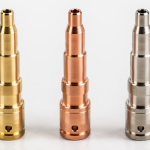
- Swiss turning (60+ Japanese Star machines): UQD and UQDB connector bodies, stainless fittings, valve components, threaded inserts
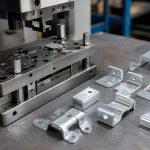
- Stamping (40 presses, 5-200 tons): mounting brackets, retention clips, contact and busbar components, aluminium and stainless up to 6 mm
- Spring coiling (60 machines): cold plate spring-loaded mounting hardware with controlled spring rate
- Injection molding (20 presses): plastic alignment guides, cable clips, non-wetted housings
- Finishing: passivation for stainless, anodising for aluminium, laser marking for traceability
- Inspection: spectrometer material verification per heat lot, Zeiss CMM dimensional inspection, pressure and helium leak testing
Where a program needs bonding outside our in-house set, we manage it through qualified partners and take responsibility for incoming inspection, leak test, and final dimensional verification.
Frequently Asked Questions
What liquid cooling components can VOLCRIX manufacture?
We manufacture the machined and formed metal components in a liquid cooling loop: cold plate baseplates and lids, UQD and UQDB connector bodies, manifold blocks and rails, rack mounting brackets, and the stainless fittings that join them.
What material is used for UQD liquid cooling connectors?
The dominant material for UQD connector bodies in data center liquid cooling is 316L stainless steel, chosen for chloride resistance and because it will not shed ions into the coolant loop the way a plated or carbon steel part would. Some manufacturers use 304 stainless for lower-cost non-critical paths, and brass appears in older or cost-driven designs.
What tolerance and surface finish do cold plates require?
The critical dimension on a cold plate is the flatness of the die-attach surface, because thermal interface material only performs as designed when the gap is uniform. Typical specifications are flatness within 0.05 mm across the footprint, surface roughness Ra 0.8 to 1.6 micrometres, and machined channel depth held to plus or minus 0.05 mm.
How do you leak test liquid cooling components?
Every liquid path component leaves our line after a pressure test at 1.5 times the working pressure, held for a defined dwell period. For components intended for high-value racks, we also provide helium leak detection, which resolves leaks down to the 1×10⁻⁹ mbar litre per second range — far beyond what pressure decay or bubble testing can detect.
Can you match the thermal performance of an existing cold plate?
We cannot guarantee thermal performance from geometry alone, because the result depends on the bonding process, the coolant, the flow rate, and the die interface material. What we can do is machine to the drawing within tolerance, control the channel geometry that drives pressure drop and heat transfer area, and supply the dimensional and leak data so you can validate on your own thermal test bench.
What is the production lead time for liquid cooling hardware?
Prototype quantities of 10 to 100 pieces run in two to four weeks from a released drawing. Production quantities of 1,000 to 50,000 pieces run in four to eight weeks depending on material, finishing, and whether a bonding or assembly step outside our facility is required.
Do you supply coolant hoses with the connectors?
No. Hoses and tubing are a separate product family with different materials, burst pressure requirements, and bend radius constraints, and we do not manufacture those. We manufacture the rigid metal components — the connector bodies, the cold plate baseplates and lids, the manifolds, and the mounting hardware.
Which liquid cooling hardware is hardest to manufacture?
The manifold block. It typically carries a dozen or more threaded ports, needs internal flow channels that cannot be inspected visually after assembly, has to keep flow deviation between ports within a few percent, and must seal under thermal cycling. A rough cast or poorly machined manifold produces uneven flow distribution that shows up months later as a hot rack, not as an obvious leak.
Related Pages
- Heavy-Duty Slide Rails for AI GPU Servers
- Micro Pogo Pin Manufacturing for AI Servers
- Humanoid Robot Joint Machining
- Precision Shafts & Turned Parts
- Quality Control
Standards Referenced
- OCP UQD / UQDB — Universal Quick Disconnect for data centre liquid cooling
- ASTM A276 / A479 — stainless steel bar, including 316L
- ASTM B152 — copper sheet, strip, plate (C11000)
- ASTM B209 — aluminium sheet and plate (6061)
- ISO 9001:2015 / IATF 16949 — VOLCRIX quality systems