
Die Casting vs CNC Machining vs Stamping: How to Choose for Aluminum & Zinc Parts
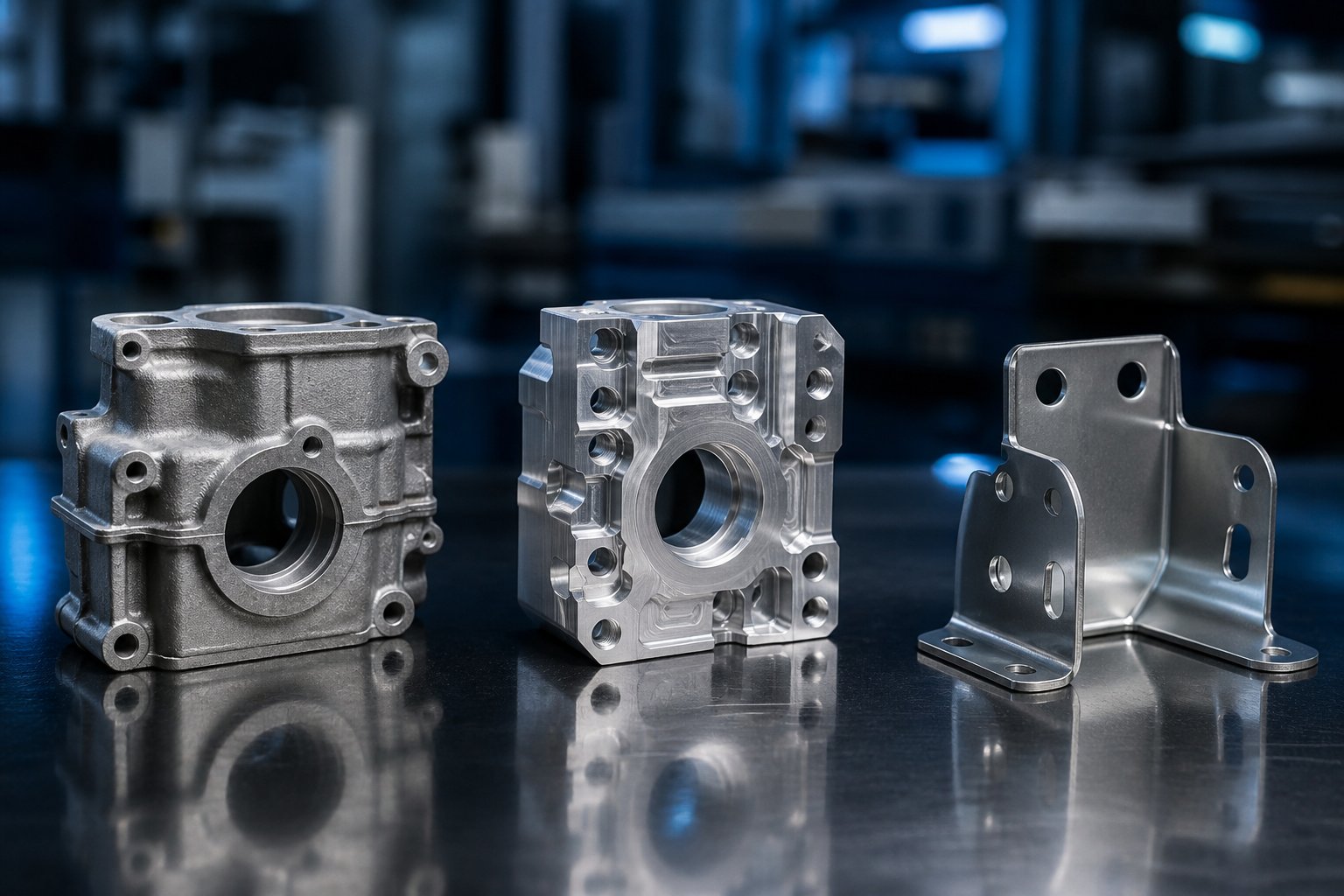
Every aluminum or zinc part request lands on the same fork: die casting, CNC machining, or stamping. Pick wrong and you pay for tooling that never pays back, or a per-part price that kills the program. The framework: die casting wins on complex 3D shapes at high volume, CNC on low volume and tight tolerances, stamping on flat or formed sheet geometry. A die casting parts OEM/ODM service that also handles machining and finishing shows where each process fits before tooling money is committed.
What Is Die Casting
Die casting forces molten metal into a hardened steel die at 10–200 MPa until the part solidifies. Hot chamber machines run zinc (Zamak 3, Zamak 5, ~420 °C melt point); the gooseneck stays in the melt, so cycles take seconds. Cold chamber machines run aluminum alloys (A380, ADC12, ~660 °C melt point), ladled into the shot sleeve each cycle.
Die casting wins when three conditions hold: a true 3D shape with internal cavities, cores, or thin walls; volume high enough to amortize the die; and walls held at 0.8–2.5 mm. As-cast surfaces run 1–3 μm Ra per ASTM B85 (aluminum) and ASTM B86 (zinc); past ~10,000 pieces a year, it is the cheapest way to make a complex metal part.
Die Casting vs CNC Machining
CNC machining is subtractive — it cuts the part from bar or billet, so there is no die and no minimum volume. Die casting is a fixed-cost game that gets cheaper per part as volume climbs. Many programs cast near-net-shape, then machine critical faces.
| Factor | Die Casting | CNC Machining |
|---|---|---|
| Tooling cost | $10k–$100k+ for the die | Fixtures and soft jaws only |
| Per-part cost by volume | Drops sharply above ~10k pcs/yr | Flat; cheapest at low volume |
| Tolerance | ~±0.1 mm (ISO 8062-3, DIN 16901) | ±0.01–0.05 mm on machined features |
| Design freedom | Internal cavities via cores and thin walls | Limited by tool access; deep internal geometry is costly |
| Lead time | 4–10 weeks for die, then fast cycles | Days from CAD to parts |
Under a few thousand pieces, machining wins on total cost. At 10k+ pieces, die casting pays for the die and undercuts machining per part. Hybrid parts — die cast body, machined sealing faces and bores — are standard in pumps and valve bodies.
Die Casting vs Metal Stamping
Stamping forms flat sheet with dies: blanking, bending, drawing, progressive-die work. It competes with die casting only where the part can be expressed as sheet geometry — a stamped bracket and a die cast bracket may do the same job, but their cost structures differ.
| Factor | Die Casting | Metal Stamping |
|---|---|---|
| Part geometry | 3D, enclosed, cored — bosses, ribs, internal passages | 2.5D sheet forms: flanges, bends, drawn cups, pierced holes |
| Wall thickness | 0.8–2.5 mm typical (zinc down to ~0.5 mm) | Sheet gauge 0.1–6 mm, uniform per blank |
| Volume economics | Tooling amortized over 10k–100k+ pcs/yr | Progressive dies need 50k+ pcs/yr; then per-part cost is the lowest of the three |
Material availability matters: stamping only works with alloys sold as sheet; die casting forms alloys that do not exist in sheet form. Closed cross-sections, cast rib patterns, or cast-in inserts rule stamping out — for sheet parts that do work as stampings, our guide to high-volume metal stamping production covers the tooling math.
When Die Casting Makes Sense for Automotive
Automotive is the largest consumer of aluminum die castings: engine blocks, transmission housings, valve bodies, oil pans, and structural brackets need complex internal geometry at OEM volume. For die casting auto parts OEM programs at 50k–500k pieces per year, the die amortizes quickly and the cast structure carries loads sheet metal cannot. A380 is heat-treatable (T5/T6), pressure-tight with proper porosity control, and about one-third the weight of the iron parts it replaces — meaningful when every kilogram counts.
Qualifying an automotive aluminum die casting parts factory runs through PPAP, IMDS, and IATF 16949 audits. Draft angles of 1–2° and uniform wall sections decide whether the die produces sound parts or scrap. Where the part works as sheet metal instead, our automotive metal stamping parts overview covers that route.
Electronics & Die Casting
Thermal and electrical needs push electronics housings toward die casting. Aluminum ADC12 conducts about 92 W/m·K, so heat sinks and LED housings shed heat through thin fins that would be expensive to machine. The same casting is a continuous conductive shell for EMI/RFI shielding, with bosses and tapped holes formed in the die.
For electronic die casting components — connector housings, RF shield frames, baseplates, power-module enclosures. Need a custom aluminum housing machined instead? We CNC machine enclosures to your drawing at any volume — volume usually justifies tooling and the as-cast surface takes plating or powder coating directly. Zinc enters for thin-wall RF gaskets where its 420 °C melt point makes hot-chamber cycles faster than aluminum. For aluminium die casting components OEM orders, we run production on your tooling with the same part-number traceability and PPAP documentation as a machined program.
Prototype Strategy
The low-risk path is CNC prototypes before any die is cut. Machine functional samples from bar stock, validate fit, tolerance, thermal performance, and assembly, then freeze the design before the 4–10 week tooling program. A flaw found in a machined prototype costs a week; the same flaw after die construction costs the tool and weeks of scrap.
Two caveats: wrought 6061 machines differently from cast A380, so confirm mechanical and thermal results against cast-material data, and lock draft angles and wall sections during prototyping. Casting simulation before steel is cut catches porosity and fill problems early.
How VOLCRIX Can Help
VOLCRIX runs CNC machining and metal stamping in-house, with finishing — plating, anodizing, powder coating — under one roof. For die casting programs, we act as your single engineering interface: we design for the process, qualify the casting supplier, machine critical features, and finish and assemble, so you approve one PPAP file instead of three vendors.
Send a drawing or a rough idea and we will tell you which process wins at your volume — and quote the other two so you can see the trade-off in dollars. Start with our die casting parts page for cast aluminum and zinc programs, or the stamping parts page when sheet geometry is the right answer.
Die Casting Services & Supplier Considerations
When you engage a die casting manufacturer or die casting supplier, the first question is whether they run a die casting factory with in-house die casting tooling, or whether they broker the work. A custom die casting partner should offer DFM feedback on wall thickness, draft angles, and die casting tolerance before you commit to die casting mold design. Most die casting OEM programs start with a die casting prototype in CNC-machined aluminum to validate the geometry, then move to production tooling once the design locks. Surface requirements matter too — die casting surface finish options include as-cast, powder coating, and CNC machining of critical faces. Whether you need zinc die casting for small intricate components or aluminum die casting for housings and brackets, the same qualification questions apply: tooling cost, sample approval, capacity, and quality system.
Die Casting vs Stamping vs Sand Casting at a Glance
Beyond die casting vs CNC machining, buyers also compare die casting vs stamping for sheet-metal-like geometries and die casting vs sand casting for low-volume large parts. Stamping wins for thin-walled formed parts at high volume; sand casting wins for one-off or very large components; die casting wins for complex 3D shapes with good dimensional consistency at medium-to-high volume. Many die cast aluminum housings and die casting heat sink designs start life as a CNC prototype from VOLCRIX, then transfer to a casting partner for production — a path we manage end to end.
For flat geometries, CNC plates machined from aluminum or steel are often the fastest path to prototype before committing to stamping tooling.
For Tier 1 programs in need of a car casting parts supplier, VOLCRIX acts as the single engineering interface — selecting qualified foundries, designing the part for castability, and machining critical post-cast features so the program reaches PPAP on schedule.
FAQ
When should I choose die casting over CNC machining?
Choose die casting when annual volume is above ~10,000 pieces, the design is a stable 3D shape with internal cavities or thin walls, and tolerance can live at ~±0.1 mm on cast surfaces. Below that, CNC is usually cheaper and faster to market.
What is the minimum order quantity for die casting?
Economic die casting starts around 10,000 pieces a year; multi-cavity dies push the floor higher because tooling scales with cavity count. Below that, machined or stamped alternatives typically win on total cost.
Can die cast parts meet tight tolerances?
Cast surfaces hold roughly ±0.1 mm per ISO 8062-3 / DIN 16901; features that need ±0.01–0.05 mm are machined after casting, following the same tolerance planning we detail in our metal stamping tolerances and quality control guide.
Does VOLCRIX offer die casting in-house?
Our in-house processes are CNC machining and metal stamping, with finishing and assembly under one roof. For die casting, we act as the single engineering interface: design for the process, qualify the foundry, machine critical features, and manage PPAP and quality end to end.
Explore die casting parts OEM/ODM service options at VOLCRIX, or get a stamped alternative quote on our stamping parts page.