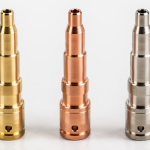


Why SMT Standoffs Are Important in PCB Assembly: Spacing, Solderability & Reliability
Direct answer: SMT standoffs (also called SMT spacers or PCB SMT standoffs) are small metal parts soldered onto the surface of a printed circuit board to lift and space a second board, shield, or heat-generating component above the primary PCB. They define mechanical clearance for shields and stacked boards, anchor through-hole leaded components during reflow, and provide a controlled standoff height that hand-assembly or wave-solder alone cannot deliver consistently. VOLCRIX machines brass and stainless SMT standoffs in tape-and-reel format for automated pick-and-place on high-mix SMT lines.
When a procurement engineer opens a drawing that says “M3 brass standoff, height 4.0 mm, tape & reel,” most of the engineering decisions have already been made — material, height, plating, packaging. What is often missed is that the standoff is not just a spacer. It is a structural element of the assembly, and the way it is machined, plated, and packaged has a direct effect on solder joint reliability, coplanarity, and reflow yield.
Across our last 12 months of production, three failure modes have shown up on customer lines that we now flag at the RFQ stage. First, coplanarity drift on a long production run — usually a plating chemistry problem, not a machining problem. Second, solder wicking up the standoff shank when paste volume is miscalibrated for the pad size — a DFM issue we resolve before tooling is quoted. Third, tape-and-reel pocket geometry that does not match the actual part — leading to mis-picks on the customer’s Yamaha or Panasonic line. Each of these is preventable with the right upfront conversation.
Common Applications of SMT Standoffs
- Board-to-board spacing on stacked PCBs. When a product has two or more PCBs that must be stacked at a precise height — IoT gateways, LED drivers, industrial controllers — SMT standoffs solder to the lower board and act as the mechanical support and alignment feature for the upper board.
- Shield-to-PCB clearance. EMI/RFI shields need a defined air gap from the PCB so they can absorb or reflect without shorting traces. SMT standoffs raise the shield above the components, typically 1.0–3.0 mm, and provide a solderable anchor so the shield is mechanically and electrically bonded.
- Heatsink and thermal interface mounting. High-power components — LED modules, motor drivers, battery management ICs — need a heatsink above them. SMT standoffs provide a controlled height for the thermal pad and let the heatsink be reflow-soldered in place without fasteners.
- Surface-mount anchoring for through-hole leads. Some legacy through-hole components (connectors, large capacitors, transformers) need a mechanical anchor on the bottom of the board so the leads do not flex during secondary assembly. SMT standoffs soldered adjacent to the through-hole pads give that anchor without redesigning the through-hole pattern.
Manufacturing Support from VOLCRIX
- Brass C3604 and C11000 copper alloy as standard. Both materials machine cleanly on Star Swiss turning with surface finishes under Ra 0.8 µm, accept tin or nickel plating without porosity, and hold ±0.05 mm on critical features. Brass C3604 (free-machining, ~3% lead) is the default for cost-driven programs; C11000 copper is specified where higher electrical or thermal conductivity is needed on the standoff itself.
- Stainless 303 and 316 for harsh environments. When the PCB is exposed to chemicals, salt spray, or autoclave sterilization (medical assemblies), stainless SMT standoffs give corrosion resistance brass cannot match. VOLCRIX machines stainless with controlled toolpath and coolant to avoid work-hardening distortion.
- Height tolerances of ±0.05 mm standard, ±0.02 mm on request. Coplanarity across the solder pad is critical for reflow yield. Each batch is inspected on a Zeiss CMM with a dedicated coplanarity program, and a Cpk report is shipped with the FAI. For high-reliability aerospace and medical programs, we routinely hold ±0.02 mm with single-point finish turning.
- Tin, nickel, gold, and matte tin plating. Reflow compatibility is plating-specific. Tin (Sn100C, SAC305-compatible) is the default for lead-free reflow; nickel underplate is added when gold is specified; matte tin is used where whiskering is a concern. Plating thickness is verified on XRF gauges at three points per batch, with a Cpk attached.
- Tape-and-reel packaging per EIA-481. Standoffs ship in 330 mm or 180 mm reels, sealed in nitrogen-purged MBB bags, with a leader and trailer for automated pick-and-place. Reels are sized to match customer feeder pitch (typically 8 mm, 12 mm, 16 mm, 24 mm). Cover tape peel strength is verified to 0.1–1.3 N per customer spec.
SMT Standoff Buyer Checklist
- Mark all critical dimensions in the drawing — height, pad diameter, coplanarity, and base flatness. These four dimensions drive reflow yield. If the drawing only specifies height, the supplier will quote to ±0.10 mm and the shields will not sit flat after reflow. The pad diameter controls paste volume; base flatness controls how the standoff seats during placement.
- Confirm whether the standoff will be soldered with lead-free SAC305 paste or Sn63/Pb37. Plating must match the reflow profile. Tin plating on brass is fine for SAC305; tin-lead components need a tin-lead plating to avoid bismuth embrittlement. Matte tin over nickel is preferred for aerospace programs where whiskering is a concern.
- Specify whether the standoff must be picked from tape-and-reel or waffle tray. Tape-and-reel adds tooling cost for the pocket design but eliminates manual handling on the SMT line. Waffle tray is cheaper per part but slower on high-mix lines. For high-volume runs above 50,000 pieces per month, tape-and-reel is almost always cheaper on a total-cost basis.
- For medical or automotive applications, specify the alloy and certification requirement. Medical PCBs often need ISO 13485 traceability; automotive programs need IATF 16949 PPAP documentation. VOLCRIX provides both — confirm with the drawing which certs are required before quoting.
- For through-hole anchors, specify the inner diameter and roundness. A loose inner diameter means the through-hole lead will rock during wave solder, breaking the joint. Inner diameter tolerance of ±0.05 mm is typical; ±0.025 mm is achievable on Swiss turning.
Related Custom Manufacturing Services
VOLCRIX supplies SMT standoffs alongside other precision electronic components. Browse our related manufacturing services:
Custom SMT Standoffs & PCB Mounting Hardware | Precision Turned Parts & Swiss Turning | Custom Pins & Contact Pins Manufacturing
Frequently Asked Questions About SMT Standoffs
What is the difference between an SMT standoff and a through-hole standoff?
An SMT standoff is designed for surface-mount reflow soldering — flat base pad, low profile, packaged in tape-and-reel. A through-hole standoff is taller, has a barbed or knurled shank, and is press-fit or wave-soldered into a plated through-hole. SMT standoffs are used when the assembly must be processed in a single SMT reflow pass; through-hole standoffs are used when the standoff itself must bear mechanical load or thread onto a mating fastener.
What materials work best for SMT standoffs?
Brass C3604 (free-machining) is the default — it cuts cleanly, plates well, and holds tolerances at the lowest cost. Copper C11000 is used when higher electrical or thermal conductivity is needed. Stainless 303 or 316 is specified for medical, marine, or chemical-exposure assemblies. VOLCRIX machines all four materials on Swiss turning with controlled coolant and toolpath to avoid work-hardening on stainless.
What plating is required for lead-free reflow?
For lead-free SAC305 reflow (peak ~245 °C), matte tin plating over a nickel underplate is standard. Bright tin is acceptable but more prone to whiskering. Gold over nickel is used for high-reliability aerospace and medical applications. VOLCRIX supplies tin (Sn100C-compatible), nickel, gold, and matte tin plating per ASTM B545, with plating thickness verified on XRF gauges.
What is the minimum order quantity for custom SMT standoffs?
For tape-and-reel packaged custom standoffs, VOLCRIX typical MOQ is 5,000 pieces per part number, with prototype runs of 500–1,000 pieces available for DFM validation. Prototype runs ship in waffle tray; production runs convert to tape-and-reel once the design is frozen.
What tolerances can VOLCRIX hold on SMT standoff height?
Standard tolerance is ±0.05 mm on height and pad diameter. Tight tolerance of ±0.02 mm is achievable with single-point finish turning and CMM inspection, with a Cpk report attached to the FAI. Coplanarity across the solder pad is held to 0.10 mm or better per batch.
Can VOLCRIX supply custom tape-and-reel packaging?
Yes. VOLCRIX designs carrier tape pockets per EIA-481, with cover tape sealed and reels labeled to customer spec. Reel diameter is typically 330 mm for high-volume runs or 180 mm for prototype runs. Each reel is nitrogen-purged in an MBB bag with desiccant and humidity indicator card.
Do SMT standoffs need to be UL or RoHS certified?
RoHS compliance is mandatory for any SMT component shipping into the EU. VOLCRIX SMT standoffs are RoHS-compliant by default — brass and stainless base materials, lead-free plating. UL certification is required only when the standoff itself is part of a UL-listed assembly; in that case, the customer provides the UL file number and VOLCRIX references it on the certificate of conformance.
How does VOLCRIX verify coplanarity on SMT standoffs?
Coplanarity is checked on a Zeiss CMM with a dedicated macro that measures the four corner points of the solder pad relative to a reference plane. Cpk is calculated per batch. For high-reliability programs, we also run a 100% vision inspection on a Keyence system before tape-and-reel packaging.
Certifications, Standards & Compliance
VOLCRIX SMT standoffs and PCB mounting hardware are built to the following international standards and customer specifications:
- ISO 9001:2015 — Quality management system across all manufacturing processes
- IATF 16949 — Automotive quality management (replaces ISO/TS 16949)
- IEC 60352-5 — Press-fit terminations for through-hole PCB connections
- ASTM B545 — Standard specification for electrodeposited tin coatings
- EIA-481 — Carrier tape and reel packaging standard for SMT components
- RoHS 2 (EU 2015/863) — Restriction of hazardous substances in electrical equipment
- REACH (EC 1907/2006) — Registration, evaluation, authorization of chemicals
- ISO 13485 — Medical device quality management (for medical PCB assemblies)
For specific compliance questions (conflict minerals, country-of-origin, REACH SVHC declarations), contact our sales team with your drawing and requirements.