
Progressive die stamping, deep draw stamping, and single-station stamping are the three most common processes for producing custom stamped parts — and choosing between them affects your tooling cost, per-part price, and lead time more than almost anything else. This guide explains the differences, when to use each, and how to decide with your manufacturer.
Progressive Die Stamping
For high volume stamping of complex parts, progressive dies hold stamping tolerances of ±0.01 mm on critical features, which is why they’re the default for automotive and electronics components. Tooling cost is higher, but the per-part economics win at scale.
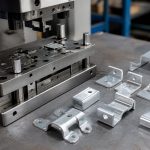
Progressive die stamping feeds a metal strip through a series of stations in a single press stroke cycle. Each station performs an operation — piloting, blanking, forming, coining, tapping — and the part is completed at the final station. Because all operations happen in one pass, progressive dies deliver high volume, tight tolerance, and consistent quality.
- Best for: complex parts with multiple features, high volume (50,000+), tight tolerances
- Tooling cost: highest of the three — the die is large and complex
- Per-part cost: lowest at volume — the tooling amortizes over the run
- Lead time: longest to tool (typically 4-8 weeks for a new die)
Deep Draw Stamping
Deep draw stamping stretches sheet metal into seamless, hollow 3D shapes — battery cans, housings, shells, and pressure vessels. The punch pushes the blank into a die cavity over one or more draws. Wall thickness stays close to the original sheet, and the result has excellent strength and leak resistance.
- Best for: cylindrical or boxed hollow parts, seamless enclosures, battery components
- Tooling cost: moderate — dies are simpler than progressive but multiple draw stages may be needed
- Per-part cost: low-to-moderate depending on draw depth
- Key consideration: material formability matters — deep draw requires ductile materials with controlled temper
Single-Station Stamping
Single-station (or compound) stamping uses one die and one press stroke to produce a part — typically for simpler geometries or lower volumes. Tooling is quick and inexpensive to build, making it ideal for prototyping, short runs, and parts with few features.
- Best for: simple parts, low-to-medium volume, prototyping
- Tooling cost: lowest of the three
- Per-part cost: higher at volume — manual handling and slower cycle times
- Lead time: fastest to tool (1-3 weeks)
How to Choose: A Decision Guide
Stamping die design is where the decision is really made — feature count, material thickness, and tolerance all drive whether a single-station or progressive die is more economical. Stamping brackets and stamping terminals are classic examples: simple brackets often use single-station tooling, while terminals with multiple bends and tight tolerances justify progressive dies at volume.
| Your Situation | Recommended Process |
|---|---|
| Annual volume under 10,000, simple part | Single-station |
| Volume 10,000-50,000, moderate complexity | Single-station or simple progressive |
| Volume 50,000+, multiple features, tight tolerance | Progressive die |
| Seamless hollow part (can, housing, battery shell) | Deep draw |
| High volume + deep hollow form | Deep draw with progressive transfer |
Cost Comparison: Tooling vs Per-Part
The classic trade-off: progressive die costs more upfront but less per part; single-station costs less to tool but more per part. At 50,000 parts, the per-part difference can be significant — the progressive route typically wins at high volume, while single-station is cheaper for small runs. Deep draw sits in between, with cost driven mainly by draw depth and material.
Ask your manufacturer for both tooling cost and per-part price at your expected volume — that’s the only way to compare fairly.
Stamping vs Machining: Which Process for Your Part?
Sheet metal stamping materials — steel, stainless, aluminum, and copper alloys — behave differently from bar stock used in machining. See our metal stamping materials guide for grade-by-grade selection advice. For low volume stamping or prototyping, single-station tooling is the fastest and cheapest way to validate a design before committing to high volume stamping with progressive dies.
When a part could be made either way, the deciding factors are volume, material, and geometry. Stamping wins at high volume with thin sheet materials — per-part cost drops dramatically. CNC machining wins for low volume, thick sections, and features that can’t be stamped (deep threads, tight internal geometries). For connector pins and terminals, stamping and Swiss turning often compete — see our Swiss turning vs stamping comparison.
Custom Stamping at VOLCRIX
VOLCRIX runs presses up to 200 tons with progressive, deep draw, and single-station capability. We design and maintain dies in-house, support prototypes through mass production, and inspect with Zeiss CMM. Materials include steel, stainless, aluminum, copper alloys, and brass — with full material certificates.
Send us your drawing with your target volume and we’ll recommend the right process, provide tooling and per-part pricing, and confirm lead time within 24 hours.
What is the difference between progressive die and deep draw stamping?
Progressive die stamping feeds a strip through multiple stations to form complex flat or formed parts in one pass. Deep draw stamping pushes sheet metal into a die cavity to create seamless hollow shapes like cans and housings. Progressive is best for high-volume complex parts; deep draw is for hollow, seamless geometries.
Is progressive die stamping cheaper than single-station?
At high volume, yes — the higher tooling cost amortizes over the run and per-part cost drops well below single-station. At low volume, single-station is cheaper because tooling is minimal. The crossover typically lands around 10,000-50,000 parts depending on complexity.
What is the minimum order quantity for stamping?
We support flexible MOQs — from prototypes and short runs to high-volume mass production. The right process (single-station vs progressive) depends on your volume and part complexity; we’ll recommend the most cost-effective approach.
Can deep drawn parts be made from stainless steel?
Yes. Stainless 301 and 304 are commonly deep drawn for corrosion-resistant housings and shells. Material temper and formability are critical — we’ll advise on the best grade for your draw depth.
How long does it take to build a stamping die?
Single-station dies typically take 1-3 weeks; progressive dies 4-8 weeks depending on complexity. We build and test dies in-house, so lead time is controlled and verified before production starts.
Need custom stamped parts for your project? View our metal stamping capabilities →