
How to Source CNC Turned Parts from China: A Practical Guide for OEM Buyers
Direct answer: Sourcing CNC turned parts from China requires evaluating suppliers on ISO 9001 or IATF 16949 certification, evidence of in-house CMM and spectrometer inspection, Star Swiss turning machine count, and customer references in your industry. Request FAI samples and PPAP documentation before committing. VOLCRIX has supplied CNC turned parts to OEM buyers in automotive, EV charging, aerospace, and medical industries since 1991 from Yueqing, Wenzhou.
Ready to Start Your CNC Turned Parts Sourcing Project?
Free DFM review · Quote within 24 hours · Prototype in 7–15 days
Common Applications
- Automotive precision turned components — for fuel injection systems, ABS valve bodies, sensor housings, EV battery contact pins, and EV charging connector pins requiring tight tolerance precision machining
- Industrial valve and fitting bodies — for hydraulic valves, pneumatic fittings, fluid control components, and instrumentation bodies requiring stainless steel 316 or brass C36000
- Medical device components — for surgical instruments, diagnostic equipment housings, dental implant parts, and optical instrument bodies requiring 304 or 316 stainless
- Electronic connector pins and contacts — for PCB headers, spring-loaded test pins, pogo pins, battery contacts, and EV charging connector contacts
Manufacturing Support from VOLCRIX
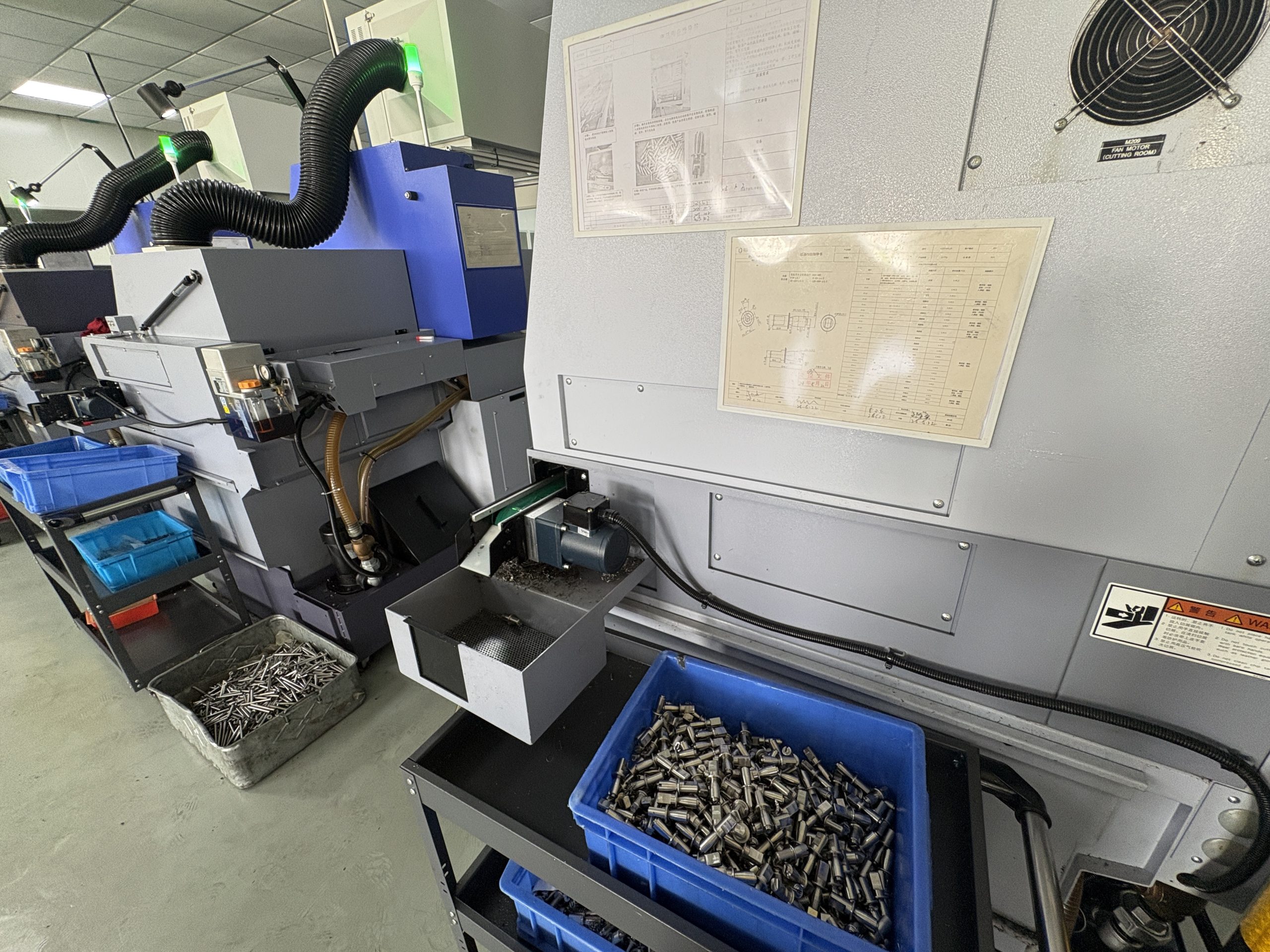
- 60+ Japanese Star Swiss turning machines — for precision turned components from 0.5 mm to 25 mm diameter range with plus or minus 0.01 mm tolerances
- IATF 16949 automotive quality system — with PPAP submission capability for OEM Tier 1 and Tier 2 supplier relationships
- In-house metrology lab — with Zeiss CMM, spectrometer, surface roughness testers, plating thickness gauges, and hardness testers
- Full material traceability — per IATF 16949 with raw material heat lot traceability, processing records, FAI documentation per shipment
Buyer Checklist
- Verify IATF 16949 or ISO 9001 certification is current and covers your product category through the IATF global oversight database
- Request sample FAI report and material certificates for similar parts to verify the supplier inspection capability
- Ask for customer references in your industry and contact them directly to verify on-time delivery and quality consistency
- Confirm equipment list — Star Swiss turning machines with current model year, in-house CMM, spectrometer, and plating capability
Related Custom Manufacturing Services
- Custom Precision Pins — connector pins, contact pins, spring pins
- Custom Precision Shafts — Swiss turned shafts
- Stainless Steel Turned Parts Guide — stainless steel grades and machining
- Custom Brass Turned Parts — brass precision machining
FAQ
What certifications should a Chinese CNC turning supplier have?
Minimum certifications for CNC turning suppliers exporting to North America and Europe: ISO 9001:2015 quality management system. For automotive programs: IATF 16949 (the automotive industry quality standard replacing ISO/TS 16949 in 2016). For aerospace: AS9100. For medical devices: ISO 13485. For defense: Nadcap for special processes. For environmental compliance: ISO 14001. Verify certifications through the certification body database (e.g. iatfglobaloversight.org for IATF, iso.org for ISO) — request the certificate PDF and check it covers your product category and is currently valid.
How do I evaluate a CNC turning supplier in China?
Evaluate on five criteria: certifications (ISO 9001 minimum, IATF 16949 for automotive), equipment (Star Swiss turning machines with current model year, in-house CMM, spectrometer, plating capability), inspection capability (sample FAI report, dimensional inspection data, material certificates per heat lot), experience (minimum 10 years in CNC turning, customer references in your industry), communication (English-speaking engineering and sales team, response time under 24 hours). Request supplier audit before committing to volume orders.
What is the typical lead time for CNC turned parts from China?
Prototype lead time: 7-15 working days after drawing approval. Production lead time: 15-25 working days for established tooling. New tooling setup: 4-6 weeks for high-volume progressive die stamping or 1-2 weeks for CNC Swiss turning setup. Shipping lead time depends on mode: air freight 5-7 days, sea freight 25-35 days door-to-door. Total timeline including RFQ, DFM review, quote approval, sample production, and shipping: 2-5 weeks for prototypes, 6-10 weeks for first production delivery.
What are the common risks when sourcing CNC turned parts from China?
Common risks: quality inconsistency (parts meet drawing but vary batch-to-batch), communication delays (language and time zone), IP protection (design drawings could be shared), tooling investment loss (if program is cancelled), shipping damage (parts damaged in transit), hidden costs (tooling, sampling, inspection surcharges). Mitigations include: AQL sampling and SPC data, NDA and supplier audit, tooling ownership contract, proper packaging and Incoterms, detailed quotation review.
Ready to Start Your CNC Turned Parts Sourcing Project?
Free DFM review · Quote within 24 hours · Prototype in 7–15 days
Certifications, Standards & Compliance
VOLCRIX products are built to international standards and customer specifications:
- ISO 9001:2015 — Quality management system
- IATF 16949 — Automotive quality management
- ASTM A484 — Stainless steel general requirements
- ASTM B49 — Copper rod drawing stock
- ASTM A240 — Stainless steel plate
- DIN 17440 — German stainless steel standard
- ISO 2768 — General tolerances for parts
- AIAG PPAP — Production Part Approval Process
For specific compliance questions contact our sales team.