
Custom Large Tonnage Stamping Parts: Heavy-Duty Progressive Die & Transfer Die Manufacturing
Direct answer: Custom large-tonnage stamping parts are heavy-gauge metal components produced on stamping presses rated 400 tons and above (typically 630-ton, 800-ton, and 1,000-ton machines) using progressive dies or transfer dies for high-volume production. VOLCRIX runs 40 stamping presses from 5 to 630 tons, holds ±0.01 mm tolerances on critical features, and supports IATF 16949 programs for automotive structural brackets, battery cell housings, server rail components, and heavy electrical contacts that lighter presses cannot form in one draw.
Large-tonnage stamping is a different engineering problem from precision micro-stamping. The press tonnage, die material, blank holder force, lubrication strategy, and springback compensation all change as material thickness and part size increase. This guide covers when to use a large-tonnage press, how to design for it, and what a buyer should audit before releasing a heavy-stamping RFQ.
Common Applications
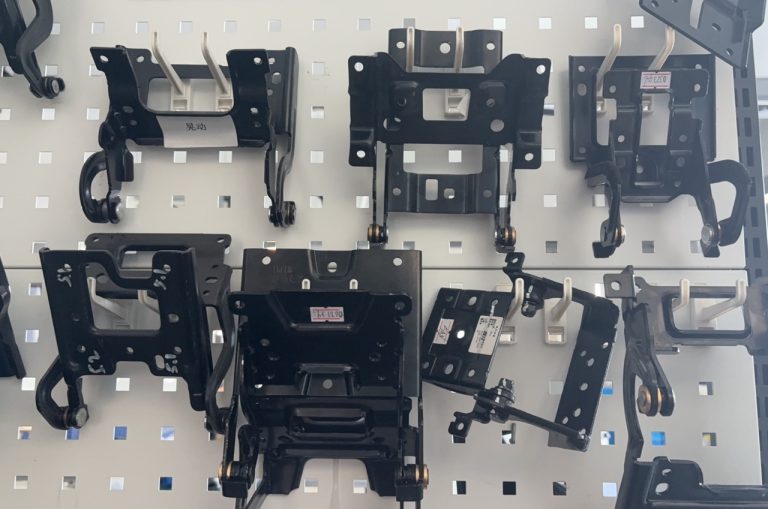
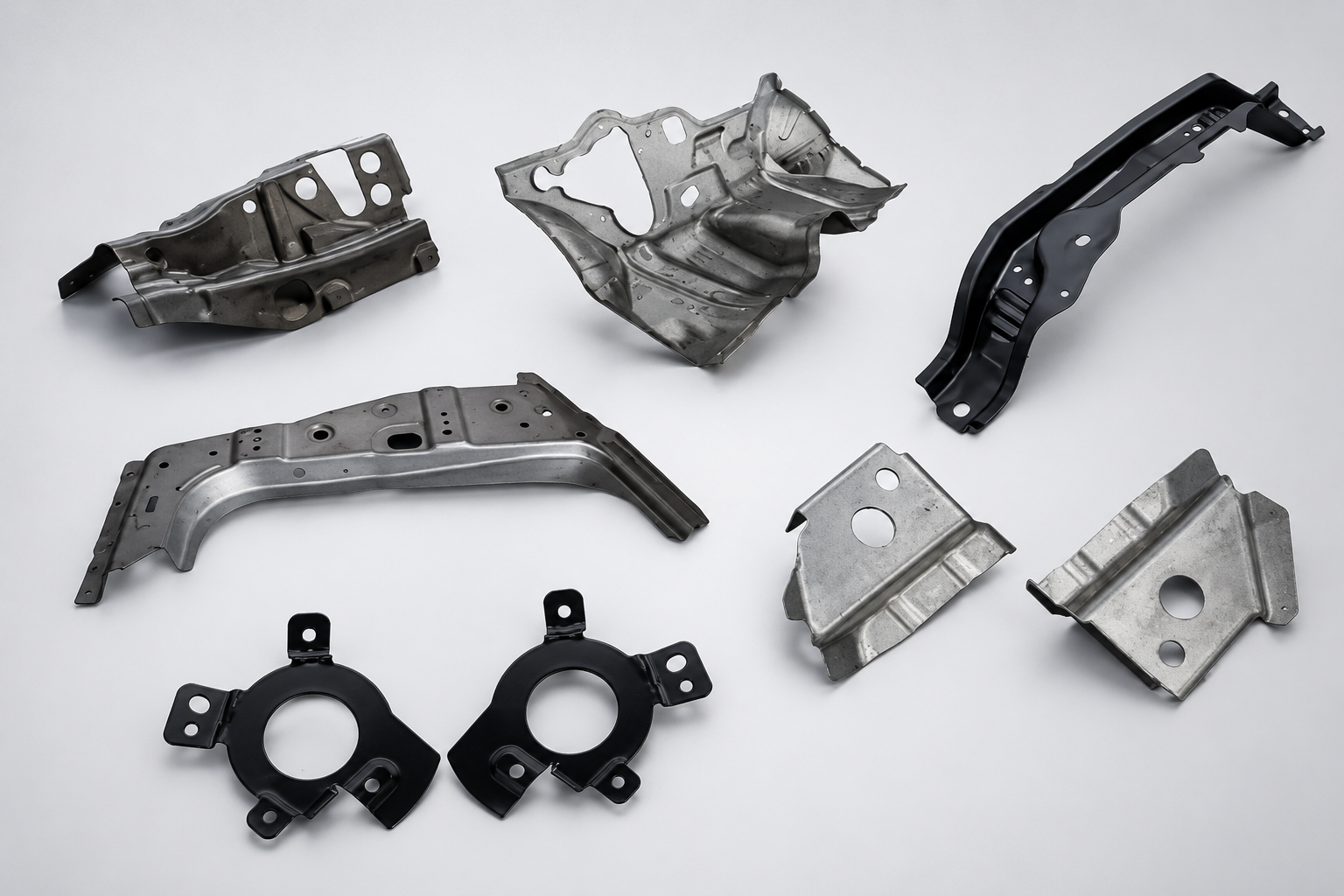
- Automotive structural brackets — body-in-white reinforcement brackets, seat rail frames, battery tray cross members, and chassis plates in 1.5-6 mm high-strength steel, often HSLA 340/420/590 and advanced high-strength steel (AHSS) up to 1,500 MPa tensile.
- EV battery and motor laminations — motor lamination stacks, battery cell housings, busbar plates, and prismatic cell lids in 0.25-2 mm silicon steel and aluminum 3003/5182/6061.
- AI server rail and rack components — sliding rails for 1U/2U/4U servers, rack-mount brackets, and chassis rails in cold-rolled steel and zinc-plated finishes for data-center infrastructure.
- Heavy electrical contacts and shunts — copper and brass shunts, EV charging contact plates, busbar terminals in C11000 / C19400 / C26000, often requiring silver plating after forming.
- White goods and HVAC components — compressor shells, motor laminations, mounting plates, and heat-exchanger end caps in cold-rolled and stainless steel.
- Industrial machinery covers and frames — equipment enclosures, support brackets, mounting plates in 1.5-4 mm steel, often paired with welding and assembly operations downstream.
Manufacturing Support from VOLCRIX
- 40 stamping presses from 5 to 630 tons — gap-frame OBI presses for small parts, straight-side presses for large-format progressive and transfer die work, including a 630-ton press for automotive structural components and EV battery plates.
- Progressive die and transfer die capability — in-house die design, CNC die tryout, and production die validation; both coil-fed progressive dies (for high-volume small-to-medium parts) and transfer dies (for large deep-draw parts that do not lend themselves to strip layout).
- Material handling for heavy coils — straighteners, coil cradles up to 5-ton capacity, and servo feeders to keep thick or high-strength coil stock flat and dimensionally stable at the die.
- Inline and offline inspection — Zeiss CMM, optical comparators, surface roughness and coating-thickness testers, plus a spectrometer for incoming coil chemistry verification per heat lot.
- Welding, assembly, and finishing coordination — MIG/TIG and resistance welding for sub-assemblies, plus plating (zinc, tin, nickel, silver), powder coating, and e-coating through audited sub-suppliers.
Large-Tonnage Stamping — Buyer Checklist
- Mark material grade, thickness, and tensile on the drawing — for HSLA and AHSS, call out the exact grade and coating (galvannealed, hot-dip galvanized, or bare); 340 vs 590 MPa behaves very differently under the same press.
- Specify critical flatness and dimensional tolerances with datums — large stamped panels are tolerant of cosmetic waviness but intolerant of hole pattern position; mark hole location tolerances to true position, not plus or minus.
- Confirm press tonnage before tool build — for a 2 mm HSLA 420 draw 200 mm deep, a 200-ton press is under-rated; running it on the wrong press ruins the die and the lot.
- Review springback compensation at the DFM stage — AHSS parts spring back 1-3 degrees; the die must be designed with over-bend geometry, not added at tryout.
- For coated or plated materials — call out the coating type and weight (e.g., GA60, EG60) and any cosmetic zones; powder build-up on the die from zinc coatings is a common line-stop cause.
Press Selection Guide
| Press tonnage | Typical part size | Typical material thickness | Common applications at VOLCRIX |
|---|---|---|---|
| 5-60 ton | Under 100 mm | 0.1-1.0 mm | Connector contacts, SMT shield cans, small terminals |
| 60-200 ton | 100-300 mm | 0.5-2.5 mm | Heat sinks, brackets, electrical shunts, AI server rails |
| 200-400 ton | 200-500 mm | 1.0-3.0 mm | Automotive brackets, EV battery plates, motor laminations |
| 400-630 ton | 300-800 mm | 1.5-6.0 mm | Battery trays, structural reinforcements, deep-drawn covers |
| 800+ ton | 500 mm and up | 2.0-8.0 mm | Large body-in-white panels, heavy industrial frames (subcontracted) |
Progressive Die vs Transfer Die for Large Parts
For large-tonnage stamping, the die architecture decision is as important as the press itself. A progressive die carries the strip through multiple stations in one die, with the part still attached to the strip until the final station. A transfer die moves individual blanks between stations using mechanical fingers or a transfer bead. Each approach has a sweet spot:
Progressive die is right when the part can be laid out efficiently in a coil-fed strip, the part is small enough that the strip width stays manageable (typically under 600 mm), and lot sizes are large enough to amortize the die. Material utilization is driven by strip layout, and pilot holes or a carry tab keep the strip registered between stations. The advantage is one continuous cycle — high throughput, no manual handling.
Transfer die is right when the part is too large for efficient strip layout, the part needs multiple independent draws that cannot happen sequentially in a strip, or the geometry forces blanks to be reoriented between operations. Transfer dies cost more and run slightly slower per stroke, but they open up part geometries a progressive die cannot reach. For large automotive structural parts and deep-drawn battery housings, transfer dies are the standard answer.
For mixed programs, VOLCRIX runs both: progressive for AI server rails and electrical shunts, transfer for battery plates and structural brackets. The decision is made at DFM, not after the die is built.
Material Considerations for Large-Tonnage Stamping
Material choice changes everything once you cross into large-tonnage work. HSLA 340, 420, and 590 are common automotive structural grades that demand higher press tonnage than mild steel of the same thickness — a 2 mm HSLA 420 part may need 30-50% more tonnage than the same part in DC04 mild steel. AHSS grades (DP600, DP780, TRIP590) push that further, and martensitic grades above 1,000 MPa can only be formed on heavy presses with controlled draw beads and generous die radii.
Coatings add another layer. Galvannealed (GA) and electrogalvanized (EG) steels protect against corrosion but build up zinc on the die over time, requiring more frequent die polishing and changing the lubrication strategy. Aluminum 5182 and 6061 are common for battery enclosures and motor housings — they draw well but spring back aggressively and need over-bend compensation in the die.
The single most common failure on a new large-tonnage program is trying to run a high-strength material on the wrong press or with the wrong die clearance. Confirm the press rating at the RFQ stage, not at the first sample.
Industry Context Buyers Should Know
The automotive industry’s shift to high-strength steel bodies and battery-electric platforms has reshaped the large-tonnage stamping market in the last decade. In 2015, a typical body-in-white used about 15% high-strength steel by weight; in 2025 that number is closer to 45-55%, with electric SUVs reaching 65% to maximize range through mass reduction. Every percentage point of high-strength steel requires more press tonnage, more sophisticated die work, and tighter process control than mild steel of the same gauge.
At the same time, EV battery enclosures and motor laminations have created entirely new large-tonnage programs that did not exist for ICE vehicles. A prismatic battery cell lid or a motor lamination stack is now a high-volume stamping part, and the supply chain has had to add capacity — particularly in 400-630-ton presses with high-tonnage transfer dies.
Buyers who spec the right press and die combination up front avoid the most common delays on these programs. Buyers who treat a structural stamping part like a simple sheet-metal bracket end up with two months of die tryout instead of three weeks.
Related Custom Manufacturing Services
Stamping Parts | Sheet Metal Parts | CNC Machined Parts | Precision Machining | Laser Marking
Authority Summary
FAQ — Large-Tonnage Stamping
What press tonnage do I need for a 3 mm steel structural bracket?
For a 3 mm HSLA 420 or similar high-strength steel structural bracket with a 200-400 mm footprint, plan on a 400-630 ton press. Lower-tonnage presses will not develop enough forming force, and trying to compensate with over-bending or multiple hits risks cracking and die damage. Confirm the press rating at RFQ stage; do not wait until die tryout.
When should I choose a transfer die over a progressive die?
Choose transfer die when the part is too large for efficient strip layout (typically footprint over 300-400 mm), when the part needs multiple independent draws or operations that cannot happen in a strip, or when the part must be reoriented between operations. Progressive dies are cheaper and faster for small-to-medium parts in coil-fed strip layouts; transfer dies open up geometries a progressive cannot reach.
What is the typical tolerance on a stamped structural bracket?
Standard tolerance is plus or minus 0.1 mm on small features and plus or minus 0.2-0.5 mm on overall dimensions, with tighter plus or minus 0.01 mm achievable on critical hole patterns when the die is built with precision pilots and guides. For tight hole position, specify true position with a datum; do not rely on a plus or minus callout, which the die cannot hold across thermal growth.
Can VOLCRIX run 1,000-ton stamping?
VOLCRIX’s in-house press line tops out at 630 tons, which covers the majority of automotive structural and EV battery programs. For larger parts that need 800-1,000+ ton presses, we coordinate production with audited partner presses under signed quality and capacity agreements, with our die tryout and process engineering driving the program.
What high-strength steel grades can VOLCRIX form?
HSLA 340, 380, 420, and 590 are routine. Advanced high-strength steel grades including DP600, DP780, DP980, TRIP590, and CP800 are run on heavy presses with controlled draw beads and lubrication. Martensitic grades above 1,000 MPa are quoted case-by-case with a tooling review because die wear and springback behavior require a controlled approach.
How long does a large-tonnage die take to build?
A new progressive or transfer die for a large-tonnage program typically takes 10-14 weeks from approved design to first sample, depending on die size and station count. Add 2-4 weeks for tryout, FAI, and Cpk study before SOP. If you have a hard launch date, share it at RFQ — die-build scheduling is the most common cause of program delays.
What is springback and how is it handled?
Springback is the elastic recovery that causes a formed part to bend back slightly toward its original shape after the press releases it. For AHSS grades, springback can be 1-3 degrees or more. It is handled in the die design with over-bend geometry, draw beads, and pad pressure — not at tryout. If your supplier is planning to “tune it at tryout,” you are paying for a die that was not engineered.
What is the minimum lot size for a large-tonnage die to be economical?
A typical large-tonnage progressive or transfer die costs USD 30,000-150,000 depending on station count and part size. Breakeven against alternative processes (laser-cut and formed, machined from plate) usually falls in the 5,000-20,000 piece range. Below that, laser-cut plus forming or CNC machining is often cheaper even though the per-piece cost is higher.
Certifications & Standards
- ISO 9001 — Quality management system
- IATF 16949 — Automotive quality management
- ISO 14001 — Environmental management
- ISO 45001 — Occupational health and safety
- AS9102 / PPAP — First article and production part approval process
- RoHS / REACH — Material compliance for electronics and EV
- ASTM A1008 / A1011 — Cold-rolled and hot-rolled steel sheet
- EN 10130 / EN 10149 — European cold-rolled and HSLA steel
- GB/T 2518 — Continuously galvanized steel sheet
- JIS G3141 / G3131 — Japanese cold-rolled and hot-rolled steel