
Quality Certifications for EV Component Suppliers: What OEM Buyers Need to Know
Quality certifications for EV component suppliers explained: ISO 9001, IATF 16949, ISO 13485. What each certification means for EV charging pin quality and how to verify your supplier’s credentials.
This guide breaks down the key certifications — ISO 9001, IATF 16949, product-specific marks, material traceability standards, and inspection credentials — and explains what each one actually means for the quality of the components you receive.
Ready to Start Your Project?
Free DFM review · Quote within 24 hours · Prototype in 7–15 days
ISO 9001:2015 — Baseline Quality Management
ISO 9001:2015 is the internationally recognized standard for Quality Management Systems (QMS). It establishes a process-based approach to quality covering ten clauses, including:
- Clause 4 — Context of the organization: Understanding internal/external factors and interested parties
- Clause 5 — Leadership: Top management commitment and quality policy
- Clause 6 — Planning: Risk-based thinking and quality objectives
- Clause 7 — Support: Resources, competence, awareness, communication, and documented information
- Clause 8 — Operation: Operational planning, product requirements, design/development, control of externally provided products and services, production and service provision, release of products
- Clause 9 — Performance evaluation: Monitoring, measurement, analysis, evaluation, internal audits, management review
- Clause 10 — Improvement: Nonconformity, corrective actions, continual improvement
For an EV charging pin manufacturer, ISO 9001 certification means the supplier has documented procedures for document control, corrective action workflows, internal audit schedules, and management review cycles. It demonstrates a commitment to consistent processes and continuous improvement.
What ISO 9001 Does NOT Cover
It is critical to understand the limits of ISO 9001:
- Product-specific safety standards — ISO 9001 does not address electrical safety, flame resistance, or high-voltage performance
- Automotive-specific requirements — It lacks defect prevention tools like FMEA, PPAP, and run@rate
- Industry-specific traceability — While it requires control of traceability where required, automotive-grade material traceability is not mandated
ISO 9001:2015 is the minimum certification an EV component supplier should hold. Think of it as a quality system foundation — necessary but not sufficient for automotive-grade components.
IATF 16949:2016 — Automotive-Specific Certification
IATF 16949:2016 builds directly on ISO 9001:2015 and adds automotive-specific requirements developed by the International Automotive Task Force (IATF). This is the gold standard for Tier 1 and Tier 2 suppliers to automotive OEMs.
Key Additional Requirements
IATF 16949 mandates specific automotive core tools that go far beyond ISO 9001:
- PPAP (Production Part Approval Process) — Level 3 submission typically requires 20+ documents, including: design records, design FMEA, process flow diagrams, process FMEA, dimensional results, material/test results, initial process capability studies, measurement systems analysis studies, qualified laboratory documentation, appearance approval report, sample production parts, master sample, checking aids, customer-specific requirements, part submission warrant (PSW)
- FMEA (Failure Mode and Effects Analysis) — Systematic approach to identifying and preventing potential failures in design and manufacturing processes
- MSA (Measurement Systems Analysis) — Statistical evaluation of measurement equipment including gage R&R studies
- SPC (Statistical Process Control) — Real-time monitoring of critical process parameters with control charts
- APQP (Advanced Product Quality Planning) — Structured framework for launching new products with defined phase-gate reviews
- Run@Rate — Production validation at quoted capacity to confirm process capability
- Warranty Management — Customer complaint feedback loop and warranty analysis
Certification Cycle
The IATF 16949 certification cycle follows a three-year cadence with annual surveillance audits:
- Year 1: Initial certification audit (Stage 1 + Stage 2)
- Years 2–3: Annual surveillance audits
- Year 3: Recertification audit
For OEM buyers, requiring IATF 16949 from your precision-machined component suppliers means you are sourcing from a facility that has demonstrated rigorous defect prevention, process control, and automotive-grade quality systems. This is particularly important for high-safety-risk components like EV charging pins, where a single failure can lead to thermal events or charging system malfunctions.
Product-Specific Certifications
Beyond management system certifications, EV charging pin components must comply with product-specific standards that govern their electrical, mechanical, and environmental performance:
- UL 2251 — Standard for Plugs, Receptacles, and Couplers for Electric Vehicles. This is the primary North American safety standard covering EV connectors, pins, and inlets. UL certification involves rigorous testing for dielectric voltage withstand, overcurrent, temperature rise, strain relief, and mechanical endurance.
- IEC 62196 — International standard for EV conductive charging. Compliance ensures compatibility with global charging infrastructure, including Type 1 (SAE J1772), Type 2 (Mennekes), and Type 4 (CHAdeMO/GB/T) connector systems.
- RoHS (2011/65/EU) & REACH (EC 1907/2006) — Material compliance regulations governing hazardous substances. Essential for suppliers exporting to the European market. Pin manufacturers must provide declarations and third-party test reports confirming the absence of restricted substances.
- China CCC Mark (China Compulsory Certification) — Mandatory for EV charging components sold in the Chinese domestic market. Without CCC certification, products cannot be legally imported or sold in China.
Material Certifications
Material traceability is non-negotiable in EV component manufacturing. Charging pins are typically machined from high-conductivity copper alloys, and each heat/lot must be traceable from ingot to finished pin:
- C11000 (Electrolytic Tough Pitch Copper) — 100% IACS conductivity, commonly used for power transmission pins
- C18150 (Chromium Zirconium Copper) — High strength with good conductivity, ideal for high-cycle charging pins
- CW617N (Lead-Free Brass) — Machinable alloy for connector housing and structural components
What to Require from Your Supplier
Reputable suppliers provide EN 10204 Type 3.1 mill test reports (MTRs) with each shipment. These certified documents include:
- Chemical composition analysis (%Cu, %Zr, %Cr, etc.)
- Mechanical properties (tensile strength, yield strength, elongation, hardness)
- Heat/lot numbers for full traceability
- Manufacturer’s name and inspector stamp
For automotive-grade applications, material traceability must extend through every manufacturing step — raw material receipt, machining, surface treatment, inspection, and final packing — to enable full backward traceability in the event of a quality issue.
Inspection & Calibration Certifications
The accuracy of your supplier’s inspection equipment is as important as their quality system:
- ISO/IEC 17025 — Laboratory accreditation standard. A supplier’s in-house lab should be ISO 17025 accredited (or use accredited third-party labs) for critical dimensional, mechanical, and electrical measurements
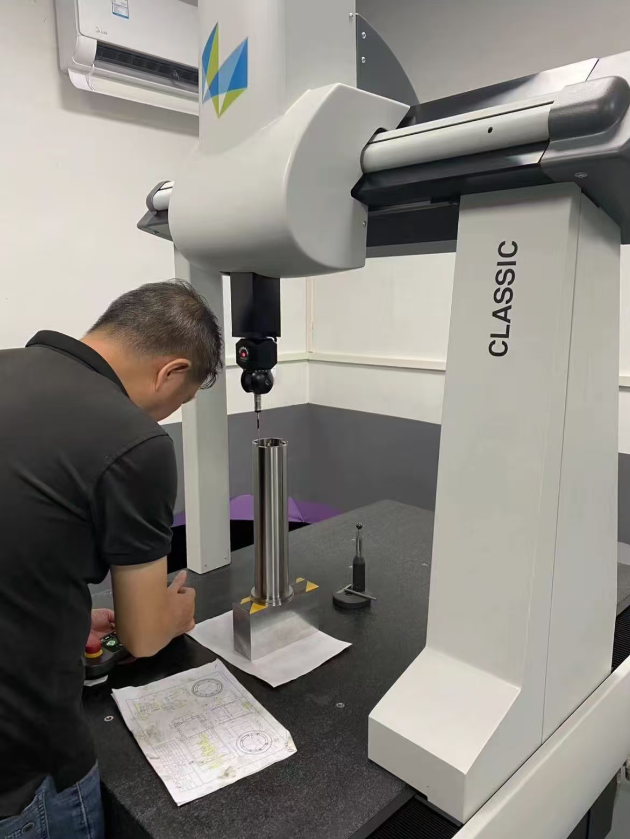
- Zeiss CMM Certification — Coordinate measuring machines (CMMs) from manufacturers like Zeiss, with regular calibration traceable to international standards, provide the highest accuracy for complex geometries
- Measurement Systems Analysis (MSA) — Gage R&R studies that demonstrate measurement variation is less than 10% of the tolerance band for critical features. Without MSA, inspection data cannot be trusted
A truly quality-focused supplier will share their calibration schedules, MSA study results, and CMM inspection reports as part of the PPAP or regular production documentation.
What Certifications to Require from Your Charging Pin Supplier
Here is a practical checklist for procurement teams evaluating EV charging pin manufacturers:
| Requirement | Priority | Notes |
|---|---|---|
| ISO 9001:2015 certification | Minimum | Non-negotiable baseline |
| IATF 16949:2016 certification | Preferred | Required for Tier 1/2 automotive suppliers |
| EN 10204 Type 3.1 mill test reports | Per shipment | Full material traceability |
| Dimensional inspection reports | Per shipment | Critical-to-function dimensions |
| CMM reports (Zeiss or equivalent) | First article + periodic | Complex geometry verification |
| MSA/Gage R&R studies | Annually | Measurement system reliability |
| Product certifications (UL, IEC, RoHS, REACH) | Per product family | Market-specific requirements |
FAQ
Q: Is ISO 9001 certification enough for EV charging pin suppliers?
A: ISO 9001:2015 is the minimum requirement and demonstrates a functioning quality management system. However, for automotive-grade EV charging pins, IATF 16949 certification is strongly preferred because it mandates automotive core tools (PPAP, FMEA, MSA, SPC, APQP) that directly address defect prevention and process control. If your application involves high-voltage charging or critical safety functions, require IATF 16949 from your supplier.
Q: What is PPAP Level 3, and why does it matter for precision-machined pins?
A: PPAP (Production Part Approval Process) Level 3 requires the supplier to submit a complete package of 20+ documents including design records, FMEAs, process flow diagrams, dimensional results, material test results, capability studies, and a Part Submission Warrant (PSW). For precision-machined EV charging pins, this ensures every critical dimension, material property, and manufacturing step has been validated before production begins. Level 3 provides the highest level of documented evidence for part approval.
Q: How often are ISO 9001 and IATF 16949 certifications renewed?
A: Both certifications follow a three-year cycle with annual surveillance audits. Year 1 involves the initial certification audit (Stage 1 document review + Stage 2 on-site audit). Years 2 and 3 include annual surveillance audits to verify ongoing compliance. At the end of Year 3, a full recertification audit is conducted. Lapses in surveillance audits can result in certification suspension or withdrawal.
Q: What material certifications should I request for copper alloy charging pins?
A: Request EN 10204 Type 3.1 mill test reports with each shipment. These certified documents include chemical composition, mechanical properties (tensile, yield, elongation, hardness), and heat/lot numbers for full traceability. For common EV charging pin alloys like C11000 (ETP copper), C18150 (chromium zirconium copper), and CW617N (lead-free brass), the MTR should show compliance with the applicable ASTM, EN, or JIS material specification. Keep these on file for at least the product lifecycle plus warranty period.
Choose a Certified Partner for Your EV Charging Pins
When your design team specifies Swiss-turned precision for EV charging pins, you need a manufacturing partner whose certifications match the rigor of your application. From ISO 9001 to IATF 16949, from material traceability to CMM-based inspection, the certifications your supplier holds are the most reliable indicator of the quality system behind your parts.
Need a certified EV charging pin supplier? VOLCRIX is ISO 9001 certified — request your quote →
Ready to Start Your Project?
Free DFM review · Quote within 24 hours · Prototype in 7–15 days
Need custom EV charging pins for your project? View our EV charging pins manufacturing capabilities →