
Swiss Turning vs Stamping for Connector Pins: Choosing the Right Process
When designing connector pins for automotive, industrial, or EV charging applications, engineers face a fundamental manufacturing decision: Swiss turning or stamping? Both processes produce metal pins, but they differ dramatically in precision, cost, lead time, and geometry capability. Understanding the trade-offs — and matching them to your production requirements — is the difference between an optimized BOM and costly over-engineering.
Swiss Turning: Process Overview
Swiss turning (also called Swiss-type CNC machining or sliding-headstock turning) cuts parts from bar stock fed through a guide bushing. The bar stock rotates while the cutting tool moves radially, and the headstock slides the material axially past the tool. This design lets the tool cut right at the guide bushing, supporting the workpiece and eliminating deflection.
Key characteristics:
- Single-point cutting from round bar stock (brass, copper alloys, steel, stainless, aluminum)
- Sliding headstock with guide bushing for vibration-free cutting
- Multiple tools can work simultaneously on different diameters
- ±0.01 mm tolerance is standard; ±0.005 mm achievable with advanced machines
- Surface finishes down to Ra 0.4 μm
- Ideal for part lengths from 5 mm to 200+ mm
- No die or stamping tool required — just CNC programming and standard tooling
Swiss turning is the go-to process when pin geometry includes multiple diameters, tapers, threads, undercuts, drilled cross-holes, or tight concentricity requirements.
Stamping: Process Overview
Stamping (progressive die stamping) feeds a continuous strip of metal coil through a series of die stations. Each station performs a cutting, bending, or forming operation until the finished pin exits the last station — one stroke per part.
Key characteristics:
- High-speed production from coil stock — up to 600+ parts per minute
- Progressive die spreads operations across 8–20+ stations
- ±0.03–0.05 mm typical tolerance; ±0.02 mm with precision tooling
- Surface finish depends on die quality; stamping leaves burrs on the breakout side
- Limited to prismatic shapes (constant cross-section) or simple bends
- Very low unit cost at scale: $0.02–0.50 per part at high volumes
- High initial tooling investment: $5,000–15,000 for a progressive die
- Die fabrication lead time: 4–8 weeks
Stamping excels when pin geometry is flat, straight, or has simple bends — think battery tabs, grounding terminals, and simple rectangular pins.
Head-to-Head Comparison: Swiss Turning vs Stamping
| Parameter | Swiss Turning | Stamping (Progressive Die) |
|---|---|---|
| Tolerance (OD) | ±0.01 mm (typical); ±0.005 mm possible | ±0.03–0.05 mm (typical) |
| Surface Finish | Ra 0.4–1.6 μm (machined finish) | Ra 0.8–3.2 μm (die-dependent; burrs on shear edge) |
| Material Options | Any machinable metal (brass, copper, steel, stainless, Al, Ti, alloys) | Coil-compatible alloys (brass, phosphor bronze, steel, Al) |
| Geometry Complexity | Complex: multiple diameters, tapers, threads, cross-holes, hex, flats | Simple: constant cross-section, flat, or single-bend shapes |
| Tooling Cost | $1,000–3,000 (CNC program + standard tooling) | $5,000–15,000 (progressive die design & fabrication) |
| Unit Cost (100 pcs) | $3.00–8.00 | $5.00–15.00 (setup-heavy; not economical) |
| Unit Cost (10,000 pcs) | $0.50–1.50 | $0.30–0.80 |
| Unit Cost (500,000+ pcs) | $0.20–0.80 | $0.02–0.50 |
| Lead Time (First Article) | 2–4 weeks | 4–8 weeks (die design + tryout) |
| Material Utilization | 50–70% (chip waste; versatile) | 60–85% (nesting in coil strip) |
| Burr Formation | Minimal; deburring often not needed | Burrs on breakout side; secondary deburring often required |
| Secondary Operations | Rarely needed; part is finished off the machine | Deburring, plating, heat treatment, or forming often required |
When Swiss Turning Wins
Swiss turning is the right choice when your pin design has any of these requirements:
- Complex geometries: Multiple diameters, tapered sections, threaded portions, or internal features (cross-drilled holes, blind bores) — all machined in one setup
- Ultra-tight tolerances: When the fit or electrical contact resistance depends on ±0.01 mm or better concentricity
- Small to medium quantities: 100 to 50,000 parts — Swiss setup costs are low and piece price is competitive
- Multiple diameters on one pin: Stepped pins with sharp shoulder transitions that stamping cannot replicate
- Tapered profiles: Needle-like points, chamfered tips, or conical seating surfaces
- Prototyping & NPI: No die investment means you can iterate part designs quickly without writing off expensive tooling
- Exotic materials: Beryllium copper, titanium, Nitronic 60, or other alloys that are difficult to stamp
The low tooling cost ($1,000–3,000) makes Swiss turning ideal for new product introduction and bridging production while stamping dies are being built.
When Stamping Wins
Stamping becomes the economic choice when:
- Very high volume: 500,000+ parts per year — the die amortization drops the unit cost below $0.05
- Simple pin shapes: Flat tabs, rectangular terminals, constant-diameter pins, or parts with a single 90° bend
- Cost-sensitive projects: Consumer electronics, commodity connectors, and high-volume automotive harness terminals
- Loose tolerance requirements: When OD tolerance > ±0.05 mm and surface finish is non-critical
- Thin materials: Material thickness under 0.5 mm is ideal for stamping but challenging for Swiss turning
- Parts that can be made in a coil carrier: Stamped parts can remain attached to a carrier strip for automated assembly into housings — a significant advantage for high-speed insertion
Stamping’s unit cost advantage at scale is dramatic — at 1 million parts, the stamped pin can cost 10× less than a Swiss-turned equivalent. But the die investment and longer lead time mean you must be confident in the design before committing.
Hybrid Approach: Combining Both Processes
Some manufacturers use a hybrid strategy to get the best of both worlds:
- Swiss-turned body + stamped contact spring: The precision-turned pin body handles current-carrying and fit requirements, while a stamped spring clip provides retention force — common in high-power EV connectors
- Swiss turning for bridge production: Use Swiss-turned pins during the 4–8 week die fabrication period, then transition to stamped pins once the die is qualified
- Swiss-turned + secondary forming: Complex features are machined, then the pin is bent or coined in a secondary operation
- Stamped + Swiss post-processing: For very high volumes, a stamped blank is Swiss-turned on critical diameters to combine speed with precision on select features
Post-process operations — plating (tin, silver, gold), heat treatment, and assembly — are common for both processes and should be factored into the total cost comparison.
Real-World Examples
EV Charging Pin — Swiss Turned
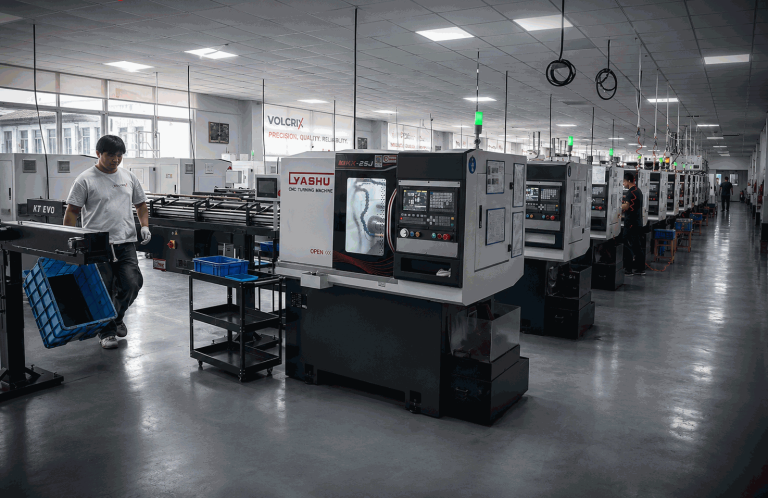
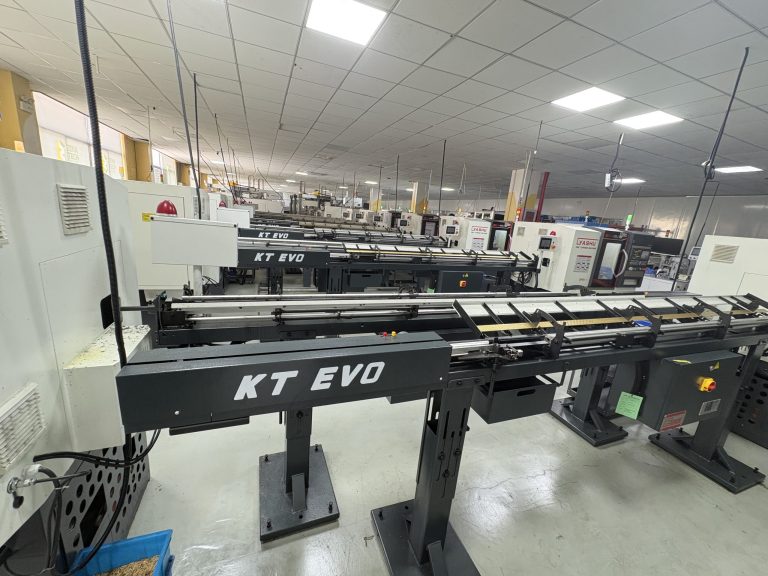
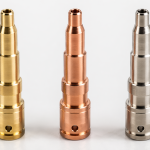
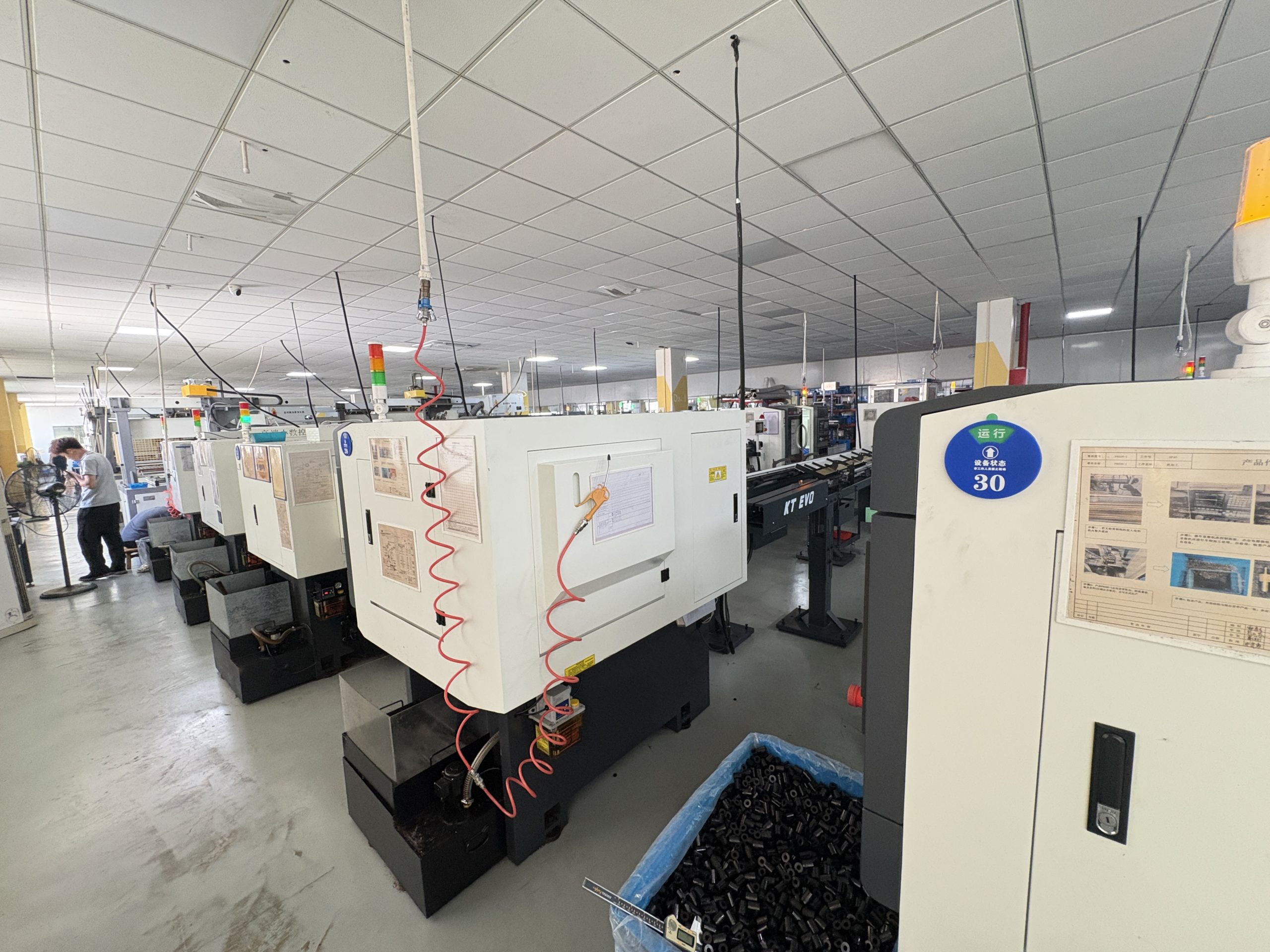
An EV DC fast-charging connector pin requires ±0.01 mm concentricity between the mating diameter and the crimp barrel, a smooth tapered tip for blind mating, and a threaded internal feature for the cable lug connection. The pin also needs multiple diameter steps (mating zone, retention groove, crimp zone) that cannot be produced in a progressive die. Swiss turning is the only practical process for this application — and VOLCRIX produces thousands of these pins daily on KT-EVO Swiss machines (featured image below).

Simple Terminal Pin — Stamped
A flat rectangular battery terminal pin for a consumer electronics battery pack has a constant 1.5 mm × 0.5 mm cross-section with a single 90° bend. The tolerance requirement is ±0.05 mm. Volume is 2 million parts per year. Stamping delivers the part for $0.03 each with a die cost of $10,000 amortized over the first production run — a clear economic win.
FAQ: Swiss Turning vs Stamping for Connector Pins
Is Swiss turning more expensive than stamping for small pins?
Swiss turning vs metal stamping for connector pins: compare precision, cost, volume, and material utilization. Learn which manufacturing process suits your EV charging pin requirements.
Can stamping achieve ±0.01 mm tolerance on connector pins?
Extremely difficult. Stamping typically holds ±0.03–0.05 mm. Achieving ±0.01 mm in stamping requires precision-ground dies, stabilized materials, and frequent tool maintenance — driving costs that often negate the volume advantage. For ±0.01 mm or better, Swiss turning is the standard process.
What materials work best for Swiss-turned connector pins?
Brass (C36000, C26000), phosphor bronze (C51000, C52100), beryllium copper (C17200), tellurium copper (C14500), stainless steel (303, 304, 316), steel (1215, 12L14), and aluminum (6061, 7075). Brass and copper alloys are most common for electrical connector pins due to their conductivity and machinability.
What is the lead time difference between Swiss turning and stamping?
Swiss turning: 2–4 weeks for first articles from print. Stamping: 4–8 weeks for die design, fabrication, and tryout. However, once the die is proven, stamped parts can be produced at rates 10–50× faster than Swiss turning, making stamping the better choice for ongoing high-volume supply.
Not sure which process fits your pin design? Contact VOLCRIX for a manufacturing process recommendation →
Need custom EV charging pins for your project? View our EV charging pins manufacturing capabilities →
Comparing stamping vs turning? Explore our progressive stamping and bending →