
AI Server Rack Rails: Precision Stamping for Data Center Infrastructure
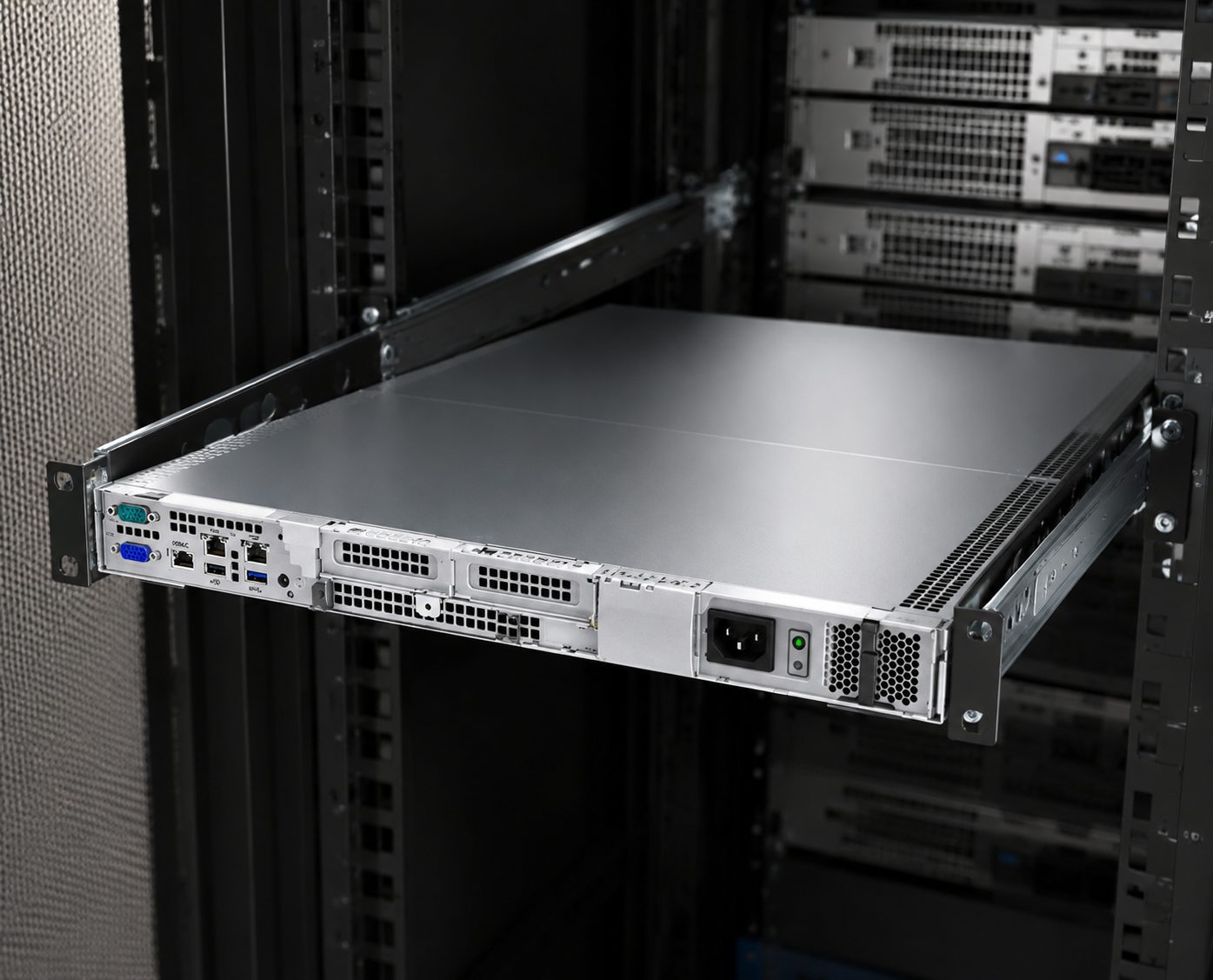
Short answer: AI server rack rails are heavy-duty stamped sheet metal components that support 19-inch rack-mounted servers, AI training systems, and data center infrastructure. They require cold-rolled steel or stainless steel construction, 1.5 mm to 3 mm material thickness, ±0.1 mm tolerances, and 200 kg to 500 kg load capacity per pair. Precision stamping with progressive die tooling is the standard process for high-volume production. VOLCRIX has manufactured precision server rack rails since 1991 on 40 stamping presses from 5 tons to 200 tons with IATF 16949 quality system.
Need AI Server Rack Rail Stamping?
Free DFM review · Quote within 24 hours · Prototype in 7–15 days
Common Applications
- 19-inch rack mount server rails — for 1U, 2U, 4U rack-mounted servers in data center applications including Dell PowerEdge, HPE ProLiant, Lenovo ThinkSystem
- AI training system rack rails — for NVIDIA DGX systems, AMD Instinct platforms, and custom AI training clusters requiring 500 kg+ load capacity
- Network switch rack rails — for Cisco Catalyst, Arista Networks, Juniper Networks switches and routers in enterprise and hyperscale data centers
- Telecom equipment rack rails — for 5G base station equipment, fiber optic transmission gear, and telecommunications infrastructure
Manufacturing Support from VOLCRIX
- 40 stamping presses from 5 tons to 200 tons — for high-volume rack rail production with progressive die capability above 100,000 pieces monthly
- Cold-rolled steel and stainless steel — SPCC, SGCC, SUS304, SUS316 with material certification per ASTM A1008 and ASTM A240
- In-house powder coating and zinc plating — for corrosion resistance per ASTM B633 and aesthetic black or gray finish per customer specification
- PPAP submission capability — for OEM data center programs with full AIAG PPAP level 3 documentation including FAI, load testing, dimensional inspection
Buyer Checklist
- Define load capacity requirement — 200 kg per pair for standard servers, 500 kg per pair for AI training systems, 1000 kg for high-density compute racks
- Specify material grade and thickness — cold-rolled steel SPCC 1.5 mm to 3 mm for economy, stainless SUS304 1.5 mm to 2.5 mm for corrosion resistance
- Indicate finish specification — zinc plating per ASTM B633 for indoor, powder coating for outdoor, black oxide for low-reflection data center applications
- Specify dimensional tolerance — ±0.1 mm standard for rack mounting holes, ±0.2 mm for overall length, verified on Zeiss CMM per IATF 16949
Related Custom Manufacturing Services
- Custom Sheet Metal Parts — precision stamping and sheet metal fabrication
- Custom Metal Stamping Parts — high-volume stamping
- Custom Stamped Brackets — stamped enclosures and brackets
- Stamping Tolerances Guide — precision stamping tolerances
FAQ
What is the typical load capacity for AI server rack rails?
AI server rack rails must support 500 kg to 1000 kg per pair for AI training systems with multiple GPUs. Standard server rack rails support 200 kg to 400 kg per pair. AI training systems including NVIDIA DGX H100 weigh 130 kg to 300 kg per unit, requiring rails that can safely support the chassis plus thermal management equipment and cabling. Load testing is performed per EIA-310-D and IEC 60297 standards with 1.5x safety factor.
What materials are used for server rack rails?
Server rack rails are typically made from cold-rolled steel SPCC or SGCC with thickness 1.5 mm to 3 mm for economy applications. Stainless steel SUS304 or SUS316 is used for corrosion-resistant applications including outdoor telecom and marine environments. Powder coating over zinc plating per ASTM B633 provides additional corrosion protection. Black powder coating is the standard finish for data center applications due to low light reflection.
What tolerance is required for server rack rail mounting holes?
Server rack rails must conform to EIA-310-D dimensional standard with ±0.1 mm tolerance on mounting hole positions and 9.5 mm square hole pattern for cage nut mounting. Overall rail length tolerance is typically ±0.5 mm to ±1 mm depending on rail depth. Telescoping rail inner and outer member tolerances must allow smooth extension while maintaining structural rigidity under full load.
What surface finish is best for server rack rails?
Black powder coating over zinc plating is the standard finish for data center server rack rails due to low light reflection and good corrosion resistance. Zinc plating per ASTM B633 with 5-15 micrometers thickness provides base corrosion protection. Powder coating 60-80 micrometers provides the black color and additional scratch resistance. Outdoor applications require heavier zinc plating 15-25 micrometers plus epoxy primer plus polyurethane topcoat per ISO 12944.
Need AI Server Rack Rail Stamping?
Free DFM review · Quote within 24 hours · Prototype in 7–15 days
Certifications, Standards & Compliance
- ISO 9001:2015 — Quality management system
- IATF 16949 — Automotive quality management (also applicable to data center OEM programs)
- EIA-310-D — 19-inch rack mounting standard
- IEC 60297 — Mechanical structures for electronic equipment
- ASTM A1008 — Cold-rolled steel sheet specification
- ASTM B633 — Electrodeposited zinc coating specification
- RoHS 3 (EU 2015/863) — Restriction of Hazardous Substances
- REACH (EC 1907/2006) — Chemical regulation
For specific compliance questions contact our sales team.