
Silver Plating for EV Charging Pins: Why It Matters and What to Specify
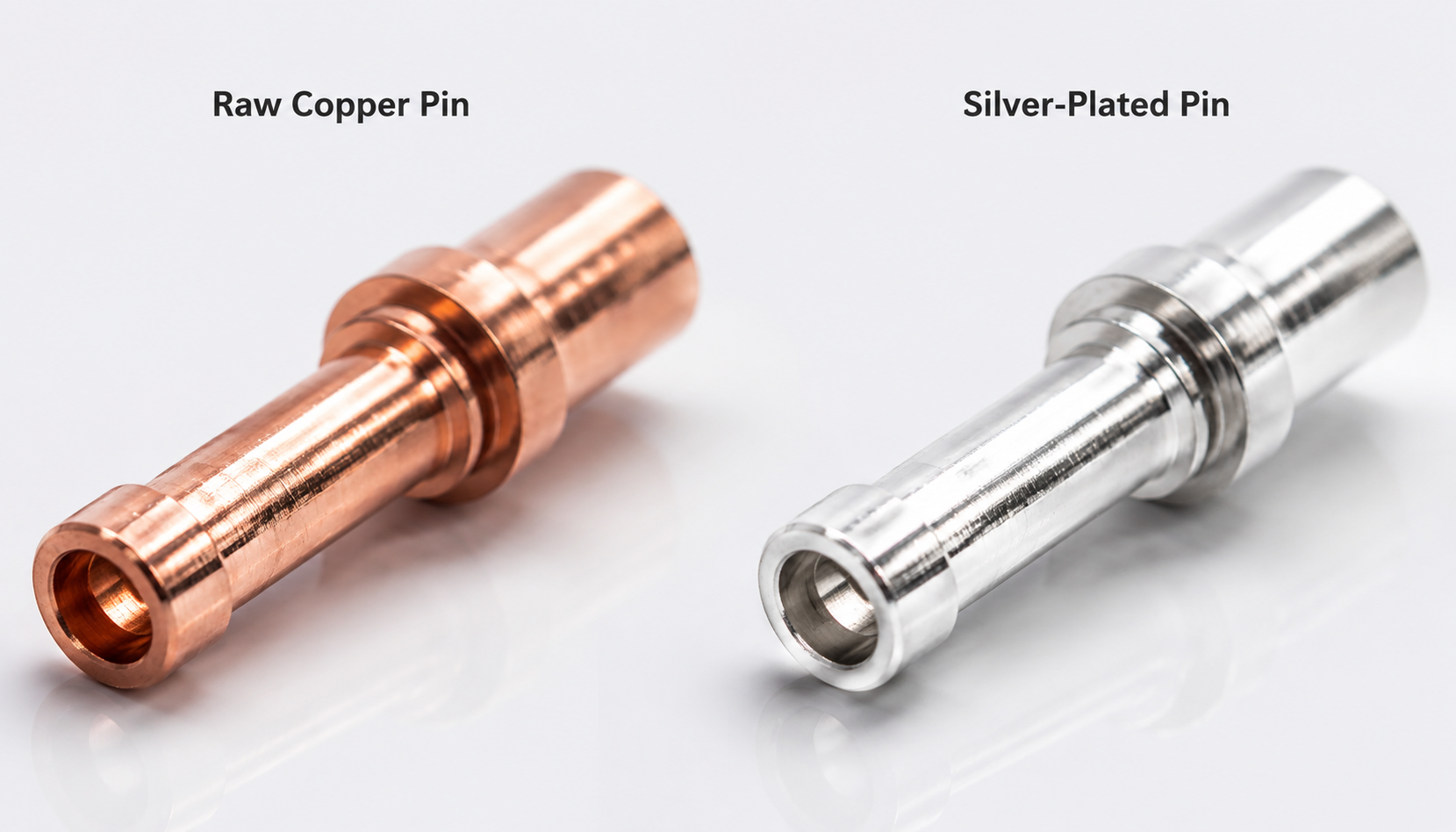
Direct answer: Silver plating is the standard for high-current EV charging pins because silver has the highest electrical conductivity of all metals, lowest contact resistance, and best thermal conductivity. For DC fast charging above 150 kW, silver plating at 3-5 micrometers minimum is mandatory. VOLCRIX applies silver plating to ASTM B700 standards with XRF thickness verification per ASTM B568 on every production batch.
Ready to Start Your Silver-Plated EV Charging Pins Project?
Free DFM review · Quote within 24 hours · Prototype in 7–15 days
Common Applications
- High-current DC fast charging pins — for 150 kW to 350 kW+ charging stations where contact resistance directly impacts thermal management and efficiency
- NACS SAE J3400 charging pins — for the North American Supercharger network and OEM vehicle inlets requiring high-cycle, high-current performance
- CCS2 IEC 62196-3 high-power pins — for European and global DC fast charging networks with liquid-cooled cables operating at 500A+ continuous current
- Type 2 IEC 62196-2 AC charging pins — for 22 kW AC home and workplace charging stations where silver plating provides low resistance and long-term reliability
- Liquid-cooled charging pins — for 500A+ continuous current applications where dielectric coolant reduces heat and silver plating ensures low contact resistance
- Outdoor charging station pins — for harsh environment installations with ASTM B117 salt spray resistance of 240-500 hours
Manufacturing Support from VOLCRIX
- Silver plating to ASTM B700 — 99.9 percent pure silver deposit, controlled thickness 3-5 micrometers for indoor, 5-8 micrometers for outdoor, over 1-3 micrometers nickel strike
- XRF plating thickness verification — per ASTM B568 on every production batch with plus or minus 0.1 micrometers accuracy
- Underplate of nickel — 1-3 micrometers electroless or electrolytic nickel under the silver layer to prevent copper diffusion
- Selective plating capability — plating only the contact zone to optimize silver cost with cost savings of 30-50 percent
- Salt spray testing per ASTM B117 — 96h, 240h, or 500h neutral salt spray exposure per UL 2251 environmental requirements
Buyer Checklist
- Specify silver plating thickness on the drawing — e.g. Silver plating 3-5 micrometers per ASTM B700 over 1-3 micrometers nickel strike per ASTM B689
- Define plating location — full body plating vs selective plating on contact zone only for cost savings
- Indicate underplate requirements — nickel strike typical or copper underplate for special applications
- Specify salt spray testing per ASTM B117 — 96h indoor, 240h sheltered outdoor, 500h harsh outdoor or coastal
- Confirm plating certification requirements — ASTM B700, ASTM B568, ASTM B499, and RoHS or REACH compliance
Related Custom Manufacturing Services
- Custom EV Charging Pins — Type 2, CCS, NACS contact pins for EV charging
- NACS Tesla Charging Pin Manufacturing — NACS-specific pin requirements
- EV Charging Pin Quality Control — dimensional, surface, and electrical QC
- EV Charging Pin Materials Guide — copper alloy selection
FAQ
Why is silver used for EV charging pins instead of gold or tin?
Silver has the highest electrical conductivity of all metals at 106 percent IACS compared to gold at 70 percent and tin at 15 percent. For high-current charging pins above 150 kW, contact resistance directly impacts thermal management. Silver minimizes I squared R losses and heat generation. Silver is also less expensive than gold at about 1/100 the price per gram, making it cost-effective for industrial-scale charging infrastructure. Tin plating is cheaper but has lower conductivity and risk of tin whiskers over time.
What thickness of silver plating is recommended for EV charging pins?
For indoor AC charging pins Type 2 home chargers: 3-5 micrometers silver over 1-3 micrometers nickel strike. For outdoor DC fast charging pins CCS NACS: 5-8 micrometers silver for 240-500h ASTM B117 salt spray resistance. For high-cycle above 10,000 mating cycles or harsh environment coastal or road salt applications: 8-10 micrometers silver is recommended. Thicker silver plating increases cost but improves corrosion resistance and durability.
What is the difference between matte and bright silver plating?
Matte silver plating has a slightly rough surface from fine-grain deposit structure, providing better adhesion for subsequent layers and slightly higher friction during mating. Bright silver plating has a mirror finish from organic brightener additives, providing lower contact resistance and better appearance but slightly reduced corrosion resistance. For EV charging pins, matte silver is typically specified for power contacts better wear resistance, while bright silver is used for signal contacts lower resistance.
Why is a nickel strike required under silver plating?
Nickel underplate 1-3 micrometers serves three critical functions. First, it prevents copper diffusion from the base metal C11000 or C18150 into the silver layer, which would cause silver tarnish and conductivity loss. Second, it provides a harder barrier layer that improves wear resistance and reduces silver loss during mating cycles. Third, it acts as a corrosion barrier if the silver is scratched or worn through, preventing copper corrosion products that would cause high-resistance failures. ASTM B689 specifies nickel plating for silver underplate applications.
How is silver plating thickness verified on EV charging pins?
X-ray fluorescence XRF per ASTM B568 is the standard non-destructive method — measures silver thickness to plus or minus 0.1 micrometers accuracy on every part. XRF instruments are calibrated against certified reference standards. For 100 percent inspection on a production line, XRF takes 2-5 seconds per measurement. Eddy current per ASTM B499 can also be used but requires known base material. Cross-section microscopy destructive is used for process validation and qualification, not routine inspection.
Can silver-plated pins be re-plated or repaired?
Yes. Silver plating can be stripped chemically with cyanide-based or non-cyanide strippers and re-applied. This is common for prototype samples, low-volume specialty pins, or pins that failed incoming inspection. The base copper alloy is unaffected by silver stripping processes. For high-volume production, scrap-and-replace is more cost-effective than re-plating. Re-plated parts must pass the same FAI dimensional and plating thickness verification as new parts.
Ready to Start Your Silver-Plated EV Charging Pins Project?
Free DFM review · Quote within 24 hours · Prototype in 7–15 days
Certifications, Standards & Compliance
VOLCRIX products are built to international standards and customer specifications:
- ISO 9001:2015 — Quality management system across all manufacturing processes
- IATF 16949 — Automotive quality management (replaces ISO/TS 16949)
- ASTM B700 — Standard specification for silver plating
- ASTM B568 — Standard test method for measurement of coating thickness by X-ray spectrometry
- ASTM B499 — Standard test method for measurement of coating thicknesses by the magnetic method
- ASTM B117 — Standard practice for operating salt spray fog apparatus
- IEC 62196-2 — Type 2 EV charging connector standard
- IEC 62196-3 — CCS Combined Charging System standard
- SAE J3400 — NACS North American Charging Standard for EV charging
- UL 2251 — Standard for plugs, receptacles, and couplers for EV charging
For specific compliance questions RoHS, REACH, conflict minerals, country-of-origin, contact our sales team with your drawing and requirements.